
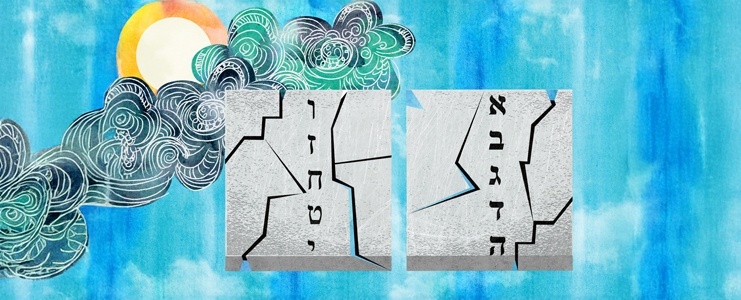
Parashat Ki Tisa is one of the most dramatic and emotional portions in the Torah. It begins at a spiritual high point — the Jewish people are standing at Mount Sinai after receiving the Torah. And suddenly, everything seems to fall apart with the sin of the Golden Calf. Inside this powerful story, we find five major life lessons: shared responsibility, the danger of pressure, the courage to break in order to rebuild, the power of prayer, and the gift of mercy. These are not just ancient events. They are lessons for real life.
Mitzvah of the Half-Shekel
The first topic is the mitzvah of the half-shekel. Every person had to give exactly half a coin — not a full one. The message is simple and deep: no one is complete alone. We each give our half, and only together do we become whole. Even Moses struggled to understand how a small coin could have spiritual power, until God showed him a “coin of fire.” It wasn’t about the money. It was about the burning heart behind it.
A true story from Jerusalem shows this idea beautifully. A group of regular working people decided to create a small fund to help families in need. None of them were rich. Each person gave a small amount every month. At first it felt like nothing. But after a year, they had enough money to pay rent for struggling families, buy food for holidays, and cover medical bills. One member said, “I thought I was giving something small. I didn’t realize I was part of something big.” That is the power of the half-shekel. Small acts, when joined together, create fire.
Sin of the Golden Calf
The second topic is the sin of the Golden Calf. The people had just heard the commandment, “Do not have other gods.” Yet when Moses delayed coming down from the mountain, they panicked. They were afraid and confused. They wanted something they could see and touch. Fear led them to make a terrible mistake.
This teaches us about the power of pressure. When everyone around you is scared or doing the wrong thing, it is very hard to stand alone. A modern story tells about a young soldier in Israel. In his unit, many soldiers made fun of religion and tradition. He felt embarrassed to stay loyal to his beliefs. For a moment, he almost gave in just to fit in. But he remembered who he was and where he came from. He chose to stay strong. Years later, he said that moment shaped his entire life. The Golden Calf reminds us how easy it is to follow the crowd — and how brave it is to stand firm.
Breaking the Tablets
The third topic is when Moses breaks the Tablets. When he comes down from Mount Sinai and sees the Golden Calf, he throws down the holy Tablets and breaks them. At first, this sounds shocking. These were made by God Himself. But sometimes protecting holiness means protecting the people first. If the nation was not ready, the Tablets could not remain whole.
A powerful example happened in Tel Aviv. A school principal discovered that a top student cheated on a major exam. The school’s reputation was at risk. The easy choice would have been to hide it. Instead, the principal canceled the grade and gave the student a second chance with guidance and support. It was painful. It felt like breaking something valuable. But that student later became an honest and respected adult. Sometimes you must break the tablets to save the soul.
Moses’ Prayer
The fourth topic is Moses’ prayer. After the sin, God says He may destroy the nation. Moses stands up and says something unbelievable: “If You do not forgive them, erase me from Your book.” This is leadership at its highest level. He is ready to lose everything for his people. Real leaders do not protect themselves first. They carry others in their hearts.
We saw this kind of leadership in the life of Rabbi Aryeh Levin, known as “the Rabbi of the Prisoners.” During the British Mandate period, he visited Jewish prisoners regularly. He encouraged them, listened to them, and treated them like his own children. Once he told a worried mother, “Your son is my son.” That is the spirit of Moses — a heart that refuses to separate itself from its people. Prayer is powerful when it comes from love and responsibility.
Choosing Mercy
The fifth and final topic is the Thirteen Attributes of Mercy. After everything — after the sin, the anger, the broken Tablets — Moses asks God to show him His glory. God responds by revealing His attributes of mercy: compassionate, gracious, slow to anger, full of kindness. The message is life changing. Even after the worst failure, mercy is still possible. The door is never locked.
After the Yom Kippur War in Israel, one family lost their son in battle. They could have chosen anger and bitterness. Instead, they created a charity organization in his memory to help others. The father said, “If God runs His world with mercy, then we must live with mercy too.” From deep pain, they created light. That is what the Thirteen Attributes mean. Mercy is not weakness. It is strength.
Parashat Ki Tisa teaches us that life is not a straight line. There are highs and lows. There are whole tablets and broken ones. There are moments of fear and moments of courage. But in every situation, we have a choice. We can choose to join together like the half-shekel. We can choose to resist pressure like the soldier. We can choose to rebuild after breaking. We can choose to pray with love like Moses. And we can choose mercy, even after failure.
Second Chances
The portion ends with new Tablets. The relationship between God and the people is restored. They are not perfect — but they are forgiven. And that may be the most important message of all. You are not defined by your worst mistake. You are defined by how you rise after you fall. No matter how broken things feel, there is always a way back. There is always another set of Tablets waiting to be carved.
Wishing you all a Shabbat Shalom,
Rabbi Asher Vaknin
BJCC Rabbi of the Bukharian Youth
And I approve this message
By Rabbi Asher Vaknin