
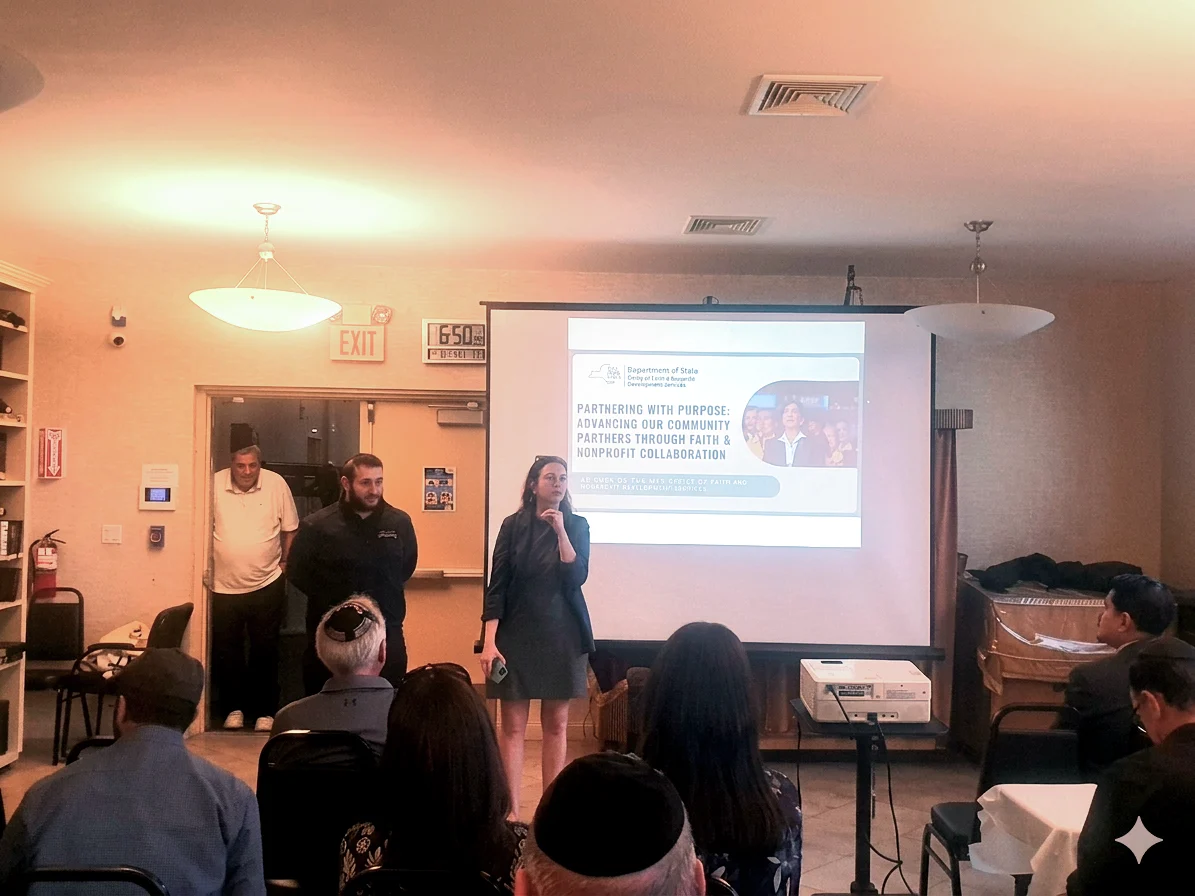
On April 16, 2026, roughly 30 community leaders, school administrators, and faith organization representatives gathered at Young Israel of Hillcrest for a State Resource Workshop on safety and funding for non-public schools, faith-based institutions, and nonprofits — a meeting that, as it turned out, couldn’t have been better timed.
The event was organized by Assemblywoman Nily Rozic’s office in collaboration with Assemblyman Sam Berger, and featured presentations from Teach NYS, the Community Security Initiative (CSI), the Department of State’s Office of Faith & Nonprofit Development Services, and the Division of Human Rights. Topics ranged from security planning and risk assessment to state grant opportunities and anti-discrimination resources.
While the workshop was hosted at a Jewish institution and drew a predominantly Jewish crowd — including more rabbis than imams — organizers were deliberate about reaching beyond that community. «We invited mosques, we invited the Armenian church — we did invite plenty from outside of the Jewish world,» said Diana Rachnaev, who helped organize the event on behalf of Rozic. The surrounding area has a significant South Asian population, and Rachnaev told The Bukharian Times that security concerns cut across faith communities. «Right now, the biggest concern is: what does security look like?»
That question has taken on new urgency. The workshop took place just one day before Governor Kathy Hochul announced a $70 million budget commitment to school and community safety — a development that lent additional weight to the conversations already underway in the room. It was also held amid a broader moment of political attention to the issue, bookended by an antisemitism conference and, more recently, a veto by New York City Mayor Zohran Mamdani of related safety legislation, which Rachnaev said has sparked considerable anxiety and discussion among faith communities, particularly Jewish New Yorkers.
For many attendees, a core practical concern was understanding how state funding actually works. Many faith-based organizations and houses of worship receive government support, but the processes for accessing those resources can be opaque. «This workshop was to learn how these processes look,» Rachnaev said. The Q&A session at the end of the event gave participants a chance to ask questions specific to their institutions — and, by many accounts, it was that direct access to state officials and agency representatives that made the gathering valuable.
The response from attendees was enthusiastic enough that organizers are already considering a follow-up, potentially in webinar format to reach those who couldn’t attend. «These things are hard to put together — getting officials from Hochul’s office is not easy,» Rachnaev acknowledged. «But that we could bring those people to the table and provide that information that was so needed — that meant a lot.»
The workshop was organized in the weeks leading up to Passover, adding to the logistical complexity of pulling it together. Assemblywoman Rozic thanked Governor Hochul for her ongoing support, as well as Howard Pollack of JCRC, Avi Posnick, Stand With Us, and Michael Cohen of AJCF for their community commitment.
A follow-up session has not yet been confirmed, but organizers say they hope to make the resources and guidance from the workshop more widely available in the months ahead.
By Erin Levi