
HISTORY
May 9, 2026 marked the 81st anniversary of the victory over Nazi Germany in the Great Patriotic War (1941-1945).
In this war and in WWII, 60 million people perished, including 6 million Jews, and more than 5,000 Bukharian Jews. Virtually every family suffered losses. Multiple members of the Bukharian Jewish community were drafted, including heads of the household and their sons.
For example, Yashar Yakubov’s family from Kokand had six members drafted to war but only one member, his daughter, came back. Our ancestors had large families and the majority of Bukharian Jews served as privates and junior commanders, predominantly in the infantry, which accounts for the high percentage of woefully heavy fatalities. Only 25% to 40% of those drafted for the war returned home. For example, out of 80 soldiers drafted from Kattakurgan 60 were killed. From the tiny community of Payshambe, out of 60 Bukharian Jewish soldiers 40 perished.
Men aged from 18 to 55 served in the Russian army totaling approximately 15,000 individuals of whom more than half lost their lives in combat or were counted missing in action. They fought bravely against the Nazis on the battlefields, like tankers and machine gunners pilots, and sailors.
Some 200 of our compatriots completed a rush training course for tankers, rifle, Artillery, and Air Force units. These were once New York residents: Boris Iskhakov, Nison Sofiev, and aviation squadron pilot Semyon Aulov.
About 100 Bukharian Jewish doctors served in the Red Army out of whom 17 perished, and 36 died from wounds. They were Yury Aronov, Sporo Yagudaeva, Frida Aulova, Rafael Avezbadalov, and N. Aronbayev to name a few. War veteran, Dvoro Kalantarova, served as the chief physician in field hospitals, and as a regiment physician, near Stalingrad, and on the Ukrainian and Belarusian fronts. She was awarded The Order of Patriotic War of Second Degree, The Order of the Red Star, as well as the Medal for the Capture of Berlin and the Medal for the Combat Merits.
Sergeant and submachine gunner, Ari Avezbakiev, captured 60 fascists during the battle for Belgorod in 1943, and was awarded the highest honor—The Order of The Red Star— equivalent to The Order of The Hero of The Soviet Union ( golden star), as well as medals For the Liberation of Warsaw and medal For the Capture of Berlin.
186 Bukharian Jewish warriors were awarded orders and medals. Among them are 52 holders of The Order of The Glory, two holders of The Silver Star of The Order of the Glory.
Four Bukharian Jewish fighters became holders of The Order of the Glory of the Third Degree— an order equivalent to the title of The Hero of the Soviet Union.
These were Mikhail Malaev and Borukhai Chulpayev from Samarkand, Mikhail Leviev from Kokand, and Berakh Aronov from Bukhara.
The remains of our fallen warriors, rest in the mass graves in the steppes of Ukraine, the forests of Belarus, and the territories of Eastern European countries. Today, many names of perished Bukharian Jewish warriors are commemorated on obelisks erected in our cemeteries in the cities of Central Asia as a testament to their tremendous efforts during the inconceivably difficult battles against the Nazis.
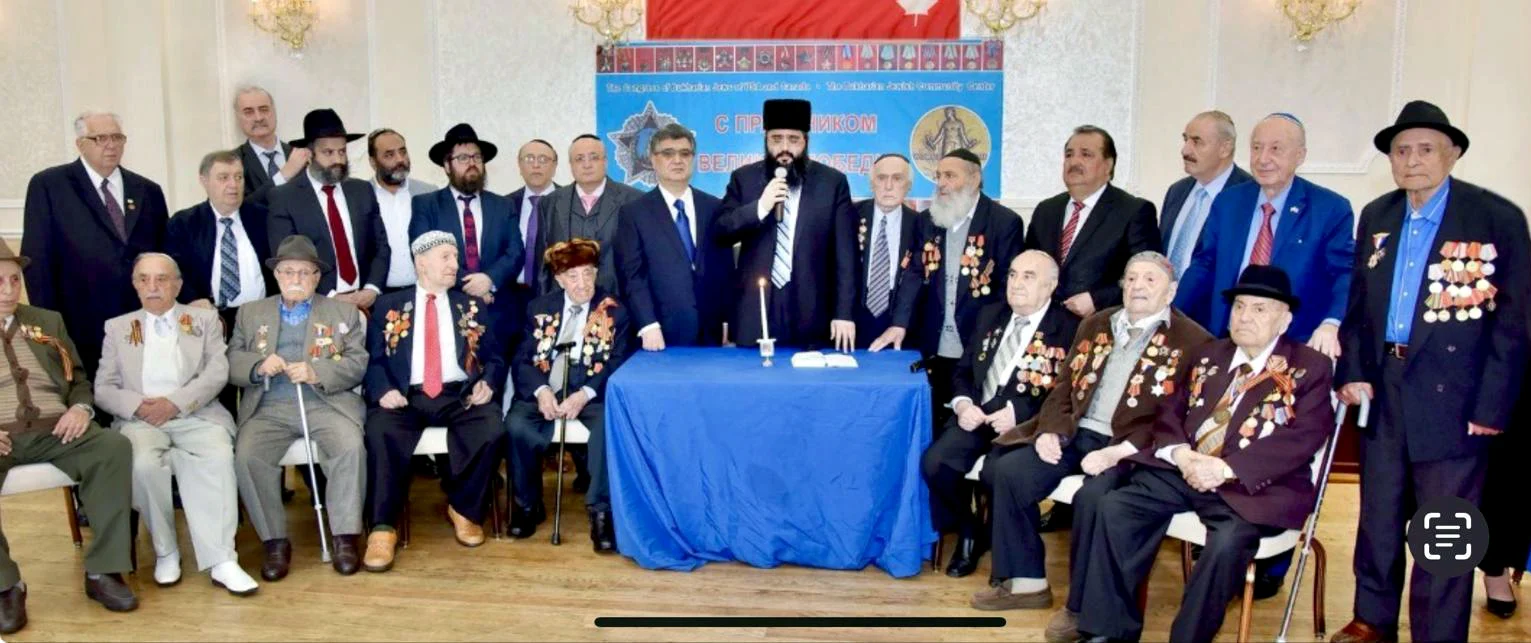
For over 25 years now, The Council of War and Labor Front Veterans has been operating in New York in our main BJCC of Forest Hills, under the auspices of The Congress of Bukharian Jews of the USA and Canada (President Chagit Leviev Sofiev) and Edward Nektalov Memorial Foundation (President Yoseph Khaimov). The organization once comprised 127 veterans. One of the last surviving veterans, Suleiman Shimonov, passed away at a venerable age of 105.
Among its chairmen, the veteran’s organization, at different times, had Boris Iskhakov, Colonel Yury Semyonovich Aronov (O.B.M), and Colonel Arkady Yakubov.
Today, the Children of War and Labor Front Veterans organization is functioning headed by Eduard Nektalov Memorial Foundation president, Yoseph Khaimov.
The heroic feat of Bukharian Jewish World War II participants will be remembered from generation to generation as an enduring legacy.
By Rafael Sofiev