
ARGENTINA
A note from our English Editor: Argentina is the only South American country I’ve seen. I visited in 2008, when my sister was studying abroad in Buenos Aires, the so-called Paris of the Southern Hemisphere. Even as a tourist passing through, the city left a mark. I remember visiting a synagogue, and I remember a cemetery—but it wasn’t Jewish.
The Cementerio de la Recoleta is a 14-acre city of the dead — elaborate mausoleums in styles from neo-Gothic to Art Nouveau laid out along tree-lined walkways, as if the streets of Buenos Aires had simply continued inside the walls. Over ninety have been declared national historic monuments. Somewhere in that labyrinth lies Eva Perón.
That was my Buenos Aires. Which is why reading Rafael Nektalov’s account of a very different cemetery on the outskirts of the city — modest granite stones, a caretaker named Luis Escobar, a wanderer from Samarkand who carried his hometown in his heart across 9,000 miles — felt like discovering a version of the city I never knew existed. The following is an excerpt from his multi-part series, published in our paper. In reading it, I find myself dreaming of a return. — Erin Levi
No matter which foreign trip I am on, at the first opportunity, I always try to visit the cemetery where Bukharan Jews are buried. Over the years, this list has grown to cover new cities, countries, and continents: Moscow, Baku, Almaty, Vienna, Shymkent, Turkestan, Karshi… In North America—Atlanta, Denver, Los Angeles, Phoenix, Seattle…
In South America, that city has become Buenos Aires, about which I am writing my fourth essay. It seems there will be no end to it; it has become so dear and close to me. I will not hide the fact that I have received quite a few letters and calls from readers who, thanks to my publications, have developed a special interest in the Bukharan-Jewish page of Argentine history.
«I also love Argentina. I’ve been there four times! But I didn’t even suspect that Bukharan Jews lived there too!» one such reader told me. «I will go with you for the fifth time!»
«BENE EMETH»
Thanks to Andreas Ilyasoff, I received the address of the cemetery where his relatives are buried: «Bene Emeth,» Marsella 343, B1821BLC Banfield, Provincia de Buenos Aires. I am writing this for those who may wish to visit it. Perhaps they will find their relatives.
My wife and I set off for the outskirts of the capital, where this cemetery is located. It belongs to a local Jewish organization, El Cementerio Judío Sefaradí de Lomas de Zamora. «Bene Emeth» translates from Hebrew as «Children of Truth.»
Unlike other Jewish cemeteries I have visited and described in my travels, the central entrance of «Bene Emeth» is adorned with an unusual portal: on a huge, white-painted cement wall, a six-pointed Star of David made of black marble is installed, upon which the Hebrew abbreviation «BE» is written, along with the organization’s name, Asociación Israelita Sefaradí. On the sides, two cast-iron menorahs are embedded into the wall; the seven-branched candelabras are positioned asymmetrically to each other, like a staircase from the first candle to the seventh.
A man of about fifty, with a typical Latin American appearance—stocky, swarthy, with dark eyes—opened the large black gate.
«Luis Escobar,» he introduced himself with a polite smile, extending his hand. «Andreas Ilyasoff called me from Spain. He asked me to show you the graves of his relatives.»
It was a bright, sunny autumn day, with weather somewhat reminiscent of Samarkand. A light breeze was blowing, and at that moment, it seemed as if time had frozen, allowing me to enjoy the warm rays that caressed every stone on the beautiful land of Argentina.
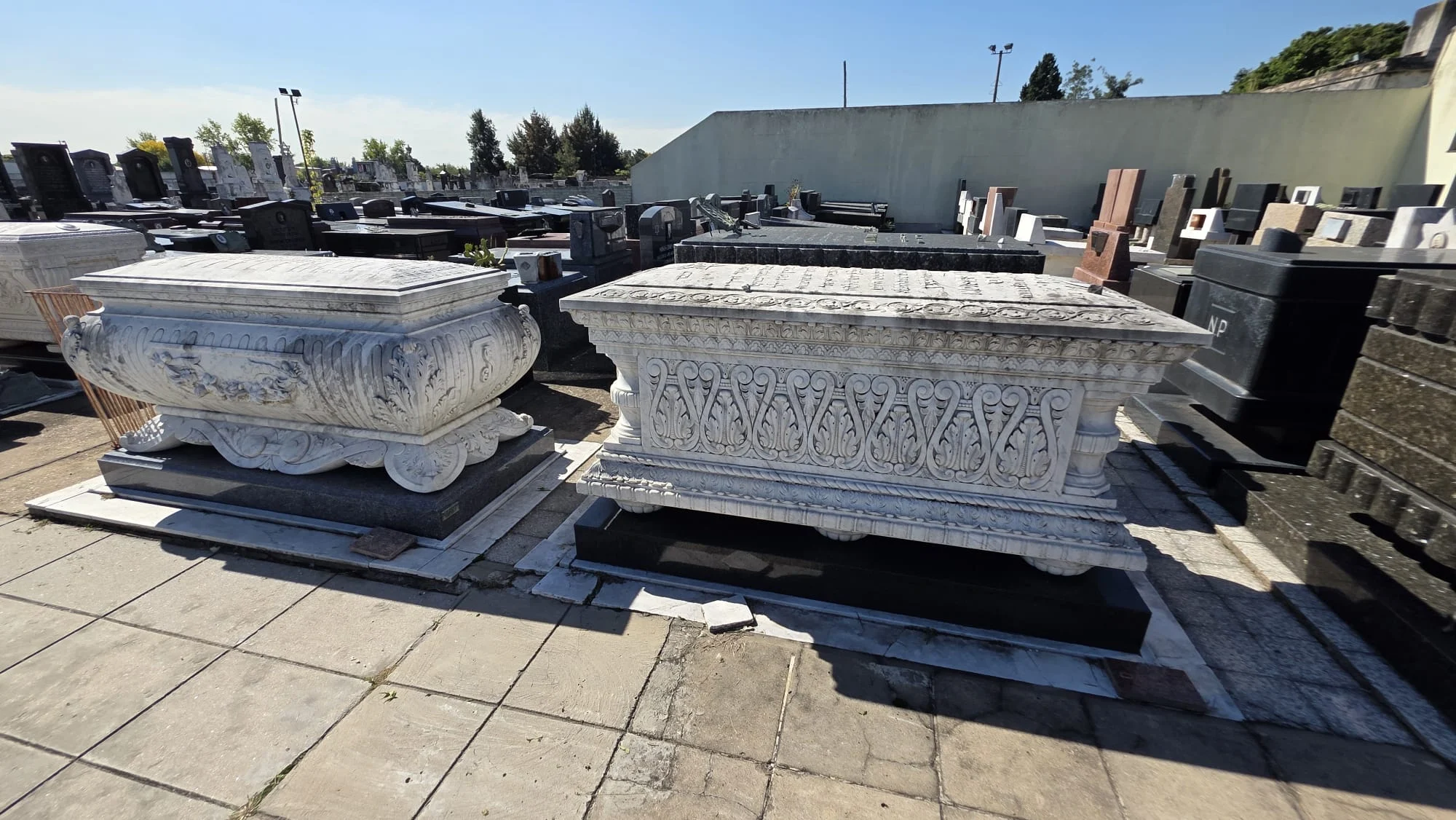
I thanked Luis, who kindly offered for me to follow him. But I stopped, because from the very first minutes of my stay, I could not hide my astonishment at the unusual beauty that appeared before my eyes, instantly expanding my perception of the history and culture of Sephardic Jewish burials in Buenos Aires.
This entire space, where white, black, and brown monuments were visibly highlighted against the backdrop of strictly cut alleys, could be taken in with a single glance. One could quietly approach any grave without stepping on places where someone else was buried. No one skimped on space here because this is not real estate, but land for descendants, relatives, and friends who will certainly come to honor the memory and pray. Let’s be honest: our cemeteries back home and in New York do not quite correspond to such principles.
MUCH IS DIFFERENT HERE
In my opinion, Sephardic tombstones differ from Bukharan-Jewish ones in their greater tolerance for images, the inclusion of patterns in the design, and the lush decor of the Renaissance era. I noticed that the monuments indicate the mother’s name of the deceased—a practice that Bukharan Jews in Israel, European diaspora countries, and America have also begun to adopt.
The most interesting thing—unusual for me, a Bukharan Jew—is the architectural form of the monument, which is divided into an upper and lower part with a space between them. As Rabbi Marciano explained to me, this gap carries deep religious and symbolic meaning in the Sephardic tradition. The lower part signifies the mortal body, which returns to the earth; the upper slab—the exalted soul (neshama). The space between them shows that although a person’s life on earth has ended, the spiritual connection between the world of the living and the world of the dead remains.
SAMARKAND IN HIS HEART!
Luis Escobar led me to the burial sites of Bukharan Jews. They are all made in accordance with our tradition, but the information about the deceased is minimal. The tombstones are made of granite or marble, close to the ground; there is no separation into two parts as with the Sephardim. Everything is integral and unified.
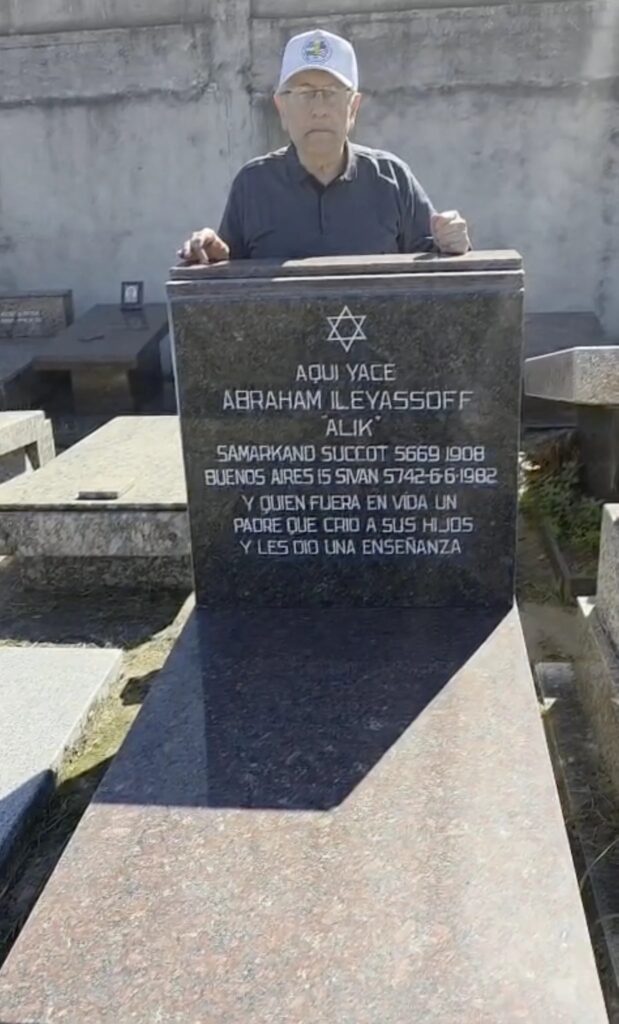
And the first thing that stunned me was the monument to Andreas Ilyasoff’s maternal grandfather, my countryman, Abraham «Alik» Ilyasoff, whose documents his grandson showed me in Samarkand in 2023 as soon as we met. I remember his Russian Empire passport. And now I am standing at his gravestone.
«Here rests Abraham Ilyasoff ‘Alik’, Samarkand, Sukkot 5669 – 1908 Buenos Aires 15 Sivan, 5742 – 6.6.1982, who in his lifetime was a father—raising his children and passing on his instructions to them.»
Reading these lines, I strangely felt an internal connection to my countryman… As if he were my relative too, such a close person to me—the name, the surname, and most importantly—the native city. Apparently, in his lifetime, he asked that Samarkand be indicated on the tombstone, and his children fulfilled his request.
Musofir… A wanderer who left his native home, spent a long time on the road in search of a place under the sun in a foreign land, where he eventually found eternal rest.
I felt, as if physically, the colossal distance between Samarkand and Buenos Aires: 9,452 miles! In our day, this is a day’s flight: half a day to New York and the same to Samarkand! Asia, Europe, North and South America! The Equator! How the motifs of space, time, loneliness, and wanderlust are intertwined…
Abraham Alik Ilyasoff left his native city in the 1920s while still a young man. Years of wanderings and migrations with his parents, new languages, cities, countries. How one must love Samarkand to live in Paris in the 30s, then in Argentina from the 40s, and carry in one’s heart the memory of a place that remained part of one’s consciousness until the last days of life!
Bright memory to a worthy son of Samarkand!
When this issue of the newspaper is released, 44 years will have passed since that day, the 15th of Sivan, when Abraham Ilyasoff was buried in Argentina, and there was something symbolic in my visit to this grave, on the eve of another anniversary of his death. If I come here again, I will definitely bring a handful of earth from the Samarkand cemetery where his relatives rest and mix it with the soil of the Argentine grave of my countryman…
Rafael Nektalov is editor-in-chief of The Bukharian Times. This piece is the fourth in his series on Bukharan Jewish communities in Argentina. It has been translated from Russian into English and both edited and condensed to be included in this issue.
By Rafael Nektalov
Editor-in-Chief of The Bukharian Times