
A 19TH-CENTURY MANUSCRIPT SURVIVED THE SOVIETS
NOW, IT MUST SURVIVE US

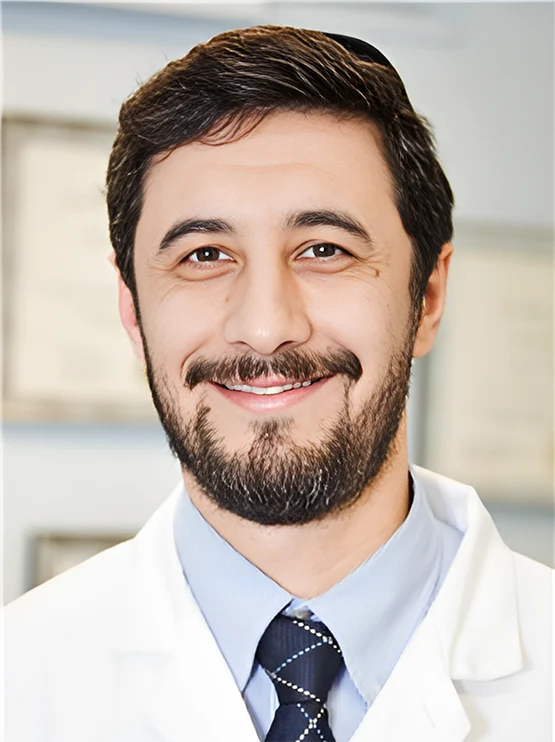

When Dr. Boris Yuabov prepared to leave Tashkent for the US in 1993, he made sure to bring his books.
Among them was a handwritten manuscript of over 100 pages. Penned in sweeping, calligraphic Hebrew and Bukharian, it was a singular artifact of 19th-century scholarship.
When asked about those final days in Tashkent before his emigration, Dr. Yuabov pauses. “A lot of things changed over there,” he says quietly. “A lot of things.”
Had this manuscript remained in Tashkent, it almost certainly would have been lost. Instead, it made its way to Queens, where it eventually found its way back to the author’s great-grandson: Dr. Arkadiy Takhalov.
Dr. Takhalov, a pediatrician who arrived from Samarkand in 1994, comes from a long line of physicians. But his roots in our community’s scholarly tradition run even deeper. The manuscript Dr. Yuabov carried out of the collapsing Soviet Union was written by Dr. Takhalov’s great-grandfather, Rafael ben Yehuda ben Eliya Takhol. The surname’s later evolution to Takhalov reflects the standard Russification of the era.
The text itself is a revelation. Titled Sefer Pitron Chalomot, it is a kabbalistic treatise on dream interpretation and palmistry. It was written in the year 1878 (5639 according to the Hebrew calendar) in the city of Bukhara, during the reign of Emir Muzaffar Khan.
Dr. Yuabov brought the Takhalov manuscript to America alongside other texts, a decision Dr. Takhalov views with clear gratitude. “We are incredibly fortunate that Dr. Yuabov had the foresight to save this manuscript and carry it safely to America,” Dr. Takhalov says. “It’s a powerful reminder of our community’s literary and religious scholarship in the 19th century, especially in Hebrew.”
Dr. Yuabov, a podiatrist by trade but a preservationist by calling, recognizes the sheer scholarly weight of the pages. Written in Hebrew and Bukharian calligraphy, the manuscript is an original composition that draws on classical sources, explicitly citing Joseph and Daniel (the Bible’s most famous dream interpreters), Rashi (the premier medieval commentator), the “Ari” (Kabbalist Isaac Luria), Rav Hai Gaon (Gaon of the Talmudic academy of Pumbedita), and Khaim Elazar ben Aharon Saadia Araki HaKohen (a Yemenite Jewish scholar who migrated to India and became the very first Hebrew printer in Calcutta).
Dr. Yuabov, who taught himself Bukharian, recognized the author’s proficiency. “This is a very serious talmid chacham (sage) in my opinion,” he says. “It’s his own composition sourced in earlier works, and he deserves full credit for that. He knows how to write in good Hebrew, and he is a very good sofer (scribe). He writes beautiful calligraphy in the Bukharian language.”
The manuscript is not an isolated artifact. Dr. Yuabov’s domot (son-in-law), Daniel Maksumov, who is related to the Takhalov family, possesses a Megillat Esther handwritten in Jerusalem specifically for Rafael’s father, Yehuda ben Milyoboy Takhol. It was given to him as a wedding gift by his grandfather. Looking at the lineage, Dr. Yuabov describes the family plainly: “These were, in my opinion, yirei shamayim. Serious, serious people.”
But acknowledging our past is only half the battle; the other half is ensuring it has a future.
Recognizing that this is likely the only existing copy, Dr. Yuabov hired a professional photographer to digitize the pages as a gift for Dr. Takhalov. But Dr. Yuabov views this as more than a personal favor; he sees it as a template for a necessary digital archive. Physical paper is fragile, and every day our history remains unarchived, it is vulnerable to “bookworms, floods, and other things.”
For Dr. Yuabov, this digitization is a blueprint for a massive and urgent project. He envisions a comprehensive digital archive of our community’s texts. “Whatever anyone does for this sacred work, and whatever they contribute to this undertaking—and everybody can contribute—it is all going to be tremendously valuable,” he says.
The greatest threat to this undertaking isn’t a lack of resources, but a lack of will. Dr. Yuabov is direct about the generational disconnect within our community. “The reality of life is, our talented children oftentimes are not interested in the heritage of their ancestors,” he observes. “Oftentimes they ignore their own treasures.”
—
“The reality of life is, our talented children oftentimes are not interested in the heritage of their ancestors,” he observes. “Oftentimes they ignore their own treasures.” — Dr. Yuabov, podiatrist and preservationist.
—
This points to a broader conversation within the Bukharian Jewish community. There is a recognized disconnect among younger generations regarding their heritage, a reality Dr. Yuabov observes, yet he refuses to lay the blame at the feet of the younger generation. “If our children do not have an awakening and appreciation of their own heritage, it means that we were not able to teach them that. It’s not their fault. It would be our fault.”
“The most important thing is to develop love in our children for the heritage of the Bukharian Jewish people,” Dr. Yuabov says. “The more we preserve, the greater respect we will show to our ancestors.”
It is easy to use the language barrier as an excuse. Many of us grew up speaking Russian, not the literary Bukharian of our great-grandparents. But Dr. Yuabov, who taught himself to read the language of the manuscript, dismisses this outright. We live in an era of artificial intelligence, Google Translate, and a “zillion dictionaries,” he points out. “We’re living in a time of zero problems with information. Desire in the heart, that is the only problem that we have.”
—
“We’re living in a time of zero problems with information. Desire in the heart, that is the only problem that we have.” — Dr. Yuabov
—
This past 9th of Tammuz, June 24, 2026, Dr. Takhalov observed the yahrzeit of his great-grandfather, Rafael ben Yehuda Takhol. Thanks to the quiet, determined efforts of a fellow doctor, Rafael Takhol’s is preserved, rather than lost in Uzbekistan.
“If proper effort had been put into our own heritage, we probably would discover a lot of interesting things,” Dr. Yuabov says, noting that he remains “very hopeful” for an awakening among our youth. But hope requires action. The survival of our intellectual history now rests entirely in our own hands.
“As far as our heritage goes, we have to preserve information,” he says. “And nobody is going to do it for us.”
Editor’s Note: During a recent visit to New York, Lev Leviev, the President of the World Congress of Bukharian Jews met with Dr. Boris Yuabov to discuss potential realization of a digital archive. Yet, moving from concept to reality remains to be seen. After all, the idea of creating a digital archive of Bukharian Jewish heritage was already brought up on the pages of The Bukharian Times over 10 years ago by Professor Yuri Mikhailovich Yuabov.
By: E. Takhalov