
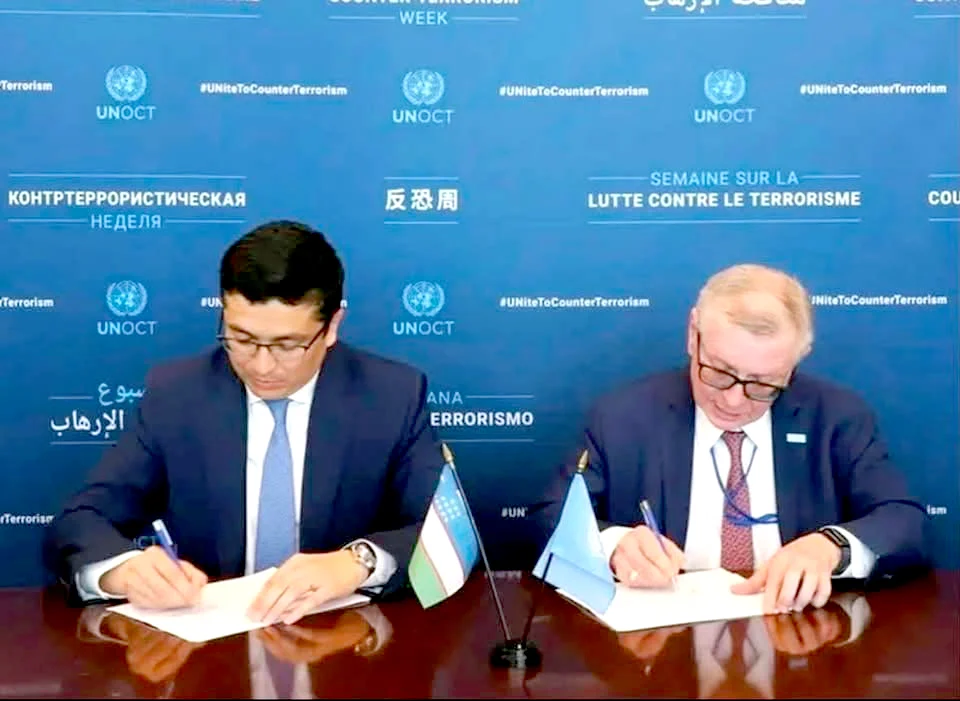
New York — Uzbekistan has reinforced its cooperation with the United Nations in the global fight against terrorism by signing a new Joint Roadmap with the UN Office of Counter-Terrorism (UNOCT) during the 2026 UN Counter-Terrorism Week at United Nations Headquarters in New York.
The Uzbek delegation, comprising representatives of the State Security Service and the Institute for Strategic and Regional Studies under the President of the Republic of Uzbekistan, concluded a series of high-level meetings aimed at expanding collaboration on counter-terrorism initiatives.
A major highlight of the visit was the signing of the Joint Roadmap for 2026–2027 by H.E. Mr. Ulugbek Lapasov, Permanent Representative of the Republic of Uzbekistan to the United Nations, and Mr. Alexander Zuev, Acting Head of the UN Office of Counter-Terrorism.
«In a milestone event, I had the honor of signing the Joint Roadmap for 2026–2027 alongside Mr. Alexander Zuev, Acting Head of the UN Office of Counter-Terrorism (UNOCT),» Lapasov wrote in a Facebook post following the meeting.
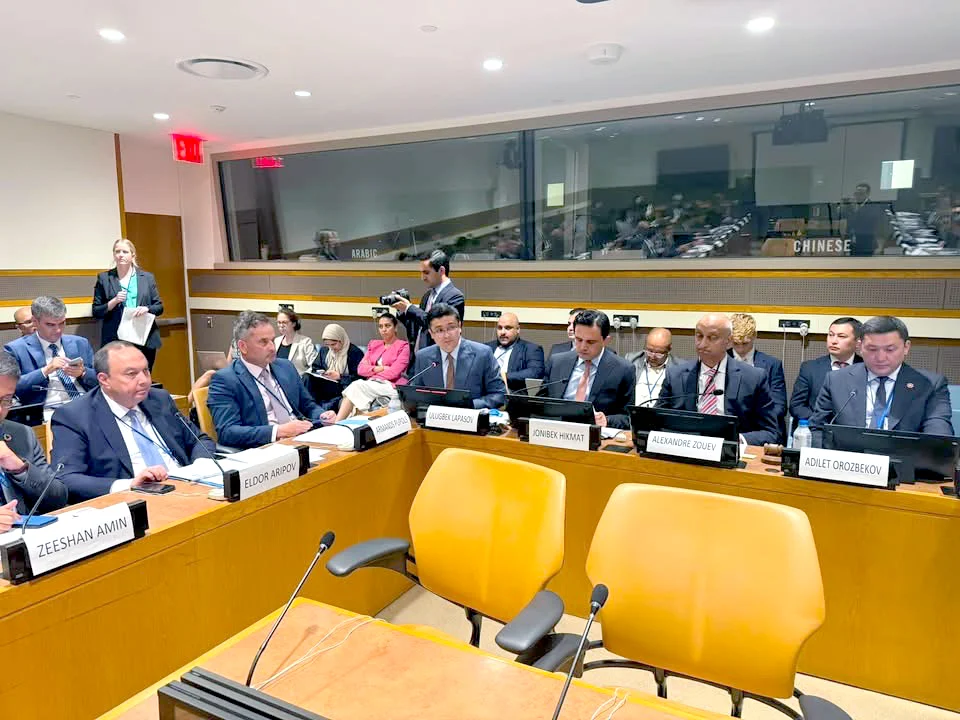
He described the agreement as a significant step forward in bilateral cooperation, adding, «This document marks a qualitatively new stage of our strategic partnership, institutionalizing long-term cooperation and expanding UN expert, technical, and advisory support for Uzbekistan.»
The Uzbek delegation also held substantive discussions with senior UNOCT officials to review ongoing cooperation across a wide range of priority areas, including institutional capacity building, combating terrorist financing, and addressing the growing threat posed by the misuse of emerging technologies by terrorist organizations.
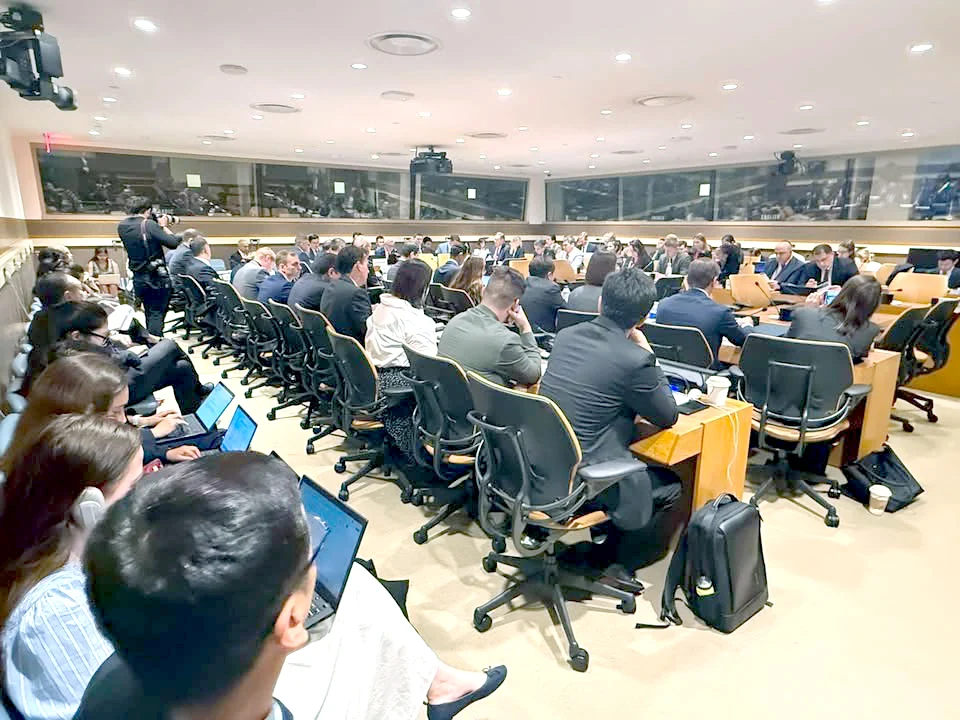
As part of the week’s events, the Permanent Mission of Uzbekistan, in partnership with UNOCT, the UN Regional Centre for Preventive Diplomacy for Central Asia (UNRCCA), and representatives from other Central Asian countries, co-hosted a side event focused on the repatriation, rehabilitation, and reintegration (PRR) of individuals returning from conflict zones. The event highlighted Central Asia’s experience and best practices in developing comprehensive reintegration strategies.
Lapasov said the visit reflected Uzbekistan’s broader commitment to international cooperation on counter-terrorism.
«This visit and the newly signed Roadmap reaffirm Uzbekistan’s unwavering commitment to the UN Global Counter-Terrorism Strategy and our growing contribution to regional and global peace and security,» he wrote.
EDITOR’S NOTE:
My interest in Uzbekistan did not stem from my own Jewish heritage or an interest in Judaism around the world. I became interested through the lens of counter-terrorism. Weeks after I started college in D.C., 9/11 happened. The war on drugs suddenly met the war on terror, and I found myself fascinated by narco-terrorist groups — their differences and motivations. Ultimately this led me to the Islamic Movement of Uzbekistan (IMU), which no longer operates in the country. Some experts said it wasn’t religious at all. Others said it was and could topple Karimov’s regime at any point. We now know that never happened. (But many Uzbek nationals have wreaked havoc around the world since — including the deadliest terror attack in NYC since 9/11: the 2017 Halloween pedestrian run-down, coincidentally next to my first New York City apartment on Chambers Street. It hit close to home in more ways than one.)
After I finished grad school at the University of St Andrews, where I earned a Master of Letters in Middle East and Central Asian Security Studies, I found myself at an inflection point. I had received two job offers on the same day: an internship at the UN Office on Drugs and Crime in Tashkent — my literal dream — and a job working for Tourisme Québec in NYC. I took the paid job. (Practicality won, i.e. my own Jewish mother.)
And now, I’m writing about Uzbekistan’s commitment to counter-terrorism from the Montréal apartment of a Québécois friend I made studying in Samarkand 19 years ago, who is a professor in Kazakhstan.
The dream internship may never have happened, but the dream life did.
The only thing missing? A husband with “oltin tishlar”.
By Erin Levi English Editor