
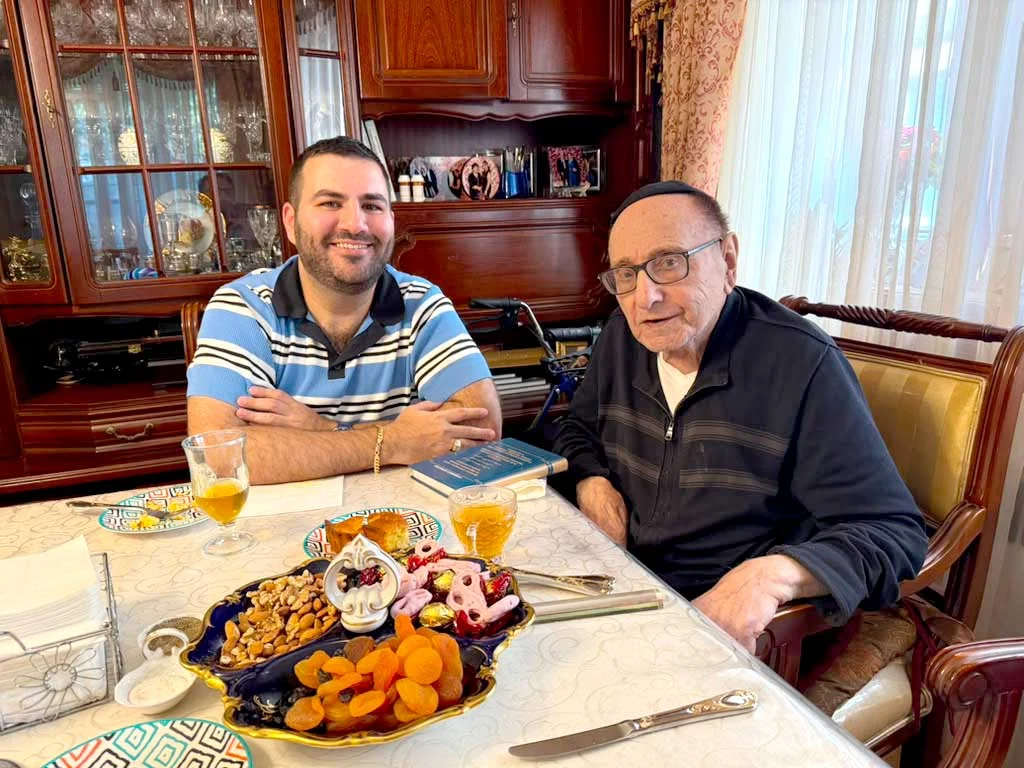
Memorial Remarks
Editor’s Note: Malkiel Danielov (Daniel), a distinguished journalist, writer and scholar who served for many years as a contributor to The Bukharian Times, passed away on July 20, 2026 at the age of 94. A veteran of international broadcasting, he was the founding head of the Tajik Service of Radio Free Europe/Radio Liberty, helping establish it as an independent service in 1975. The following remarks were delivered on Tuesday in his memory by Robert “Bobby” Nudel-Iskhakov, an Ashkenazi Bukharian living in Maryland who speaks many languages, including Bukhori.
“There is no joy in all the world Greater than beholding loved ones and dear friends. There is no torment upon this earth More painful than being parted from such noble companions.” — Rudaki.
First, I would like to begin my remarks with the words of the late friend of Uncle Malkiel, Boris Bakhor Ilyayevich Babayev, Deputy Principal of School No. 26 in Samarkand:
“There are people who occupy a high place in society. They have rightfully earned the great respect, admiration, and love of their people. They are loved for their modesty, honesty, fairness, charm, humanism, courtesy, compassion, diligence, integrity, kindness, hospitality, and, above all, for a humanity that knows no boundaries. Spending time with such people brings joy and inner peace. They serve as an example for everyone.”
Malkiel Nisimovich Danielov ben Yaffo was, is, and forever will remain one of those people—a man who has always been, and will always remain, an example for me.
Unfortunately, I had the privilege of knowing this remarkable man personally for only a short time. Yet through his work with the Bukharian Times, as well as through his poems and literary works published in Tajikistan, Israel, Germany, and the United States, I came to know so much about him.
I am deeply grateful to fate and to Aunt Bella Ibragimova—the mother-in-law of my cousin Joseph, daughter of the Honored Artist of Tajikistan, Fatima Kuinova, and a close friend of the Danielov family—for introducing me to this extraordinary family.
In 2024, I moved from Miami to Maryland for work in Washington, D.C. I found myself completely alone—without family and without friends. It was a very difficult period in my life. Thanks to Aunt Bella, however, I met Malkiel’s eldest grandson, David, his wife Emily, and their sons Ezra and Jackson, who live only fifteen minutes away from me in Rockville.
David and Emily are wonderful physicians, and the doors of their warm and welcoming home have always been open to me. I often spent Shabbat with them, especially when I felt lonely, and they always welcomed me as though I were a member of their own family, even without any prior notice.
As our friendship grew, I came to know David’s mother, Gail (Gulya), her husband Michael Reishwald, and their daughter Yaffa. Soon afterward, I had the great honor of meeting Gail’s extraordinary father, Malkiel Daniel, and his beloved wife, Lily.
From that moment on, I became a frequent guest in their home. Whenever I traveled to New York to visit my own family, I always made sure to visit Gail and her loved ones. The Shabbat evenings in Malkiel and Lily’s home became especially meaningful to me. Their home truly felt like my own, and I never once felt like an outsider.
I witnessed the love and devotion with which their younger son, Gabriel, together with his wife Irina and their sons Michael and Nathanel, cared for Uncle Malkiel and Aunt Lily. Their kindness, respect for their parents, and sincere devotion touched me deeply.
What impressed me most was Uncle Malkiel’s attitude toward me. Although I was nearly 60 years younger than he was, he always addressed me with the formal “you”—or, as we say in Tajik, Shumo. It was yet another reflection of his refined character, noble upbringing, and profound respect for others, values he inherited from his late parents. Xudo rahmat kunad. Menuchatam b’Gan Eden. May G-d have mercy upon them. May they rest in Gan Eden.
Every conversation with him was fascinating. He spoke about his life, the hardships he had overcome, and the difficult journey that led him from the Soviet Union to freedom in the West.
One day he gave me an invaluable gift: a copy of his autobiographical book, Through Thorns to Freedom, personally inscribed to me. That book will forever remain one of my most treasured possessions and a sacred reminder of this extraordinary PERSON.
To me, Uncle Malkiel was not only a mentor, teacher, and role model, but also another wonderful grandfather in my life. I admired his pure and kind soul, his sharp intellect, his wisdom, his profound knowledge, and, above all, his extraordinary HUMILITY.
Throughout all the time I knew him, I never once saw him lose his temper, raise his voice, or speak harshly to anyone. He always remained calm, composed, noble, and honorable. That is how I will remember him forever.
His beautiful, clear, resonant, yet gentle and dignified voice brought peace to everyone around him. His words were always wise, sincere, and filled with kindness. Listening to him was a genuine pleasure.
We shared a deep love for our Tajik-Persian-Bukharian language, our literature, our arts, and our common mission of preserving our culture, traditions, and heritage for future generations.
It is therefore especially important to emphasize that Malkiel Nisimovich’s many years of dedicated work in the fields of culture, literature, and the preservation of the spiritual heritage of Bukharian Jews received the recognition it so richly deserved.
For his lifelong dedication to our culture, language, history, and traditions, Malkiel Nisimovich was honored with the Israel Prize of the World Congress of Bukharian Jews and recognized as a Distinguished Cultural Figure.
For me, this award is not simply an honorary title or official recognition of his achievements. It is a fitting tribute to his entire life, his many years of devoted work, and the immense love he dedicated to his people. He did not simply write about our culture — he lived it, preserved it, and through his work passed it on to future generations.
His beloved wife, Lily Rafaelovna Saidova, daughter of Basanda Qoshchin, is a remarkable, wise, and energetic woman. Beautiful both inside and out, she recognized in Malkiel Nisimovich what mattered most: his kindness, honesty, diligence, integrity, and above all, his humanity. As a devoted wife, mother, grandmother, and great-grandmother, she became his greatest source of strength and love. I firmly believe that it was through her care, devotion, and selfless love that the Almighty granted him many additional years of life. At ninety-four years old, he looked and felt remarkably younger—many would never have guessed he was older than seventy-five.
Whenever I left their home, Lily would always prepare food for me to take on the road so that I would not go hungry. She cared for me as though I were her own grandson. For that maternal warmth and kindness, I will always love and deeply respect her.
Their beloved son-in-law Michael and beloved daughter-in-law Irina proudly called Malkiel Nisimovich “Dad,” and he loved them as though they were his own children. It is a great honor for me to be a friend of this wonderful family—his children, grandchildren, son-in-law, daughter-in-law, and, of course, Lilya Rafaelovna.
His grandson David, my good friend, as well as his granddaughter Yaffa and their mother Gail, told me many times that Malkiel Nisimovich always spoke of me with kindness, wishing me health, happiness, and success. Despite his advanced age, he even promised that he would attend my future wedding. To him, I was never merely an acquaintance—I was like another beloved grandson.
Three weeks before he passed away, I visited him. Although his body had grown weak, his mind remained as clear as ever, and his thoughts were just as profound and wise. He gave me his blessing, and that blessing will remain in my heart forever.
It is worth mentioning that my love for the history, culture, language, and traditions of our people often brings me to Central Asia—to Samarkand, the hometown of both my mother and Uncle Malkiel, and to Dushanbe, where they spent most of their lives during the Soviet era.
One of the most meaningful things I was able to do for Uncle Malkiel during the last years of his life was to locate the graves of his father, brother, and sister in Dushanbe. Sadly, when I found them, they had fallen into severe neglect.
On my initiative, and with the help of my friend from Dushanbe, Shuhrat Saidov, I suggested to Gulya and Uncle Malkiel that these graves be restored and renovated. Malkiel Nisimovich was sincerely grateful that I was able to help him—and many other families—locate, restore, and care for the graves of their loved ones throughout the former Soviet Union. I never did this work for recognition or praise. I did it wholeheartedly, in the spirit of KORI MISVO—a true mitzvah.
I especially want to emphasize that Uncle Malkiel was a happy man. He was grateful to the Almighty for his destiny and lived a long, honorable, and meaningful life. He left this world
with a sense of fulfillment, having witnessed the realization of his dreams and having accomplished so much during his 94 years.
I would also like to recognize that despite the distance and the tremendous demands of his profession, his eldest grandson David, an outstanding physician, carefully oversaw his grandfather’s medical care during the final months of his life, addressing every medical concern both remotely and through frequent trips to New York.
From the bottom of my heart, I would like to thank Lily, Gail, Michael, Gabi, Ira, and all of the grandchildren for the love, devotion, and selfless care with which you surrounded Malkiel Nisimovich during the final months of his life.
I am forever grateful to the Almighty for giving me the privilege of knowing this wonderful family and its beloved patriarch, Malkiel Nisimovich Danielov ben Yaffo.
I would like to conclude my remarks with a poem that weaves together the words of Malkiel Nisimovich himself with the immortal verse of the great Tajik-Persian poet Saadi Shirazi:
Raft az moyon dasti dilbardori mo,
Shavharu purdonu xushguftori mo,
Xanda bar lab, mehr dar dil doshtand,
Fikri farzand, fikri manzil dostand.
Aqli xurshedi ba mahfil doshtand, Har kujo bud tor, kandil doshtand.
Malkiel aka jigarband budand bo xurdu kalon, In kas barobar budand bo ahli zamon, In kas nishonzan budand be tiru kamon, In kas jahoni digare budand dar jahon.
Malkiel aka sari bolo, dili bedor doshtand, Az xusumat, az xushomad or doshtand, To naozorad kase, ozor doshtand, Bahri Gulyayu Gavriel kor doshtand.
Bazmtafson, majlisoro budand in kas, Ba ahli olam ovozi ozodī budand in kas, Malkieli yakto budand in kas,
Shavharu padaru boboi mehrubon budand ham.
Dasthoyashonro ba pokī xondandu raftand, Moro xandonandu ba’d giryon karda raftand, Ashk andar chashmi Lilya mondandu raftand, Mehrashonro dar dilho jo kardandu raftand.
Vodaregh ast rūyi kase toftan, Ki digar nashoyad chun ū, Malkiel, yoftan!
Translation (by author):
Our beloved supporter has departed from among us, Our husband, wise and kind in speech. With a smile upon his lips and love within his heart, He always thought of his children, always cared for his home.
He possessed the wisdom of the sun that brightened every gathering; Wherever there was darkness, he became the light.
Malkiel Aka was dear to young and old alike, He stood as an equal among all people. He was a marksman without bow or arrow— A man who was a world unto himself.
Malkiel Aka held his head high and kept a vigilant heart. He shunned both enmity and empty flattery. Rather than hurt another, he chose to bear hardship himself. He devoted himself to Gulya and Gavriel.
He brought warmth to every celebration and honor to every gathering. To those around him, he was a voice of freedom. He was one of a kind—our Malkiel. A loving husband, father, and grandfather.
He left this world with hands kept pure. He made us laugh, and then left us in tears. He left tears in Liliya’s eyes, But he also left his love forever in our hearts.
Alas, what sorrow to see such a face no more, For another like Malkiel can never be found again.
By Bobby Nudel-Iskhakov