
Can the decision of two Bukharian Jews change the rules of New York politics?
In politics, there are events that at first seem almost symbolic. Two people announce that they are leaving a political party—what does that mean for a city of millions like New York? At first glance, not much. But sometimes it is precisely such actions that foreshadow changes whose true scale becomes apparent only much later.
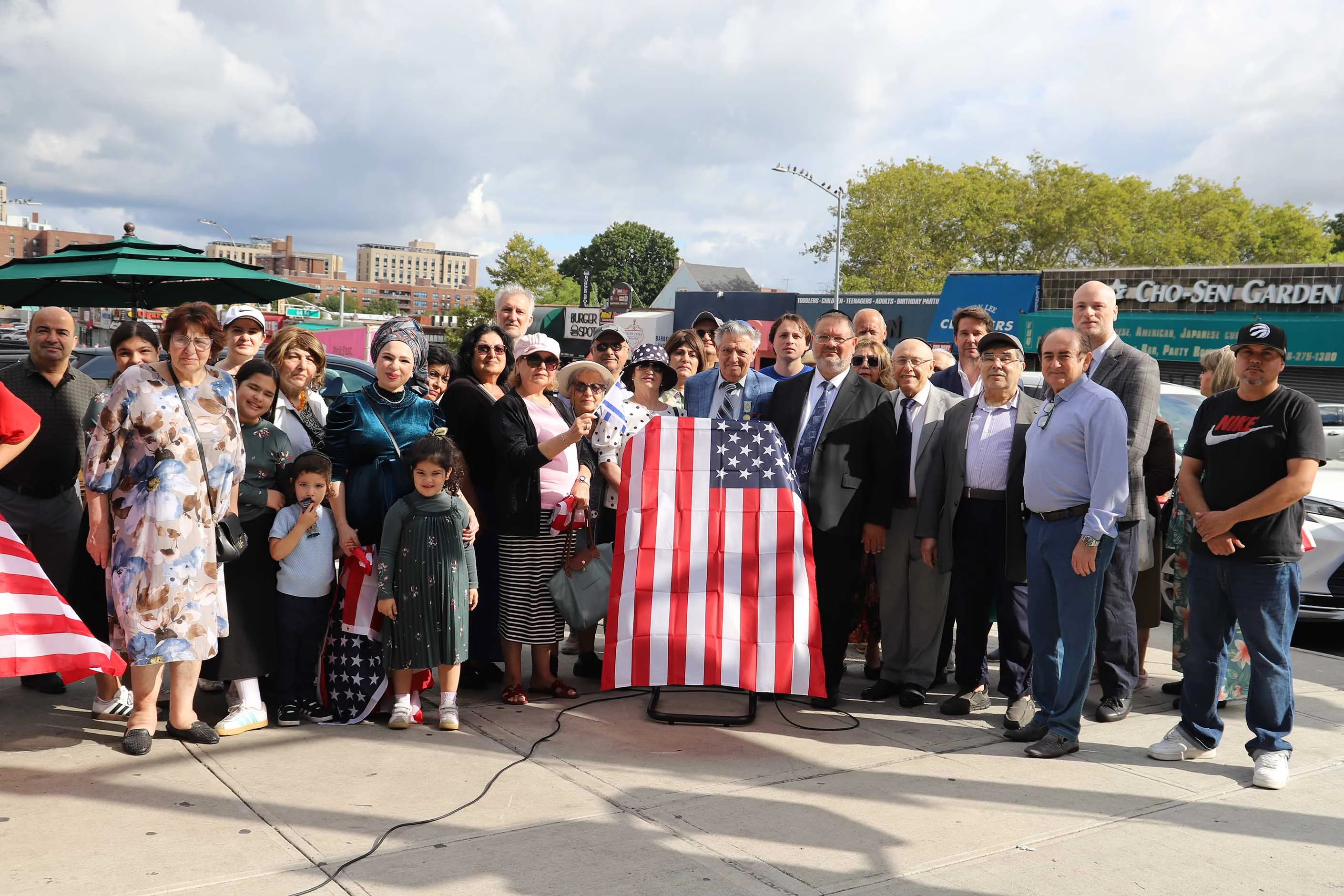
On September 6 in Forest Hills, two prominent representatives of Queens’ Bukharian Jewish community—The Bukharian Times Editor-in-Chief Rafael Nektalov and Rabbi Nahum Kaziev, a representative of Druzhba magazine and founder of DruzhbaTV—held a press conference to announce that they were leaving the Democratic Party. The organizers believe that many Queens residents may follow their example.
At this point, the issue is not so much about two party registrations as it is about a question that New York Jews are asking themselves with increasing frequency: Have we been approaching our relationship with city politics the right way?
Until recently, the answer seemed obvious. For decades, New York has been a city where the Democratic Party enjoys an enormous advantage. Jewish organizations, including representatives of the city’s large Bukharian Jewish community, therefore sought to maintain good relations primarily with Democrats. It was simple political pragmatism: if Democrats run the city, the community needs access to those making the decisions.
But then New York elected Zohran Mamdani mayor. His victory caused serious concern among a significant portion of the Jewish community. The new administration’s first decisions were a particular source of concern. On his first day in office, Mamdani revoked a number of executive orders issued by his predecessor, Eric Adams, including a prohibition on city officials participating in a boycott of Israel and the city’s adoption of the IHRA (International Holocaust Remembrance Alliance) definition of antisemitism.
At the same time, Mamdani said he would retain the Mayor’s Office to Combat Antisemitism and intended to take the problem of anti-Jewish hatred seriously. It would therefore be overly simplistic to reduce what is happening to the slogan “the mayor is against the Jews.” But statistics ahead of Rosh Hashanah give reason for concern. According to the NYPD, 425 hate crimes were recorded in New York City during the first eight months of 2026. Of those, 229 targeted Jews—53.9 percent of all confirmed incidents in this category, even though Jews make up only about one-tenth of the city’s population.
And this is where a story begins that may ultimately be more important than the controversy surrounding Mamdani himself.
The announcement by Nektalov and Kaziev immediately raises an objection: leaving the Democratic Party is a mistake. If Democrats govern New York, the Jewish community needs to preserve its influence within that party. By leaving, it risks voluntarily giving up its seat at the table where decisions are made.
It is a serious argument. But it works only when the existing system actually provides influence. What happens if a party is confident that the Jewish vote will remain with it no matter what? What if the community’s support begins to be taken for granted? Political loyalty then ceases to be an advantage.
A vote that belongs to one party in advance is politically worth less than a vote that must be fought for. That is why the actions of these two representatives of the Bukharian Jewish community take on a different meaning. This does not necessarily have to be about turning New York Jews into Republicans. Far more important is to stop being automatically Democratic or automatically Republican and instead become an independent political force.
New York is particularly well suited to such a model. It is a city of communities—Jewish, Chinese, Korean, Indian, Muslim, Christian, Caribbean, Latino, Russian-speaking, and many others. Community life is especially strong in many neighborhoods, with their own religious institutions, schools, stores, media outlets, civic organizations, leaders, and entrepreneurs.
Queens is a vivid example. Bukharian Jews have built a powerful infrastructure here: synagogues, schools, restaurants, media outlets, mutual-aid organizations, and businesses. But like many other ethnic communities in New York, a significant portion of the community has long taken a pragmatic approach to politics: support those who are in power.
But what if the principle itself were changed?
Imagine a New York where winning the Democratic primary is not enough for a mayoral candidate. Afterward, that candidate must still convince the city’s organized communities that he or she deserves their support.
If the Jewish, Chinese, Indian, Korean, Russian-speaking, and other communities begin telling candidates, “Our vote does not belong to anyone in advance,” then party affiliation will no longer be the only thing that matters. Genuine political competition will emerge.
The central question will no longer be, “Who are the Democrats asking us to vote for?” but rather, “Who will provide our community with security, good schools, support for small businesses, a well-functioning city, and respect for our values?”
Today, that may be a Democrat. Tomorrow, a Republican. The day after tomorrow, an independent.
That is political power.
For this reason, I do not consider Rafael Nektalov and Nahum Kaziev’s decision a mistake. On the contrary, it may prove to be a timely signal. But on one condition: that the resounding “Goodbye, Democratic Party!” be followed by an equally important “Hello, politics!”
You want our votes? Come talk to us. Explain your position on Israel. Tell us how you intend to fight antisemitism. What will you do to protect synagogues and schools, support small businesses and education, and keep our streets safe? How will you improve our roads?
And most importantly—show us what you have done, not merely what you promise to do.
Then a politician will understand that he or she is dealing not with a handful of community activists, but with an organized community capable of turning out voters—and just as capable of collectively withholding its support.
And this applies not only to Jews. If other New York communities begin to adopt the same principle, the very nature of city politics could change. Winning one party’s primary would no longer be viewed as practically guaranteeing the keys to City Hall.
That is why a small press conference outside Jerusalem Bagels in Forest Hills may turn out to be far more important than it appears.
Not because two Bukharian Jews decided to leave the Democrats, but because a more consequential idea was voiced: New York’s Jewish vote should not belong to any political party by inheritance. It must be earned.
If this idea extends beyond one community and beyond Queens, the step taken by Rabbi Nahum Kaziev and Rafael Nektalov could indeed become historic—not as the departure of Jews from the Democratic Party, but as the beginning of their return to the larger political arena.
This first appeared in issue 1283
and was translated
from Russian into English.
By Leonid Elizarov,
Editor, Menorah newspaper, Israel