
TORAH, NAMES, TRADITION AND MODERNITY
JEWISH TRADITION
Rabbi Baruch Babaev: Rabbis never dictate to parents or require them to give their children specific names!
Recently, a strange phenomenon has become increasingly common: parents choosing not to name newborn children after deceased relatives on the husband’s side. Moreover, some parents justify this decision by citing… rabbis.
“What led you to choose a name that does not honor the memory of your late father? After all, he passed away relatively recently,” I asked one couple.
“You see, my husband and I are Orthodox Jews and lead a religious lifestyle accordingly. We always consult our rabbi (I know his name, but for ethical reasons I will not publish it. — R.N.), and he opened the Torah and told us that we had to give our son this particular name,” the young mother confided in me. “This is our first son! Everything has to be done properly!”
I congratulated the young parents on the birth of their first child—and began to think. At one time, I studied the onomastics of Jewish names and read dissertations on the subject. Before emigrating, I myself lived in the Jewish quarter of Samarkand, where this couple comes from, yet I could not recall a single instance in which a son might disregard the name of his deceased father.
I turned to Rabbi Baruch Babaev, Chief Rabbi of the Bukharian Jews of the United States and Canada, and asked him to clarify this issue, whose roots reach back into Jewish antiquity, the Torah and the Talmud.
CHOOSING A NAME IS PROPHECY
R.N.: Rabbi Babaev, is it correct that in Orthodox Jewish families, the right to name a newborn is the prerogative of the rabbi?
B.B.: No!
That has never been the case, is not the case now, and never will be. As a rule, this happens with henpecked husbands who sometimes unquestioningly carry out the decisions or requests of their wives. And if a wife considers herself an Orthodox Jewish woman, she should not pressure her husband with proposals that do not correspond to traditions rooted in Jewish practice—although that practice itself is not entirely uniform.
As a rule, a rabbi advises his congregants. When people approach him for advice about what to name a child, he should explain the laws and traditions of their community. He should ask whether their parents are still living, and ask the names of grandparents who have passed away.
If children have already been named in their honor, and the parents have many children (as is generally the case in Orthodox families), then he may suggest names from the Torah or the names of great Jewish righteous figures and sages for the newborn. But there should be no pressure to give the child that particular name.
I repeat: the right to choose belongs exclusively to the parents. Grandparents and other relatives cannot demand a particular name against the parents’ wishes. Nevertheless, every community has its own nuances.
In Jewish tradition, a person’s name is regarded not merely as an everyday label, but as a key to the essence of the soul, influencing character and the course of one’s life. The foundations of these ideas and the rules for naming children and grandchildren were laid down in the Talmud and later developed in the writings of sages and Kabbalists.
AS THE SAYING GOES, “WHATEVER YOU NAME THE SHIP, THAT IS HOW IT WILL SAIL!”
R.N.: Sailors have always been particularly careful when choosing the name of a vessel on which they would embark on long voyages. They believed that an unfortunate name would bring misfortune.
B.B.: Correct. And the same applies to a person. But in Judaism, the reasoning is more serious. The Talmud states directly: “A name influences destiny” (shma garim—“the name causes”). The sages explain that a name can alter a person’s spiritual constellation and fortune (mazal).
Before suggesting—but not insisting upon—a name for a newborn, a rabbi should learn the parents’ views, calculate the gematria, and determine the date and month according to the Jewish calendar. According to Kabbalah, the soul prefers to descend from Heaven to the place where it was before departing this world.
R.N.: How long has the tradition of naming children in memory of their ancestors existed?
B.B.: The Talmud notes that in ancient times, names were given in connection with significant events. However, by the Talmudic era (1st–5th centuries CE), the custom of naming children after ancestors had already become established as a way of preserving their memory and passing on their spiritual virtues.
Among Bukharian Jews—that is, Mizrahi Jews—the name of the closest deceased relative is generally chosen: a father, mother, grandfather, grandmother or great-grandparent. But the first son is named for the father’s side, in honor of the grandfather, and the first daughter in honor of the paternal grandmother. The second son and daughter are named for the mother’s parents or grandparents. It is not customary to name children after living relatives.
R.N.: Ashkenazi Jews have the same tradition. Among Sephardic Jews, it is different.
B.B.: Yes. Among Sephardim, naming children after living relatives is permitted and encouraged. It is considered a sign of respect. The Talmud confirms this. But here, too, there is a strict order: the first son is named for the paternal grandfather and the first daughter for the paternal grandmother. The second son and daughter are named for the mother’s parents.
R.N.: What exceptions are there? And where does the Bukharian Jewish tradition of giving children double names come from?
B.B.: Jews, regardless of community, were not permitted to give children the names of wicked people—for example, Nimrod. The Talmud strictly prohibits naming children after the wicked. It is said: “May the name of the wicked rot.” Bukharian Jews would say, nomash gum shavad. Bearing the name of a wicked person can negatively influence a child’s character.
R.N.: It was also strongly discouraged to name children after those who drowned young or died tragically in a catastrophe. But this does not apply to those who died heroically in war: by giving children their names, it was as though they were being brought back to life. Nomashon shod shud.
B.B.: According to the Midrash, a person has three names: the first is given by his father and mother, the second by those around him, and the third he earns himself through his deeds.
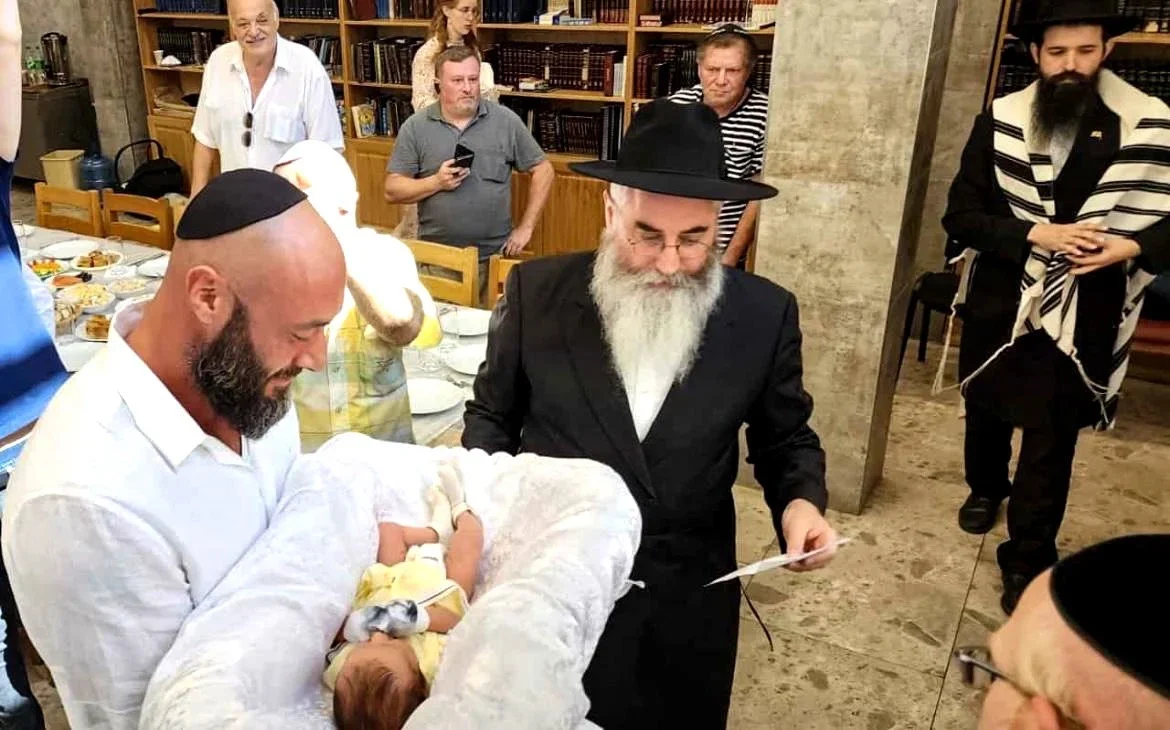
A boy is formally given his name exclusively during the brit milah, on the eighth day after birth. A girl is given her name in the synagogue during the Torah reading on one of the first days after her birth—usually on the first Shabbat, or on a Monday or Thursday, when the Torah is taken out.
Until the official naming, it is customary to keep the child’s name strictly secret from others in order to avoid the evil eye or harmful influences.
Once children have already been named after deceased ancestors, it is customary—though not obligatory—to give subsequent children the names of tzaddikim and prophets. It is believed that their spiritual merit will protect the child.
If a relative died young or suffered a tragic death, the Talmud and subsequent laws recommend not giving the child that person’s name by itself. Parents either change the name or add protective names such as Chaim or Boruch. If a mother has experienced repeated pregnancy losses, children may be given a second name such as Istat or Pulod.
NAMES ON TOMBSTONES
R.N.: After emigrating to Israel and the United States, Bukharian Jews began adopting the tradition of identifying the deceased through the mother rather than through the patronymic or the father’s name. After Israel began requiring repatriates to provide documentation proving their Jewish status, the question of Jewish identity through the maternal line arose. In the USSR, however, whether children were considered Jewish or non-Jewish by birth was determined by the father. If the father was Jewish, the children were Jewish.
B.B.: That was how it was in the USSR. But in the birth records of Bukharian Jews, the nationality of both the newborn’s father and mother was recorded even before World War II—that is, during the first half of the 20th century. And on the tombstones of the deceased, they would write, for example: “Ephraim, son of Sarah and Isaac Abramov, died.”
In earlier times, births were registered only in synagogue records, where all the newborn’s information was recorded. Later, this became the responsibility of the civil registry office (ZAGS). But after World War II, people began writing the deceased person’s given name and patronymic. Today, there has been a return to the custom of Mizrahi Jews—as well as religious Sephardim and Ashkenazim—of inscribing names in accordance with the centuries-old tradition.
R.N.: Thank you, Rav Baruch Babaev, for your important comments and for answering questions concerning the culture and tradition of names in our Bukharian Jewish community.
B.B.: I would also like to take this opportunity to wholeheartedly wish all the newspaper’s readers a happy Sukkot! May the Festival of Booths be a time of joy, peace and warm fellowship. I wish you prosperity, strength, success in all your endeavors and tranquility. May your lives be filled with more bright days, good news and people in whose company you feel comfortable and at peace!
R.N.: Thank you.
This was translated
from Russian into English.
By Rafael Nektalov Editor-in-Chief, The Bukharian Times