
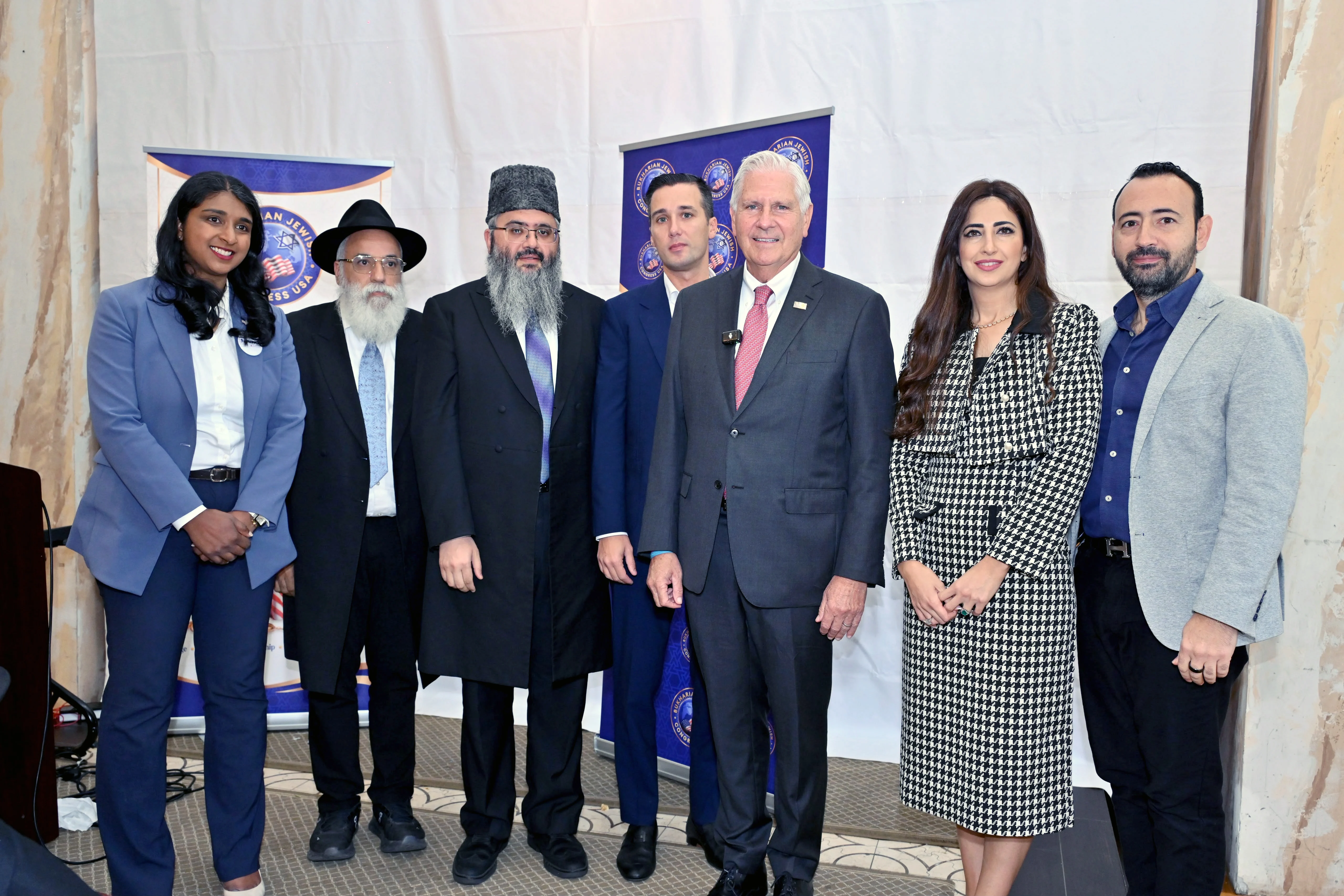
On October 7, the third anniversary of the Hamas attacks on Israel, the Congress of Bukharian Jews of the USA and Canada, led by President Chagit Sofiev-Leviev, hosted a special breakfast with prominent political figures, including Nassau County Executive and New York gubernatorial candidate Bruce Blakeman and New York State attorney general candidate Saritha Komatireddy. Held at the BJCC in Queens, the gathering brought together more than 50 Bukharian Jewish community leaders, including rabbis, synagogue presidents, and members of the press, less than a month before the November 3 midterm elections.
As the Bukharian Jewish community becomes increasingly engaged in political and civic affairs, the Congress is renewing efforts to strengthen relationships with elected officials and address pressing community concerns, particularly rising antisemitism. One catalyst for this shift was the Hamas terrorist attack of October 7, 2023, which claimed approximately 1,200 lives in Israel.
New York City is home to approximately 1.4 million Jews, making it the largest Jewish metropolitan center in the world, surpassing even Tel Aviv and Jerusalem. Across New York State, the Jewish population approaches two million. Events in the Middle East resonate deeply within this community, and the October 7 tragedy left a profound collective trauma.
The breakfast began with a memorial prayer for the victims of the October 7 attacks and the lighting of a memorial candle by Rabbi Baruch Babaev, Chief Rabbi of the Bukharian Jews of the USA and Canada. He also offered a prayer for the well-being of Israel Defense Forces soldiers.
In her remarks, Sofiev-Leviev emphasized the importance of ensuring that the Bukharian Jewish community, numbering more than 100,000 people throughout the United States, has a stronger voice in public affairs.
«Our community has grown significantly over the years, but with that growth comes a responsibility to become more actively involved in public life. We must build relationships, make our voices heard, and ensure that our community has a say. The fact that so many community leaders have gathered here today demonstrates their commitment to that responsibility,» said Sofiev-Leviev.
Blakeman, a longtime supporter of Israel and the Jewish community, addressed attendees on issues affecting New Yorkers, including public safety and the protection of Jewish communities. His remarks drew enthusiastic applause, and the audience gave him a standing ovation.
Blakeman enjoys considerable respect among members of the Bukharian Jewish and Russian-speaking communities of Queens and Brooklyn. The previous week, he had met with community activists at a fundraising event in Kew Gardens. On the table where he sat before delivering his remarks was an open copy of The Bukharian Times, featuring photographs from that gathering.
A Republican, Blakeman has taken strong positions on immigration, government spending, and law enforcement. He has criticized New York’s Democratic leadership over high taxes, public expenditures, and public safety, while advocating stronger support for law enforcement and restrictions on state-funded assistance to undocumented immigrants.
He has also supported Jewish community leaders in Brooklyn and Queens in their opposition to Mayor Zohran Mamdani’s positions on Israel and antisemitism, participating in rallies throughout New York City.
In May 2026, Blakeman joined Republican State Assembly members Michael Novakhov and Alec Brook-Krasny, along with Jewish community leaders, in efforts to stop a Brooklyn concert by Uzbek singer Yulduz Usmanova, whose statements about Israel had drawn accusations of antisemitism. The concert, scheduled for Victory Day, commemorating the defeat of Nazi Germany, was canceled, as were subsequent performances planned in Washington and Chicago.
For members of the Russian-speaking community who opposed the performances, the episode demonstrated the importance of having political representatives willing to support grassroots initiatives and respond to community concerns.
Saritha Komatireddy, the Republican candidate for New York State attorney general, outlined her plans to combat antisemitism and hate crimes. Expressing solidarity with the Jewish community following the tragedy of October 7, she pledged that, if elected, she would declare a state of emergency over rising antisemitism in New York on her first day in office.
Having met Komatireddy personally and attended her campaign rallies in Queens, I found her to be open and straightforward. As the daughter of Indian immigrants, she also shares an Asian heritage with our community.
Komatireddy also said her office would exercise its lawful authority to pursue criminal prosecutions if local district attorneys failed to adequately protect Jewish and other communities from hate crimes.
Of particular importance to me was her proposal to reactivate the Hate Crimes Bureau. Our community experienced a disturbing incident in the seemingly peaceful neighborhood of Forest Hills when Rabbi David Shushan, who serves at the synagogue where the breakfast took place, was attacked in broad daylight. The attacker was charged with hate-motivated assault and aggravated harassment but was subsequently released under supervision. The case remains unresolved.
Komatireddy also proposed adopting the International Holocaust Remembrance Alliance’s (IHRA) working definition of antisemitism as official state guidance.
The event was moderated by Simon Taylor, the recently appointed director of the Congress.
In his closing remarks, Rafael Nektalov, Congress coordinator and editor-in-chief of The Bukharian Times, called for greater voter registration and participation among Bukharian Jews. He urged community members to help middle-aged and older residents reach polling stations in Queens on November 3.
«Unfortunately, voters often focus primarily on federal elections. Everyone rushes to vote for president, even though people’s everyday lives are more directly affected by local decisions,» he observed.
Nektalov emphasized that civic engagement at every level of government affects essential neighborhood services, from road maintenance and public transportation to schools, parks, and sanitation.
«We must teach our voters the importance of participating in local council elections so that our community has a genuine voice in advancing its interests and influencing how city and neighborhood budgets are spent.»
By Rafik Sharki
Photos: Kaykov Media
This was translated from Russian and edited for length.