
FAMILY JOURNEY
The war scattered this family across a vast country and beyond its borders, grinding down lives that had once been settled and whole.
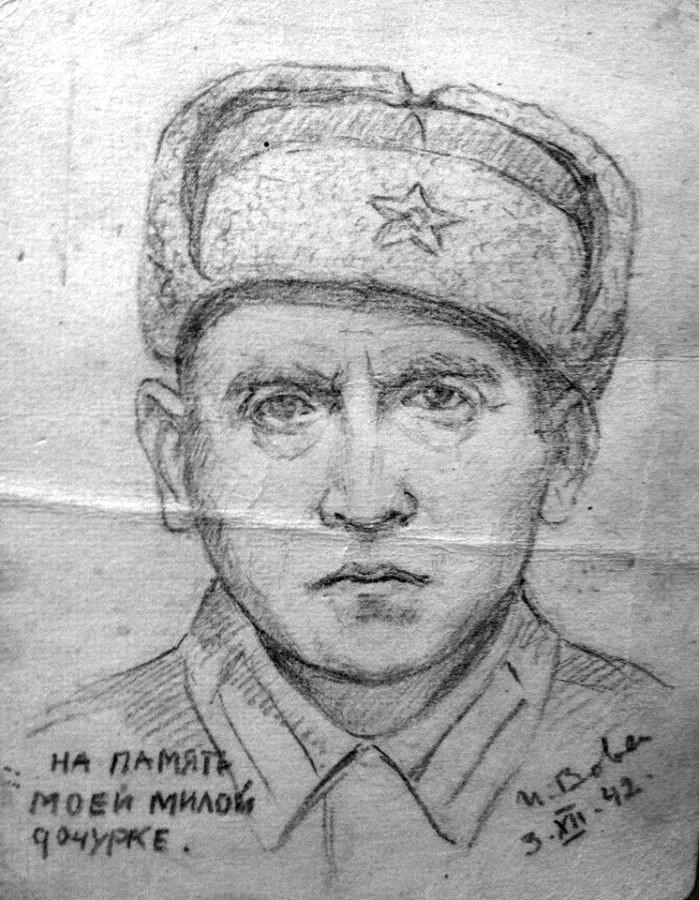
Itzhak Vovsi, born in 1901 in Dvinsk (now Daugavpils, Latvia), was a man of art, educated at the Latvian Academy of Arts. Before the war he lived in Riga, where he taught and worked as a ceramic artist, and later became an employee of the Riga State Jewish Theater. He married Sara, and together they had a daughter, Aviva. Their peaceful life collapsed in June 1941.
Together with his wife Sara Moiseevna Vovsi (1908–1943) and three-year-old Aviva (1938–2009), Itzhak fled the advancing enemy toward Yangi-Yul. His creative profession proved unsuited to survival, so to feed his family he traded his clay and palette for a photo camera. Even this fragile new life didn’t last: in July 1942 he was drafted into the Red Army, serving first in a reserve regiment and then in the 323rd rifle regiment of the 308th Latvian Rifle Division on the 2nd Baltic Front. Even amid the harshness of war, he remained a devoted father and husband, and a creative spirit — sketching scenes from the front. He was awarded the medal for «Battle Merit.» His path ended on September 20, 1944, in battle near the Latvian village of Irshi. He was buried in the military section of the Vecbebri village cemetery. His preserved frontline sketches later appeared in the book Impressions of the Great Patriotic.
While Itzhak fought, Sara and Aviva struggled to survive after evacuation. In the summer of 1943, likely driven by hunger and desperation, Sara set out with Aviva on the nearly 3,000-kilometer journey from Uzbekistan to the settlement of Medvedok in Kirov Oblast, where her sister Haya (Anna) and Haya’s husband, Lev Kagan, had found refuge. The journey proved fatal: exhausted, Sara died in Kirov in August 1943, never reaching her destination. Aviva was left alone in a foreign land. Haya and Lev — recently demobilized after Lev’s wounding — took her in as their own, sparing her a children’s home.
Tragedy touched other branches of this close-knit Jewish family as well. Sara and Haya’s brother, Mikhail Cemel, died in Siberian exile early in the war, a victim of repression. His wife, Zinaida Maksimovna Cemel (Khazanovskaya), was exiled from her hometown of Ludza to Krasnoyarsk Krai and did not return to Riga until 1956. Haya and Lev Kagan ultimately raised four children — two of their own, plus Aviva and Yakov, the son of Haya’s sister, who had been sent to the camps with her mother. Theirs is bitter evidence that the war’s cost was paid not only by the millions who died at the front, but by the countless broken lives left behind.
In 2020, copies of Itzhak’s frontline letters to Sara, Aviva, and Haya were given to the Archive Department of the Russian Center «Holocaust» by his grandson, Ilya Vovsi (Yokneam, Israel), and published in the sixth volume of the center’s collection «Preserve my letters…». Ilya, born in Riga in 1977, is the son of Aviva and grandson of the artist. He shared with me the story of his search for his grandfather’s grave.
«For decades, our family lived with unanswered questions and the pain of never being able to visit our relative’s grave,» Ilya explains. «My mother was three when the war began. She died in 1943, on the way from Uzbekistan to Russia, and was raised afterward by her aunt. The circumstances of my grandfather’s death were always a mystery — first we received a notice saying he was ‘missing without a trace,’ and after the war, an official reply only said he’d perished in Latvia, with no location given. My mother died without ever knowing where or how.»
For years, the family’s hope of finding the grave nearly faded, since it seemed he’d been lost in some unmarked mass grave. Their only lead came from a relative who, after the war, met a fellow serviceman who said the train carrying Itzhak’s unit had been attacked by the «forest brothers,» and that he had been killed.
The breakthrough came through the digitization of Russian military archives. In 2019, on the site «Feat of the People,» Ilya found a casualty list confirming his grandfather’s death on September 20, 1944, near a village called «Benoit» in the Vecbebri rural municipality — a name Google couldn’t locate, likely a phonetic transcription or later renaming. Knowing his grandfather’s division, Ilya cross-referenced its position on that date with a Latvian database of military burials in the Bebru region of Kokneses. After methodically checking several possibilities, he found it: a listing for «private I.Y. Vovsi» among the fraternal graves at Zutēnu Cemetery. «A single mistaken letter in the initials, and confusion over the volost’s name, had hidden him from us,» Ilya says.
Photographs of the well-tended cemetery — its obelisk and memorial plates in good condition — moved him deeply. «I found him after 74 years. Now I know he perished in battle, not missing without a trace like so many others. I only regret that my mother never lived to see this and learn her father’s fate.»
Noticing the engraved error in his grandfather’s initials, Ilya wrote to the Russian embassy in Riga, which now maintains the cemetery. Half a year later, they sent him a photograph confirming the correction — a round trip that, as he notes, took five hours of driving from Riga.
Ilya has since visited his grandfather’s grave three times, leaving stones and reciting Kaddish — preserving, for his own children, the memory of a man who paid the highest price for victory.
Photos from the Archive
of the Center «Holocaust» and
the Archive of Ilya Vovsi (Israel).
By Yana Lyubarskaya