
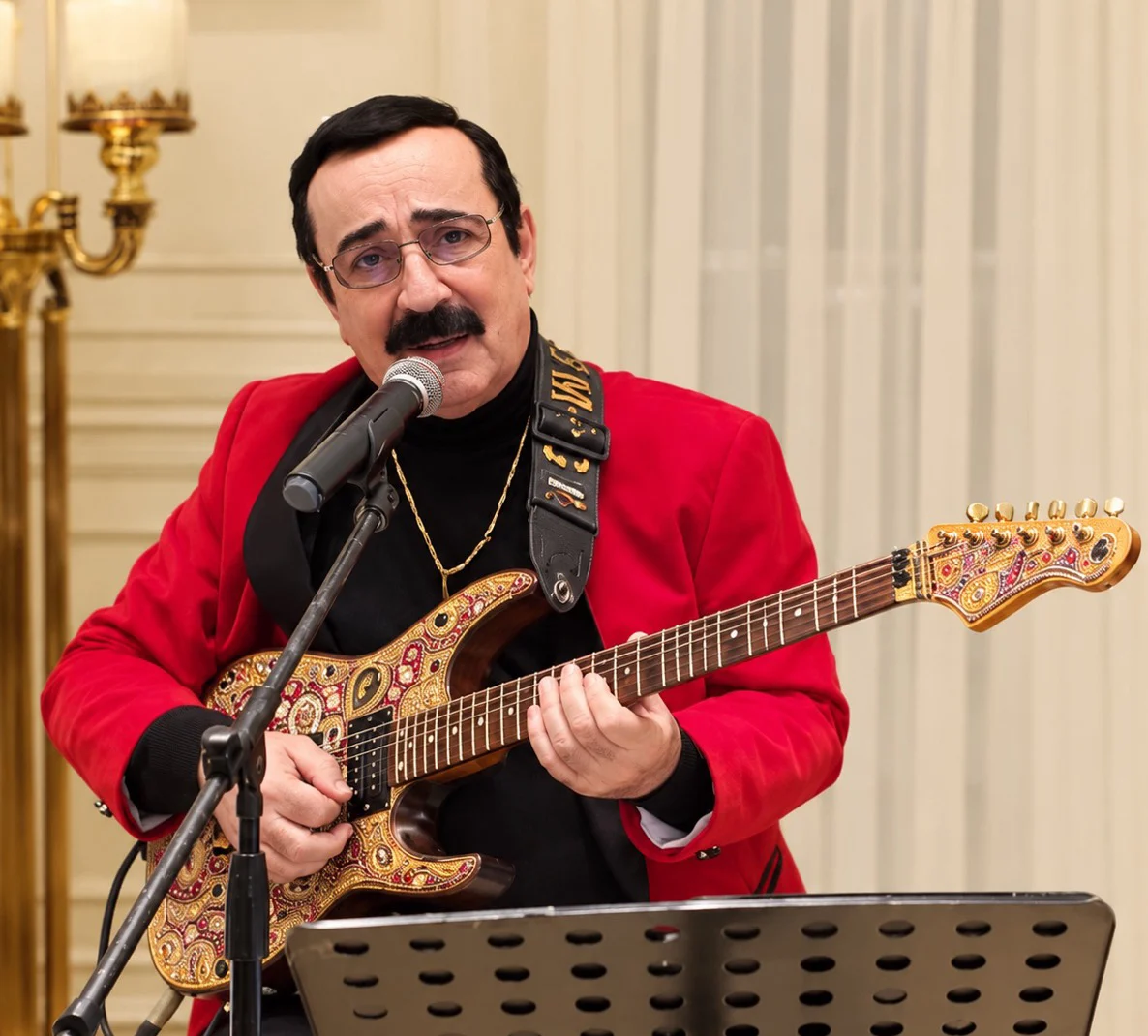
WHY THE SINGER WON’T CELEBRATE HIS 70TH BIRTHDAY — AND WHAT HE WANTS INSTEAD
Our Heritage
Why is the celebrated singer not celebrating his 70th birthday? Who will save Bukharian Jewish culture, and why are concerts alone no longer enough? Leonid Elizarov finds the answers.
Avraham Tolmasov has turned 70. One might think it would be the perfect occasion to gather friends, colleagues, and admirers around a festive table, reminisce about Samarkand, and sing beloved songs. After all, among Bukharian Jews, a milestone birthday without music and a proper feast is practically a violation of public order.
But Avraham Tolmasov has decided otherwise. No birthday celebrations. No speeches in his honor.
Our conversation with the celebrated singer began with memories of the past and ended with a serious discussion about the future of our culture.
Why I’m Not Celebrating My 70th Birthday
— Avraham, let’s begin with a question many people must be asking you. Why have you decided not to celebrate your 70th birthday?
— I don’t want to!
— That’s all? Usually, a Bukharian Jew wouldn’t dream of celebrating even an ordinary birthday without guests, and here we’re talking about 70 years!
— Why should I be summing up my life? I still have many plans, many projects. Of course, I could organize a gala evening to celebrate turning 70, then celebrate 71. But is that really what matters? I want to use the time I have for creativity, good deeds, and preserving our people’s culture.
— So you don’t consider 70 an age when it’s time to look back?
— There’s nothing wrong with looking back. But I have no intention of living only in the past. I still have things to say and songs to sing.
My Conservatory Was Samarkand
— Let’s look back a little anyway. What do you remember about the Samarkand of your childhood?
— I grew up in a large family. There were 12 children: 10 biological children and two adopted children. Among us was a Muslim girl. We all grew up together.
And all around our house lived famous performers: Gavriel Mullokandov, my father Gavriel Tolmasov, my uncle Mikhael Tolmasov, Israel Tolmasov, Avner Baraev, and many others.
It was a real musical neighborhood. Imagine: music coming from almost every house, rehearsals taking place, singers gathering together. People came from all over Samarkand to invite our performers to sing at weddings and celebrations.
I grew up among these people, listening to them and learning from them. Our neighborhood was one big conservatory for me.
— But you did try to obtain a formal musical education, didn’t you?
— I did. I went to audition for music school. They asked me to sing a song about Buchenwald. They listened and told me, «You’re tone deaf!»
Can you imagine? Me, someone who had grown up surrounded by musicians!
Then my cousin Rafael Tolmasov came to sort things out. He said, «How can you say that? He sings and plays several instruments!»
Eventually, they admitted me. But do you know which instrument they assigned me? The tuba! A big brass horn!
— Why the tuba?
— They said I had good lips.
For six months, I sat there playing, «Boo-boo, boo-boo…»
Meanwhile, I was already being invited to perform and earning what was considered good money at the time.
In the end, I left the school voluntarily. So I never earned a diploma.
But I believe I graduated from my real conservatory: the Bukharian Jewish neighborhood of Samarkand.
— And judging by everything, life itself administered your final examination.
— Exactly!
A Concert and the KGB
— Over the decades of your artistic career, you’ve given hundreds of performances. Is there one that stands out in your memory?
— I’ll tell you a story that ultimately convinced me to leave for Israel.
I had a concert scheduled in Samarkand. Every ticket had sold out. Suddenly, I was summoned to the KGB.
They asked, «How much does a ticket to your concert cost?»
I don’t remember exactly, 20 or 25 rubles.
They told me, «A ticket should cost three rubles, four at most!»
I replied, «But perestroika has begun. We’re supposed to have freedom of artistic expression now. Am I committing a crime? People are buying the tickets of their own free will. Just try getting your hands on one now!»
They didn’t like how confidently I spoke to them.
They called in several more officers and began threatening to cancel the concert.
But I said, «The concert will take place. People are waiting for me. They’ve paid their money, and I won’t let you cancel it.»
— Not every performer would have dared to speak to the KGB that way.
— I’ve never liked being threatened.
At the time, I had a good relationship with General Dragunsky in Moscow. He had once told me, «If you ever have problems, let me know.»
I sent Rafik Normatov to see him. He explained the whole situation. Dragunsky began calling officials in Uzbekistan.
After those calls, everything changed dramatically. They urgently tracked me down and brought me to the theater.
The KGB chief said, «So it turns out you have connections up there, too!»
And I replied, «I have support even higher up!»
Then I told him directly, «Now I’m definitely leaving for Israel. I won’t live among you.»
— How did the story end?
— We performed six concerts in three days. Two concerts a day!
Every one of them was a tremendous success. And I donated all the proceeds to an orphanage.
— Why? After all, you were already preparing to leave.
— I wanted to prove that it wasn’t about the money. We were already earning a good living.
What mattered to me was something else: that no one should be allowed to humiliate an artist or dictate the value of his work.
Not Losing Our Identity
— Avraham, today our community does a great deal to promote Jewish education. Schools are being built, and children are studying the Torah, traditions, and history. But one question concerns me: Can a young person grow up to be a good Jew while knowing absolutely nothing about Bukharian Jewish culture?
— That’s a very important question!
A person needs to know where they come from. Who their parents and grandparents were, how they lived, what language they spoke, what songs they sang.
And that applies to all peoples.
As for education, we had excellent schools in Samarkand. The teachers were Bukharian Jews. What a high standard of education we had!
I remember that in my older brother’s class, 12 students received academic medals. A commission came from the city’s education department. They didn’t believe the results and decided to hold the examinations again. They checked, and every student had genuinely earned their medal!
We received a good education, but we also knew our culture.
And what’s happening today?
Young people no longer understand the Bukharian language. Soon, even Russian will become a foreign language to many of them.
And along with the language, we lose the songs, jokes, proverbs, and an entire world that belonged to our ancestors.
— So the danger is real?
— Of course! We may preserve many things yet lose our own identity. After all, culture isn’t just concerts and weddings. It’s our memory.
What Should We Do About Our Culture?
— We’ve learned how to organize beautiful festivals and concerts. But can culture really be preserved that way?
— Concerts alone won’t solve anything.
Today you perform, tomorrow everyone goes home. And what’s left?
We need ongoing work. We need schools, studios, a theater, a place where children can come and study music.
Why not teach the Bukharian language in the schools our children attend, or establish a dedicated school? Why not create a Bukharian-language radio station where our songs can be heard?
Look at what Ezro Malakov is doing! He’s taught such wonderful children to perform Shashmaqam! When I heard them, I was simply amazed.
And so much of this depends on personal enthusiasm. But how long can we expect culture to survive solely through the efforts of enthusiasts?
— You’ve touched on a very sensitive issue. We have talented singers, musicians, writers, journalists, and artists. But everyone works independently. Isn’t it time to join forces?
— It’s long overdue!
But I don’t want it all to end with talk. We could gather 10, 20, or 50 people. Everyone would make speeches, everyone would say the right things. And then everyone would go home.
We need a program. And we need funding to carry it out.
— At one time, Israel had a Bukharian Jewish theater. Why don’t we have a permanent theater today?
— When Lev Leviev supported Boris Namatiev’s theater, our community had its own theater. So we know it’s possible.
Today, we need a fully functioning Bukharian Jewish cultural center, with its own theater, music studios, children’s classes, and a structured program of activities.
We must think not only about today’s concert, but about who will be performing our songs 20 years from now.
Lev Leviev and Responsibility for the Future
— But who could implement such a program? After all, it requires not only money, but organizational skills, authority, and the ability to bring people together.
— I’ll speak p lainly.
We have quite a few wealthy Bukharian Jews. Some are extremely wealthy.
But I don’t see anyone else who takes the problems facing our community as seriously as Lev Leviev does. He has already accomplished a great deal and continues to do so. People know him. They trust him. Today, he is a recognized leader of the community.
I believe Lev Leviev could support the creation of such a cultural center.
And when other wealthy individuals see that he’s involved in the project, I’m certain many of them will want to help as well.
— At the same time, I think it’s important not to make the preservation of culture the responsibility of a single philanthropist, even if that philanthropist is Lev Leviev.
— Of course!
As I said, we have many wealthy people. But someone has to take the first step and bring everyone else together.
We could approach members of the Knesset, city officials, and seek government and municipal support.
I’m not speaking about Leviev because I want to flatter him. I’m saying what I think. He has demonstrated through his actions that he genuinely cares about the fate of our community.
— That’s difficult to dispute. Under Leviev’s leadership, the World Congress of Bukharian Jews has established a powerful system of support for Jewish education, religious life, and community activities. Perhaps the time has come to complement that work with an equally serious program to preserve our cultural heritage. Not instead of existing projects, but alongside them.
— Exactly. Because tomorrow may be too late.
Zhanna Cohen: Culture Begins With Children
— You’ve spoken about the need to cooperate with municipalities. Are there already concrete examples of such cooperation?
— Of course. I’d particularly like to recognize Zhanna Cohen, the deputy mayor of Or Yehuda.
She does a tremendous amount for our community.Thanks to her support, I’ve been trying to introduce schoolchildren to Bukharian Jewish culture.
Do you know what I especially appreciate about her? She doesn’t limit herself to fine words. She tries to provide practical assistance, even when her resources are limited.
She always does more than her position requires. People like that deserve our support.
— I understand exactly what you mean. Cohen demonstrates how important local government can be in preserving culture. After all, a major initiative doesn’t always begin with a large budget. Sometimes it begins when a deputy mayor helps an artist meet with children, opens the doors of a school, and convinces teachers that ethnic culture isn’t an additional burden, but an integral part of education.
— Absolutely. If a child hears an authentic Bukharian song today, becomes interested in it, and tries singing it, that’s already an achievement.
We need to start with children. Then they’ll bring their friends and parents.
— But young people today live in a completely different world: the internet, social media, contemporary music. How do you convince a teenager to listen to Shashmaqam?
— You don’t need to convince them. You need to spark their interest.
If there’s a good studio and a good teacher, if a child sees how beautiful it is, they’ll want to participate.
We need a theater. We need musical ensembles.
We must introduce children to both our music and our spiritual traditions.
And most importantly, it must be an ongoing effort, not something that happens once a year.
Perhaps these words capture the essence of our entire conversation. Culture lives not when we remember it at a festive celebration, but when we pass it on to our children.
What I Don’t Regret
— Avraham, let’s return to your birthday. Seventy is a significant milestone. Surely there are things you wanted to do but never managed to accomplish. What do you regret?
— Nothing!
— Absolutely nothing?
— My life has unfolded as it was meant to. I’ve worked hard, performed, and met wonderful people. I’ve faced difficulties, but I’ve never regretted the path I chose.
There’s only one thing I wish for.
If I had a great deal of money, I would gather a group of people in need and create a system to provide them with ongoing assistance. Not one-time charity, where someone receives something and is then forgotten, but continuous support.
— It’s interesting. When you were initially rejected by music school, you didn’t give up music. When the KGB tried to cancel your concert, you refused to back down. And now, when it’s time to celebrate a milestone birthday, you’re once again doing things your own way.
— And why should I do otherwise? I am Avraham Tolmasov!
— Still, what gift would you like to receive for your 70th birthday?
— I want our culture to live on.
I want young people to know our songs, our language, and our history. I want us to have a genuine cultural center.
Now that would be a wonderful gift.
Not just for me, but for our entire people.
This was translated from Russian to English.
By Leonid Elizarov