
REFLECTION
Many years ago, in the first few days after I moved to America, I landed my first job (thanks to my cousin Raya) as a waiter at the Swissôtel in Atlanta, which was owned by the Swiss airline Swissair.
Ah, those were the golden days!
I worked there for about a year in room service, delivering food orders to hotel rooms, until I passed my engineering exams and joined BellSouth (which later became AT&T).
At the time, my manager in room service was a German woman named Christina Reinhardt. And no, she wasn’t just a German-American—she was a young woman from Germany who had recently come to America to work for Swissôtel under contract.
While working with her, a genuine West German, I was once again reminded of how punctual, meticulous, and educated Germans can be.
A nation that gave the world great engineers, philosophers, and poets.
A nation that values the famous German Ordnung—order—above all else, in everything, always, and everywhere.
Sometimes, while at work, Christina would suddenly hide in a corner of her office so no one could see her and begin to cry bitterly. And somehow, it always happened during my shift.
ONE DAY I COULDN’T TAKE IT ANYMORE. I WALKED OVER AND ASKED HER DIRECTLY:
“CHRISTINA, WHAT AM I DOING WRONG? WHY ARE YOU CRYING?”
SHE REPLIED:
“You know, since you arrived, our department has become the best in the hotel. And with your arrival, I finally managed to get the other room service employees to maintain the kind of German order” (she was saying this to me, a Jew—can you imagine?), “the order I had dreamed about for the two years since I started working here. Before that,” she said, “everything was complete chaos”—at least by her strict German standards.
“But I cry,” she continued, “because, as a German, I am always ashamed of what my people once did to your people. We Germans carry this constant feeling of guilt toward the Jews—a feeling that is impossible to get rid of.”
I TOLD HER:
“Oh, come on, don’t. Why talk about that now? Besides, it didn’t happen because of all Germans. It happened because of some crazy Austrian loudmouth whom people chose to believe. Austrians and Bavarians,” I told her, “are like many southern Germans—temperamental, hot-headed, impulsive talkers and fools. Not like you northern Prussians—reserved, cold, and closed-off. So don’t blame yourself, and don’t blame all Germans. You may all be German, but you’re really two very different peoples.”
(CHRISTINA WAS FROM MAGDEBURG, IN WHAT WAS HISTORICALLY PRUSSIA IN NORTHERN GERMANY.)
SHE SUDDENLY FELL SILENT, WIPED AWAY HER TEARS, WIDENED HER BLUE ARYAN EYES, AND ASKED:
“HOW DO YOU KNOW SUCH FINE DETAILS ABOUT US GERMANS?”
What could I say?
I had to admit that I have three passions in life: the history of Iran, the history of Afghanistan, and, above all, the history of Nazi Germany.
I can study it day and night. I devour films, books, documentaries, and articles on the subject. I can read about it endlessly.
And what’s also interesting is that, for some reason, Russian history barely interests me at all. I suppose I got my fill of it in school—except perhaps for the period of the Great Terror of 1937–38, and even then only because some of my own relatives suffered during that time.
One of them was my maternal great-grandfather, Mullo Nisoni Karshigi (Rubinov), who served as the Chief Bukharian Rabbi of Samarkand from 1927 to 1937 and lost ten years of his life in Kolyma, a notorious complex of 80 gulag camos. There were others as well.
In short, Christina and I agreed that the German painter Christian Griepenkerl, who failed Hitler on the entrance exam to the Vienna Academy of Fine Arts and prevented him from becoming an artist, was a complete fool, a brute, and a scoundrel.
If he had taken pity on young Adolf (“Adik”) Hitler and admitted him to the academy, Christina Reinhardt would never have had to shed bitter tears decades later over the tragic fate of the Jews or blame herself and her people for what happened.
Millions of people might have remained alive, and today’s world could have been entirely different.
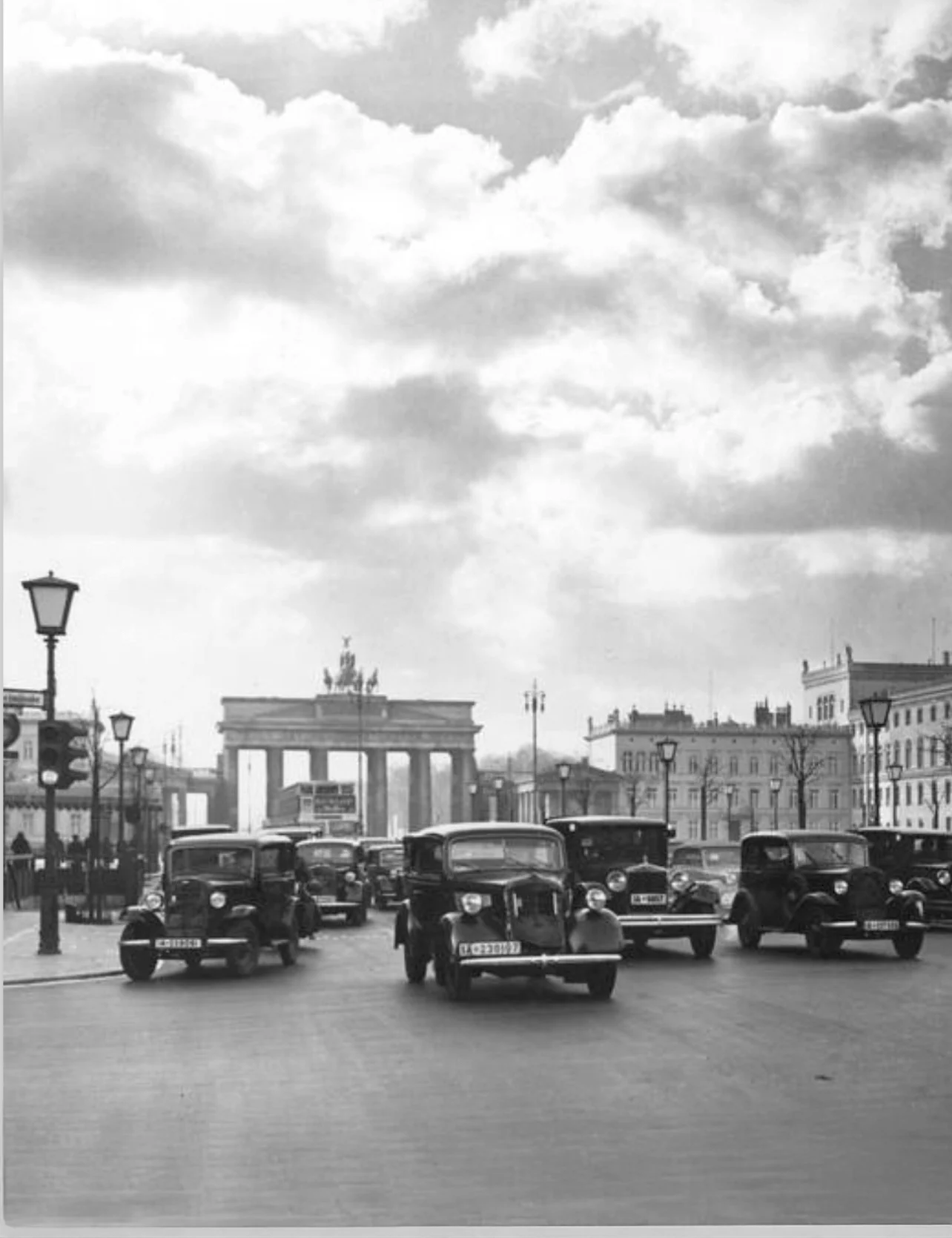
What inspired me to write this was a German documentary from 1936 about Berlin’s preparations for the Olympic Games that year.
What a country they destroyed!
Germany was truly magnificent then. The cars, the architecture, the economy!
A nation that gave the world highways, machine tools, electric turbines, highway interchanges, and the first rockets.
It was the engine of the world.
And all of this came only a short time after the First World War and the Great Depression, which had plunged Germany into poverty.
In short, there was progress—and then it all disappeared.
And the fascists and Hitler were responsible.
Before I left the hotel, Christina once told me something that stayed with me.
She said that if Germany had not murdered most of its Jews and burned them in the crematoria, and if those people had lived, then today it would not be America wearing the crown of the world. Germany would be leading the world instead.
After all, she said, so much of what America takes pride in today was created by German Jews.
Can you imagine what emotions were boiling inside me—in my Jewish heart—when I heard those words?
Yet despite everything, we parted as close friends, embracing like family before saying goodbye.
And at the very end I told her that it was a shame the examiner in Vienna had not been Jewish.
Because if he had been, perhaps his big Jewish heart would have taken pity on the struggling young Hitler and given him a chance to become a mediocre artist.
And then Christina would not have been crying in America all those years later.
After that, Christina and I were swept away by the currents of our own lives and lost touch completely.
Christina, if you happen to read this, get in touch!
GEORGI GAVRIELOV
ATLANTA
This was translated from Russian to English and lightly edited.