Argentine composer Federico Beilinson wins Lincoln Center prize for a work that premiered in Baku, the city his grandfather left in 1924
When Federico Beilinson walked onto the stage at Lincoln Center to accept second prize for Oğlan, he carried with him a story that began more than a century ago on a train out of Baku.
Beilinson, an Argentine composer and guitarist whose paternal grandfather was born into a Jewish family in Baku, received second prize at the Fifth International Composers Competition, organized by the National Music and Global Culture Society (NMGCS).
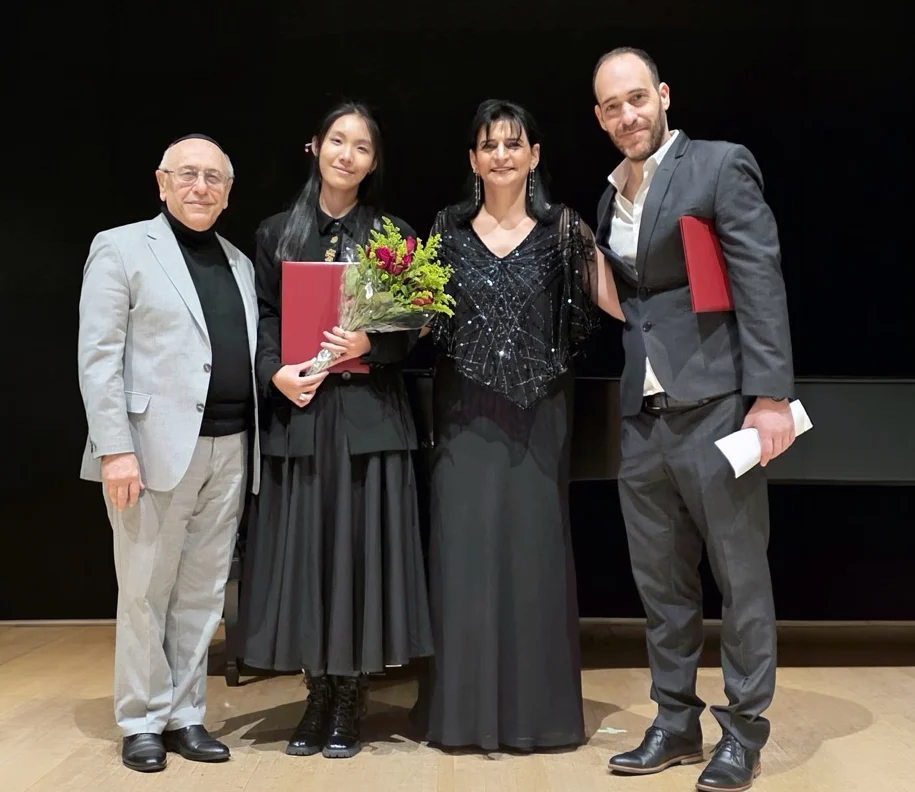
His award-winning composition, Oğlan, was performed on October 6 at Bruno Walter Auditorium at Lincoln Center in New York, where Beilinson attended the gala concert and award ceremony.
The event brought together musicians, composers, and cultural representatives from around the world to celebrate Azerbaijani music and the rich musical heritage of Turkic peoples.
For Beilinson, however, the recognition carried a deeply personal significance.
His grandfather was born in Baku and emigrated to Argentina with his family in 1924, traveling by train to France before boarding a ship bound for Buenos Aires. More than a century later, Beilinson’s award-winning composition received its world premiere in the very city his grandfather had left behind.
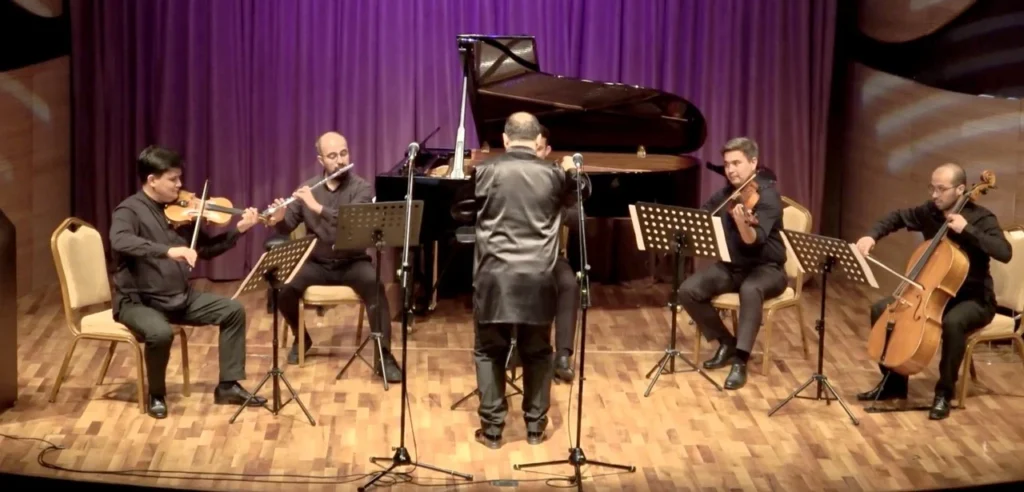
The piece, inspired by elements of traditional Turkish music, premiered on September 25, 2026, at the Üzeyir Hacıbəyli International Music Festival in Baku before being performed in New York.
“When I composed Oğlan, I never imagined that its world premiere would take place in Baku,” Beilinson recalled in a personal essay. “The piece is not connected to my family history, but the fact that my music was first heard in the city where my grandfather was born, just over a century after he left for Argentina, was an extraordinarily meaningful coincidence.”
A MUSICAL INHERITANCE
Born in Argentina in 1981, Beilinson grew up surrounded by music. His grandfather played a particularly important role in nurturing his musical interests, regularly taking him to concerts and operas at the renowned Teatro Colón in Buenos Aires.
Those childhood experiences left a lasting impression. His grandfather also encouraged him to pursue music professionally and lived to witness the beginning of his career.
Years later, Beilinson discovered a collection of family documents that included the original train and ship tickets from his grandfather’s 1924 journey to Argentina.
The discovery inspired him to compose Bakú Buenos Aires 1924, a work for string quartet and guitar that traces his family’s migration from Azerbaijan to South America.
Trained primarily as a guitarist, Beilinson draws on Argentine folk traditions and contemporary classical composition in his work. His repertoire includes music for guitar, chamber ensembles, and orchestra.
In 2025, he won first prize at the Portus Apostoli International Composition Competition in Spain for Cuatro historias gallegas, a composition for solo harp and string orchestra.
His latest international recognition has also reconnected him with his ancestral homeland.
“In a way, I feel that music allowed me to forge a new connection with that part of my family’s history,” he reflected. “It also reminded me how much my grandfather had to do with the path I chose as a musician.”
CELEBRATING MUSIC ACROSS CULTURES
The 2026 competition attracted participants from 19 countries across five continents. Since its inception, the competition has brought together composers from more than 45 countries, resulting in approximately 150 new musical works.
It was organized by NMGCS under the leadership of its president, Nargiz Aliyarova, an Honored Artist of Azerbaijan and accomplished pianist, with support from Azerbaijan’s State Committee for Work with the Diaspora.
The jury was chaired by Pulitzer Prize-winning American composer Melinda Wagner, alongside Reiko Füting, chair of the composition department at the Manhattan School of Music, and Azerbaijani composer Elmir Mirzoyev.
First prize went to Shafag Alijioglu of Türkiye, while Beilinson received second prize and Xun Wang, representing China and the United States, took third.
The October 6 gala featured performances of the winning compositions alongside musical works from Azerbaijan, Kazakhstan, Kyrgyzstan, and Türkiye.
Among those attending were representatives of New York’s Central Asian communities, including a delegation from the Uzbek organization Mahalla USA, led by its president, Abdumalik Ahmedov, as well as members of the Kyrgyz community.
The evening also included the presentation of the Critics’ Choice Award from the Ishak Mavashev Foundation to Turkmen composer Rovshen Nepesov.
CONNECTING NEW YORK AND BUENOS AIRES
Following the concert, Rafael Nektalov, editor-in-chief of The Bukharian Times and executive director of the Mavashev Foundation, met with Beilinson.
Their encounter highlighted the enduring cultural connections among Jewish communities whose histories span Azerbaijan, Central Asia, and the wider diaspora.
For Nektalov, the meeting also presented an opportunity to envision future cultural exchanges between Jewish communities in North and South America.
“In future we want to organize a Bukharian Jewish festival in Buenos Aires, and our English Editor, Erin Levi, who speaks Spanish, will be with me,” said Rafael Nektalov.
Such an initiative would introduce audiences in Argentina to the music, traditions, and cultural heritage of Bukharian Jews while strengthening ties between communities separated by geography but connected through shared history.
By Erin Levi
The Bukharian Times English Editor