
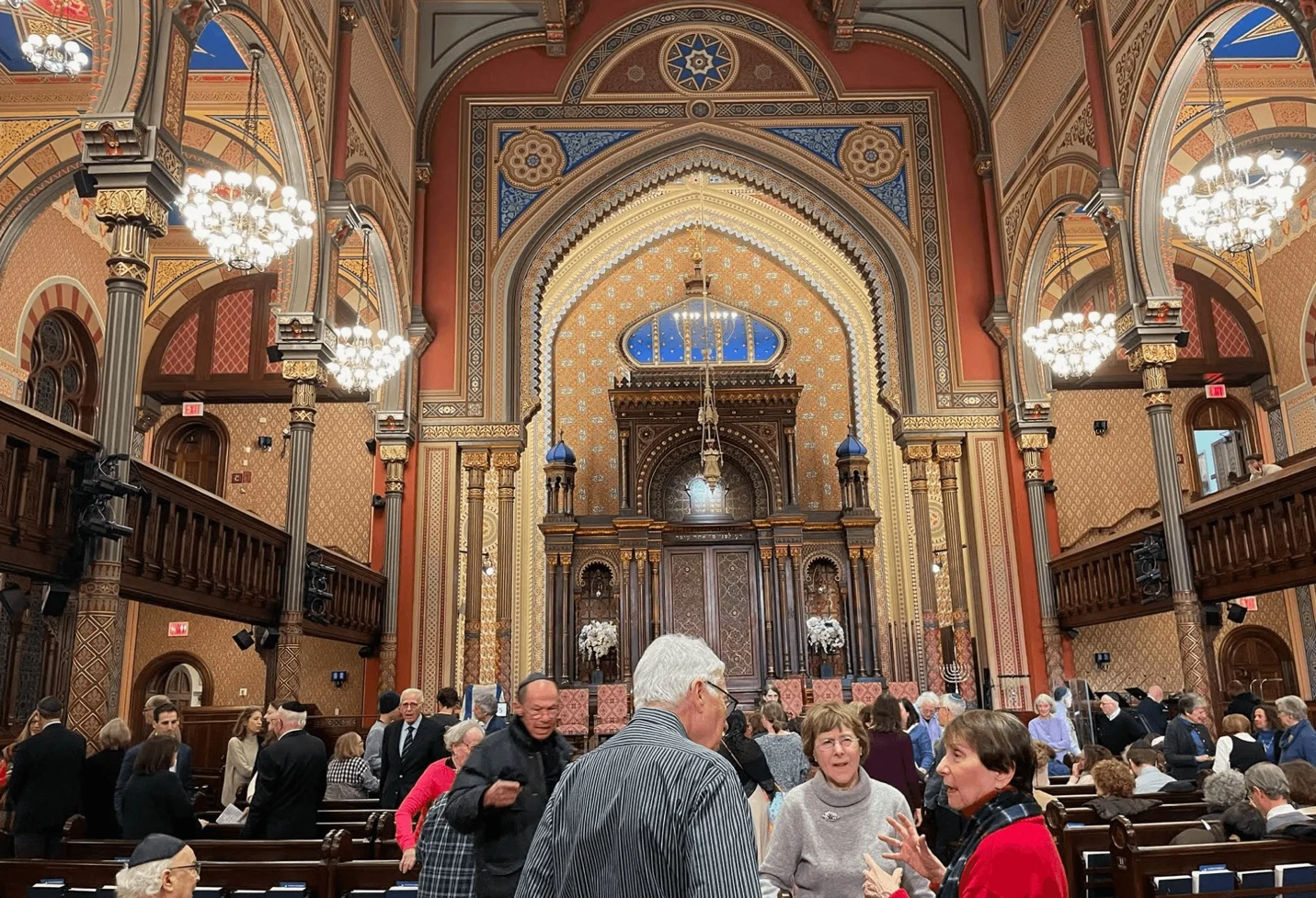
I don’t often go to synagogue. Outside of the High Holidays, it is not somewhere I would ordinarily find myself on a Friday night.
In the last few years, I have made a point of spending Shabbat with my grandmother. We light candles, eat together and let the week recede for a few hours. I don’t see it as an obligation so much as the comfort of doing something that has been done before, by people I love, in a rhythm that existed long before I did.
And yet, synagogues have a strange way of finding me when I need them.
Last summer, while travelling through Europe to visit two of my closest friends, I found myself in London, exhausted from weeks of constant movement. I happened to walk past a synagogue and realized that Shabbat was the following day. I reached out and asked if I could join their services. I remember thinking that perhaps this was exactly what I needed: a few hours to sit still, focus, and breathe.
And I was right.
There is something uniquely grounding about entering a synagogue in an unfamiliar place and discovering that the ritual is familiar. You may be thousands of miles from home, surrounded by people you’ve never met, but you know when to stand. You recognize the melodies. You open the same prayers. You know that somewhere else in the world, other Jews are doing some version of the same thing.
So when, only a few days after moving to New York, I was connected with a member of Central Synagogue through a potential landlord and they invited me to join them for Shabbat services, I thought: Why not?
I had just arrived in a city where I was beginning a new job at the Forward, a new life, one that, for the first time, was entirely mine to shape. That is a daunting task. What better way to spend my first Friday night than doing something that has always made the unknown feel a little more manageable.
Moments after services began, I was sitting in the sanctuary, allowing myself to take in the week that had just passed — my first week in New York — when a man entered and began moving violently through the congregation.
He knocked down the Shabbat candles that had just been lit. He moved through the rows of congregants. I watched him strike another person.
People around me ran toward the sides of the sanctuary. My own body went into the same instinctive state of shock and survival: Where is the danger? Where can I go? What do I need to watch for?
The security response was swift. The intruder was stopped, we re-lit the candles, and services continued.
Those around me who knew I was new to the synagogue immediately went into protection mode. They checked on me, expressing disbelief that something like this could have happened there, especially given the level of security they pride themselves on maintaining. They told me that in the nearly three years since October 7, nothing like this had happened.
The clergy, too, seemed to understand what the moment required. They gave us strength and courage, using the same voices that had moments earlier been leading us in song and prayer to restore some sense of calm. Throughout the service and again afterward in their online response, they returned to the same idea: it was our duty to keep joy alive.
Joy, one of the rabbis said, is itself an act of resistance.
I understood the sentiment. But my body hadn’t quite caught up.
Shabbat is one of the rare times when I allow myself to become completely uninhibited. I sing. I look up from the prayer book. I watch the rabbis and the people around me. I let myself become absorbed in something larger than whatever has been occupying my mind that week. For a few hours, I am not thinking about work, or apartment hunting, or navigating a new city. I am simply there.
That is also why the disruption was so jarring. I had come to Shabbat to let my guard down, and suddenly I found myself unable to do so.
I kept my eyes toward the front of the room, watching for movement. When it came time to turn around during Lecha Dodi, I felt a jolt of anxiety at the thought of putting my back toward the congregation. I could no longer surrender myself completely to the moment and what it required of me. I knew, rationally, that the threat had passed. But my body had learned something different: that even here, even now, even in this room, I might need to be ready.
For a moment, I considered leaving. But the people around me seemed to embody a quiet confidence that everything was going to be okay. They had chosen to stay, and I followed their lead. There is a certain strength in knowing that you are not standing alone.
I had come to Central Synagogue because I wanted to feel at home in my new city. Instead, on my first Shabbat in New York, I was reminded how quickly the simple act of practicing Judaism can become an exercise in vigilance. And yet, looking around the room that evening, I also understood that vigilance does not have to mean retreat.
By Elia Gross
Forward