After completing the prestigious Digital Storytellers Lab fellowship, the creator of Bukharian Bites reflects on using food, family, and storytelling to preserve Bukharian Jewish heritage.
An Opportunity I Could Not Pass Up
One day in April 2025, while scrolling through Instagram, I came across an advertisement that made me stop and click.
The Digital Storytellers Lab, one of two signature fellowships of the Jewish Writers Institute, is a project of the Maimonides Fund that supports creators telling compelling and authentic Jewish stories through film, television, and digital media. The yearlong fellowship offers funding, mentorship, creative workshops, Jewish learning, and a community of peers, along with immersive gatherings in Los Angeles, New York, and Israel.
I read the description and immediately thought about Bukharian Bites.
It felt like exactly the kind of opportunity I had been hoping for: the time, resources, mentorship, and creative community to help transform an idea into something much larger. I knew I could not pass it up.
Bukharian Bites had already become an important part of my life. What began as an idea in 2023 came to life on Instagram in 2024 as a platform to share Bukharian Jewish cuisine, culture, and the stories behind the food. Along the way, my writing also found a home in The Bukharian Times, allowing those stories to reach readers within the very community that inspired the project.
But I wanted to understand how far Bukharian Bites could go. I did not want our cuisine to remain something known only inside Bukharian homes or recognized only by those who grew up around it. I wanted to show the world what had been sitting on our tables all along.
This fellowship felt like the chance to do exactly that.
Following my acceptance into the Digital Storytellers Lab, Bukharian Bites expanded beyond Instagram to TikTok, YouTube, and Substack, giving the project new ways to reach audiences and tell Bukharian stories in greater depth.
Food Was Always the Doorway
Bukharian Bites began with food, but it was never just about food.
Behind every kazan of plov, every samsa pulled hot from the oven, and every table crowded with family is a much larger story about Jewish life in Central Asia—a story about migration, hospitality, survival, adaptation, and the stubborn refusal to forget where we came from.
A plate can tell you quite a bit if you are willing to pay attention.
It can tell you which ingredients were available. It can reveal the influence of neighboring cultures. It can show how families stretched what little they had and transformed it into something worthy of a celebration. Most importantly, it can carry the memory of people who may no longer be here to tell the story themselves.
Through the fellowship, I learned to look beyond what was on the plate and ask what the plate was trying to say.
Reaching Beyond the Jewish Community
As the project reached people beyond the Jewish community, I began to see that Bukharian cuisine did not need to be simplified to be appreciated. It simply needed to be presented with honesty, context, and a willingness to invite people in.
One of my greatest goals has always been to introduce Bukharian cuisine to the wider world. But I realized that mission began much closer to home.
As I explained our traditions to my young nieces and nephews, I found myself describing why Mohibir’yon—fried fish served with a sharp garlic-and-cilantro sauce—traditionally opens our Friday night Shabbat dinner. I told them about Osh Savo, our answer to cholent or hamin: a sweet-and-savory mixture of rice, meat, vegetables, and dried fruit left to cook slowly overnight and eaten for Shabbat lunch.
These were not simply recipes. They reflected the rhythms of our Jewish lives and the traditions that made Bukharian Jews distinct from our neighbors in Central Asia.
As I explained these customs, I realized how easily they could disappear if they were not documented, shared, and made part of the larger conversation. Bukhori, our language, is already endangered among the younger generation. I did not want our cuisine to follow the same path.
That realization gave Bukharian Bites a greater purpose. I wanted to introduce our cuisine to the wider world, but I also wanted to preserve it for the generations that would come after us.
The Digital Storytellers Lab helped amplify Bukharian Bites beyond the audience I had originally imagined. It gave me the tools and confidence to speak not only to Bukharian Jews or the broader Jewish community, but also to people who had never heard the word «Bukharian.»
That meant learning how to provide context without turning every story into a history lesson. I wanted viewers to understand our traditions while still feeling the warmth, humor, and humanity behind them.
Someone may not know the history of Bukharian Jews. They may not speak Bukhori or recognize the name of a dish. But they understand the smell of a childhood kitchen. They understand a grandmother refusing to let anyone leave hungry. They understand the way food can return you to a time and place you thought you had forgotten.
Food creates that bridge.
The fellowship helped me build it.
Collaborations That Expanded the Story
The fellowship encouraged me to leave the comfort of working alone and collaborate with people whose perspectives could expand the project.
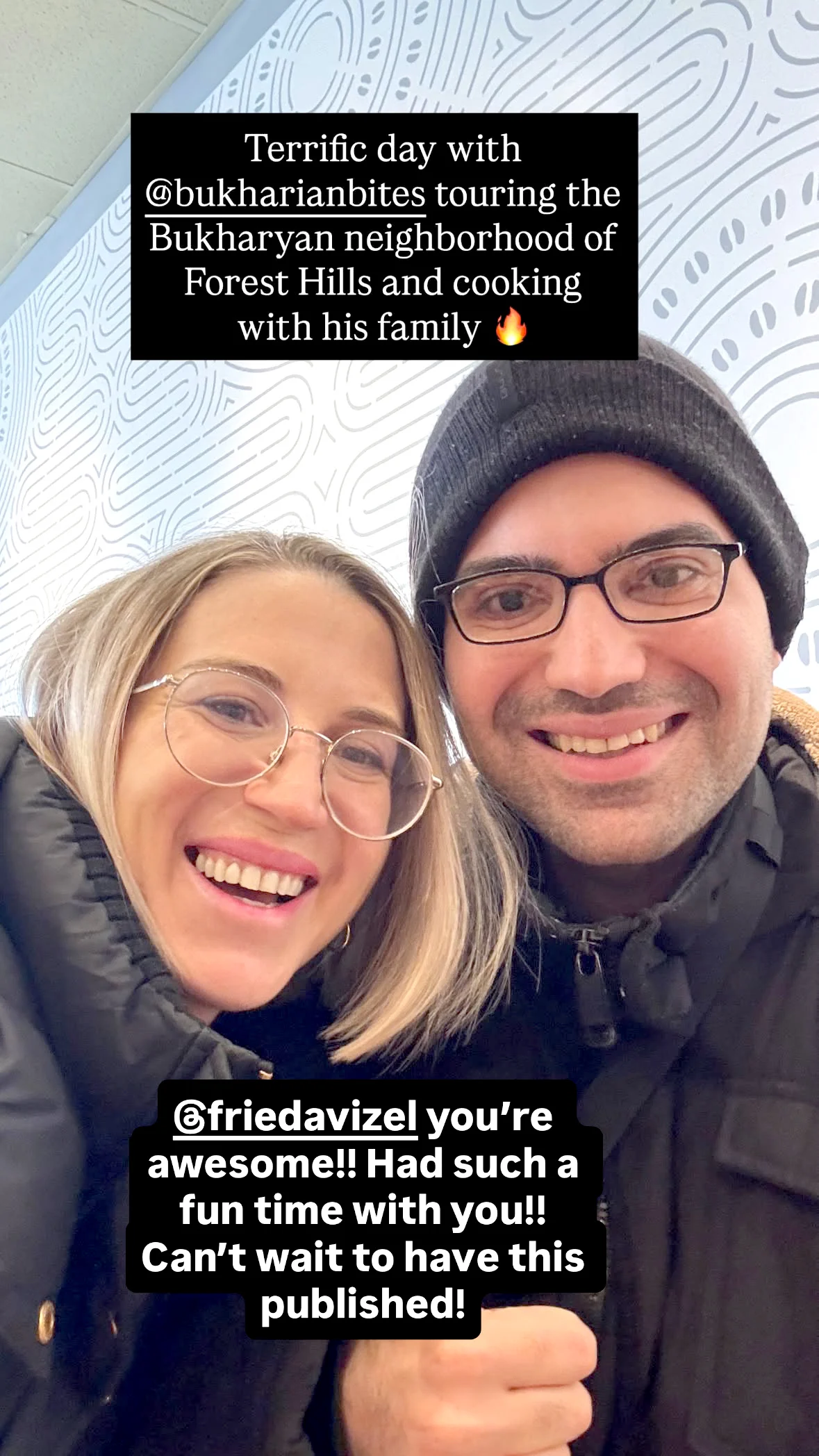
One of those collaborators was Frieda Vizel, a Brooklyn tour guide and digital storyteller whose YouTube videos, essays, and walking tours explore Hasidic life, food, customs, and community. Frieda had been part of the Digital Storytellers Lab cohort the year before mine, making our collaboration feel like a natural extension of the fellowship community. Together, we explored Forest Hills and shared aspects of Bukharian Jewish life, including hushquiliq, the traditional Chanukah pastry.
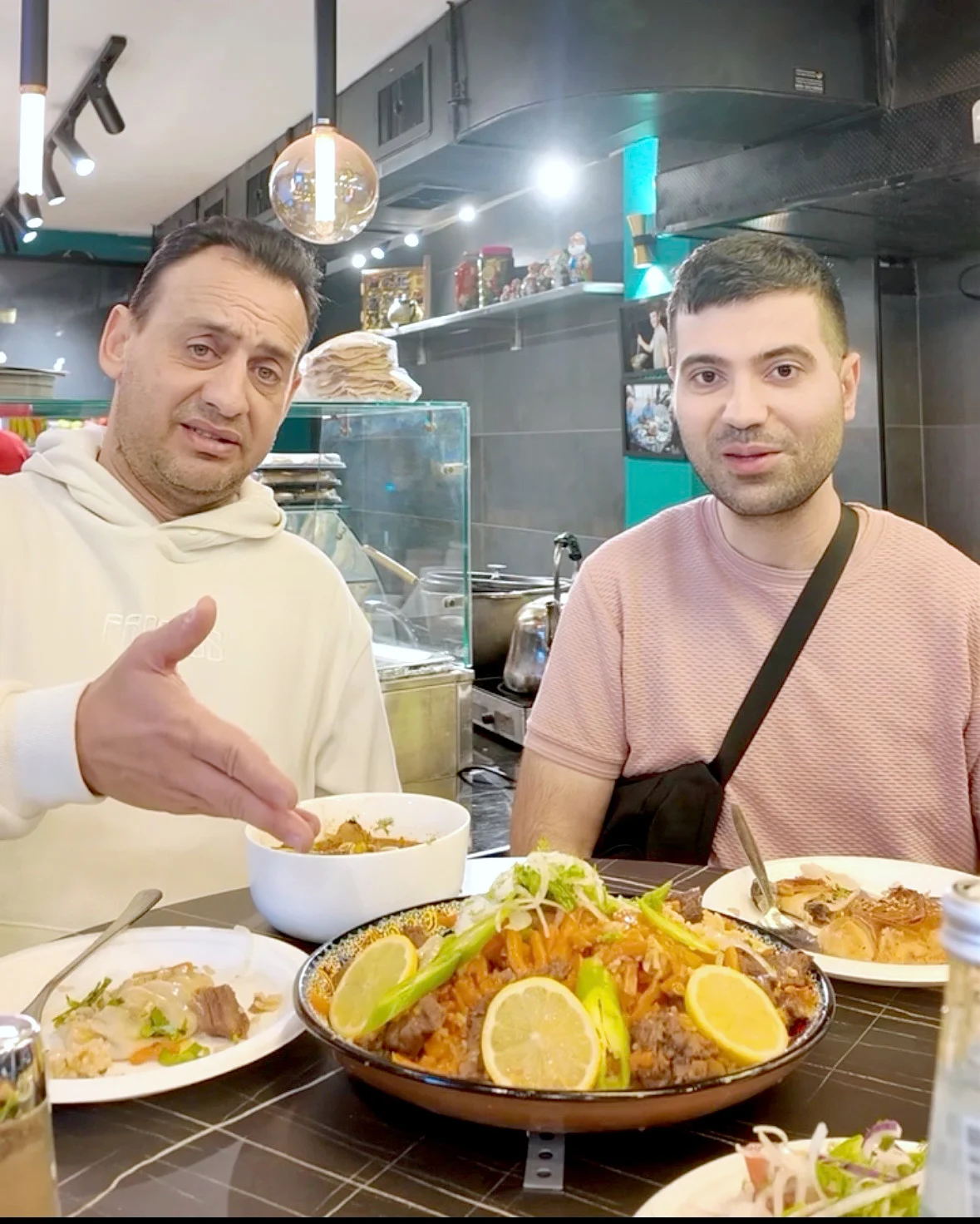
During some free time at the Israel convening, I had the opportunity to film with Israeli actor and comedian Hay Davidov at Ma’tamei Bukhari, a Bukharian street-food spot in downtown Tel Aviv whose name fittingly translates to «Bukharian Bites.» Over samsa, manti, and, of course, plov, we talked about Bukharian food, identity, and Hay’s upcoming comedy show in New York.
It was exactly the kind of exchange I hoped the project could create: two Bukharian Jews meeting across continents and connecting through food, humor, and a shared culture. The conversation was filmed as part of Bukharian Bites and can be viewed on the project’s Instagram page.
I also became more intentional about filming with chefs, elders, family members, and others who carry pieces of Bukharian culture within them. The goal was never to place myself at the center of every story, but to create a space where our community’s voices, recipes, memories, and humor could be preserved and shared.
The fellowship taught me that collaboration is not about giving up control. It is about opening another window into the same world.
Learning to Think Like a Storyteller
Throughout the year, from summer 2025-2026, workshops, monthly virtual sessions, creative milestones, and conversations with mentors challenged me to become more deliberate about my work.
I began thinking carefully about language. How could I explain something unfamiliar without removing what makes it special? How could I reach a broader audience while remaining authentic to my own community? How could I make a short video entertaining while still leaving the viewer with something meaningful?
I also learned to think across platforms, strengthen my scripts and voiceovers, develop clearer creative goals, and use audience engagement more intentionally. I was later invited to present what I had learned about using Instagram Stories to create a stronger relationship with viewers.
These may sound like technical lessons, but they changed the way I approached Bukharian Bites. I stopped thinking only about the next post. I began thinking about the larger body of work I was building.
Every video became another piece of a cultural archive.
Los Angeles, New York, and a Community of Creators
The in-person convenings in Los Angeles and New York gave the fellowship a life beyond computer screens.
There is something powerful about entering a room filled with people who also feel responsible for telling Jewish stories. The projects were remarkably different—comedy sketches, animated series, video games, and short-form sitcoms—but everyone understood that storytelling could preserve something that might otherwise be overlooked or lost.
The New York showcase, held in June 2026 at the Marlene Meyerson JCC Manhattan on the Upper West Side, was especially meaningful. By day, I work as a master barber, a profession built around people, conversation, and community. Bukharian Bites began as the creative work I pursued outside the barbershop, which made standing on that stage and presenting it as a serious cultural project feel even more meaningful. What had started as an idea online was now being seen, discussed, and recognized in a room filled with creators, mentors, and supporters.
The workshops gave me practical tools, but the people gave me momentum.
I am deeply grateful to my mentors for challenging my ideas, sharpening my vision, and refusing to let me settle for work that was merely «good enough.» I am equally grateful to the other fellows. Their creativity, honesty, and encouragement pushed me to exceed my own expectations and achieve more than I imagined when the year began.
Creative work can become lonely. This fellowship made it communal.
Israel: The Greatest Highlight
Of every experience the fellowship gave me, Israel was the greatest highlight.
The eight-day Israel convening in February 2026 was an immersive part of the Digital Storytellers Lab, bringing our cohort together for Jewish learning, cultural exploration, meetings with Israeli creators, and dedicated production time for our own projects.
It was also my first visit to the Holy Land.
For most of my life, Israel had existed through prayer, history, family conversations, and stories. It was a place I knew deeply without ever having seen it for myself.
My wife and children traveled with me separately, giving the experience an even deeper meaning. My wife was born in Israel but had not returned in twenty years. For me and our children, it was our first visit. I was experiencing the Holy Land for the first time as she returned to the place of her birth.
Watching my children walk through Israel, hear its sounds, meet its people, and begin forming their own connection to the land was something I struggle to put into words. As a father, I was not simply visiting Israel for the first time. I was watching my children inherit something I never had the opportunity to experience at their age.
Throughout the convening, we met Israeli storytellers working across food, television, comedy, music, and digital media. I was especially inspired by Polina Fradkin of the Shvesters, the Yiddish vocal duo she formed with Chava Levi. Their contemporary interpretations of traditional Yiddish songs showed me that preserving Jewish culture does not mean freezing it in time. Heritage can be carried forward by presenting it in ways that resonate with new generations—a philosophy that deeply aligned with what I hope to accomplish through Bukharian Bites.
Food remained my own doorway into those stories. New York Times bestselling cookbook author Adeena Sussman led our cohort through Tel Aviv’s Carmel Market, introducing us to the ingredients, vendors, and communities that shape Israeli cooking. At the offices of Keshet, we met the actors, writers, and producers behind Eretz Nehederet, Israel’s long-running satirical sketch-comedy program, and saw how humor can help a society process its joys, challenges, and current events.
During one of our production periods, I filmed with actor and comedian Hay Davidov before joining the cohort for dinner at Samarkand, a Bukharian restaurant in Tel Aviv-Yafo. Until then, nearly every Bukharian meal I had eaten outside my family’s home had been in New York. Here I was, halfway around the world, eating the familiar dishes of my childhood in Israel.
The food was unmistakably Bukharian, yet it tasted different. The herbs were brighter, the flavors fresher, and the dishes seemed to carry the same language with a different accent. Truthfully, some of it tasted even better than what I had eaten in New York.
It was more than a memorable meal. It showed me that Bukharian Jewish cuisine had not merely survived migration. It had taken root in another Jewish homeland while remaining unmistakably itself. Sitting there with my fellow creators, I realized I was not simply documenting Bukharian food. I was witnessing how our culture continues to live, evolve, and flourish in different corners of the Jewish world.
The fellowship helped me understand that we were not simply touring Israel. We were learning how Israeli creators use food, humor, music, television, and digital media to tell Jewish stories—and how those lessons could strengthen our own.
From the moment I arrived, I felt welcomed. There was a familiarity I could not logically explain, as though I had returned to a place I had somehow always known.
Israel did not make me feel like a visitor.
It made me feel as though I had always belonged.
Jerusalem and My Transformation at the Kotel
Jerusalem affected me differently from anywhere else.
The city does not feel like a museum where history has been placed safely behind glass. History is under your feet, above your head, and built into the stone surrounding you. Every street seems to carry the footsteps of someone who came before.
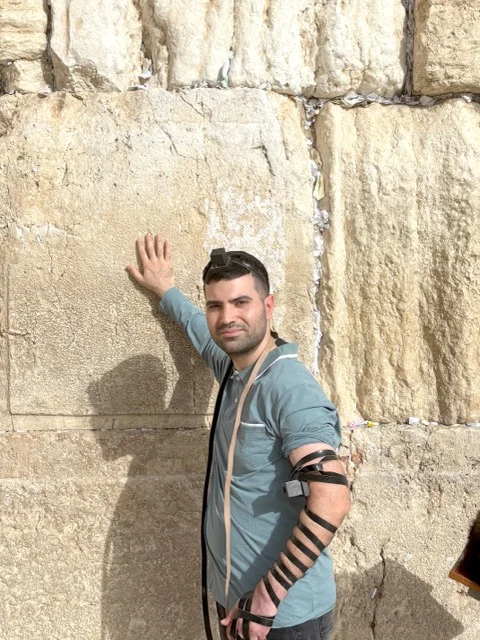
At the Kotel, I experienced something transformative.
I approached the Wall carrying everything a person carries through life: gratitude, responsibility, ambition, fear, family, and the prayers that remain private because ordinary language cannot hold them.
Then I placed my hand against the stone.
In that moment, Judaism no longer felt like something I only practiced, studied, inherited, or explained. It felt alive in front of me. I felt more connected to Judaism than ever before.
I thought about the generations of Jews who faced Jerusalem in prayer but never had the chance to stand where I was standing. I thought about my ancestors, my family, and my children beside me. I thought about how many people had whispered their hopes into those same stones.
You arrive at the Kotel believing you are visiting a place.
Then you realize the place has been waiting for you.
I did not leave Jerusalem as the same person who entered it.
The connection was no longer theoretical. It became physical, emotional, and deeply personal.
Tel Aviv, Jaffa, and the Shuks
Israel also became part of the creative journey of Bukharian Bites.
I experienced Tel Aviv, Jaffa, Old Jaffa, and the shuks, meeting people, tasting food, listening to stories, and exploring the relationship between cuisine, place, and Jewish identity.
Old Jaffa offered another side of Israel. Its ancient stone passageways opened toward the sea, carrying the evidence of centuries of travelers, merchants, conquerors, and ordinary people who had all passed through before us. Nearby, Tel Aviv moved at an entirely different speed: modern, restless, creative, and alive.
Then there were the shuks.
Markets reveal a country in a way that monuments cannot. They are noisy, crowded, impatient, generous, and alive. Vendors call out. Spices hang in the air. Someone insists that you taste something. Another person tells you that you have been eating it incorrectly your entire life.
This is where culture breathes.
Experiencing these places reinforced a lesson that stayed with me throughout the fellowship: food cannot be separated from the people who make it, the places where they live, or the history they carry.
A recipe is never merely a list of ingredients. It is geography, movement, memory, and identity served on a plate.
Kfar Aza and the Nova Festival Memorial
Not every part of the journey was joyful.
Visiting Kfar Aza and the Nova music festival memorial site forced us to confront the terrible atrocities of October 7 in a way that could never be understood through a screen.
At Kfar Aza, the silence carried its own weight. Knowing what had happened there, and thinking about the lives, families, and sense of safety that were brutally taken, was devastating. It was no longer a distant news story or another image passing across a phone. We were standing where human beings had lived ordinary lives until terror entered their homes.
The Nova festival memorial was equally emotional.
The photographs of the young people murdered and taken hostage gave faces to a tragedy that can otherwise become buried beneath numbers. These were people who had gathered to dance, celebrate, and live. Standing there, surrounded by their images, the scale of the loss became painfully personal.
There are places where words feel inadequate.
Kfar Aza and the Nova memorial were two of them.
Yet even in the shadow of that pain, I felt the strength of Israel and its people. I saw grief, but I also saw determination. I saw a country carrying wounds that were still open while continuing to welcome us with extraordinary warmth.
That welcome stayed with me.
It reminded me that belonging is not always something that needs to be explained. Sometimes you arrive somewhere for the first time and recognize it immediately.
Israel was that place for me.
I came as a visitor, but I never felt like one. I felt connected to its people, its pain, its joy, and its future.
I felt as though I had finally arrived somewhere I had always belonged.
From Food Content to Cultural Responsibility
By the end of the fellowship, I no longer saw Bukharian Bites as simply a social media page.
It has become a cultural storytelling project.
The fellowship did not change the heart of what I wanted to do. It amplified it. It helped me clarify my goals, expand my reach, collaborate with others, and understand how Bukharian stories could resonate far beyond our own community.
That growth became measurable. Over a recent 90-day period, Bukharian Bites generated nearly 200,000 views, reached close to 100,000 accounts, and connected with audiences in the United States, Israel, Canada, the United Kingdom, and beyond. Numbers alone do not tell the whole story, but they show that Bukharian cuisine is reaching people far beyond the homes and neighborhoods where it has traditionally been preserved.
It also gave me a greater sense of responsibility. Bukharian cuisine deserves to be known beyond the homes and neighborhoods where it has been preserved for generations. Our dishes tell the story of a people who carried Jewish identity across Central Asia, absorbed the flavors surrounding them without disappearing into them, and rebuilt their lives in new countries while continuing to gather around familiar tables.
That story deserves to be documented.
It deserves to be shared.
Gratitude and the Road Ahead
I remain deeply grateful to the Maimonides Fund for creating and supporting the Digital Storytellers Lab. Opportunities like this do more than fund individual projects. They give creators permission to think bigger about whose stories matter and who deserves to tell them.
I am grateful to my mentors for their guidance, patience, honesty, and belief in what Bukharian Bites could become. I am grateful to every fellow who shared ideas, offered encouragement, and pushed me to exceed and succeed. Their work inspired me to raise the standard of my own.
Most of all, I am grateful that this fellowship helped bring me closer to my original goal: showing the world the beauty of Bukharian cuisine and the Jewish people, memories, and traditions behind it.
The world is a very large table.
After this fellowship, I feel more prepared than ever to make sure Bukharian cuisine has its rightful place on it.
Abe Fuzaylov