
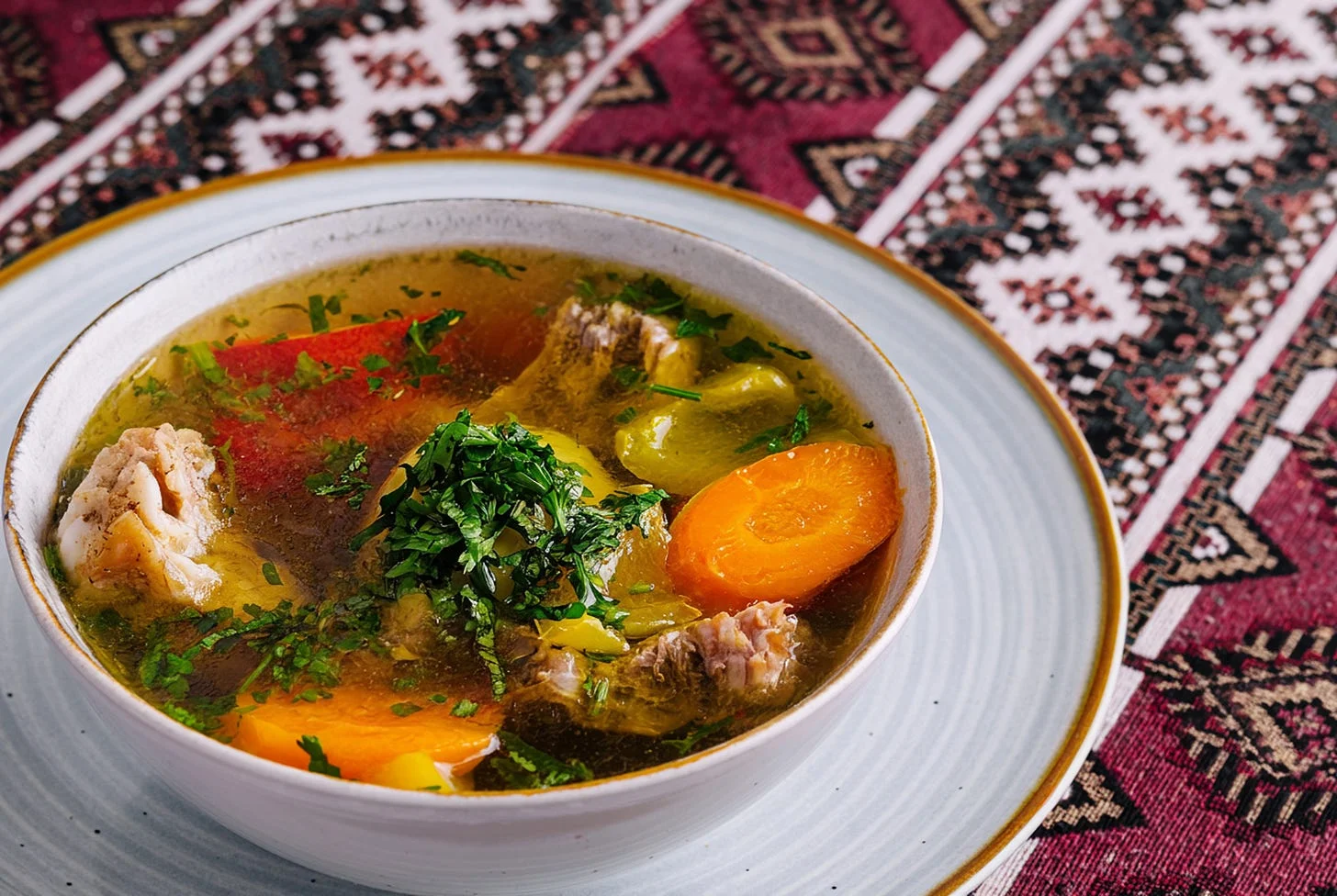
There are dishes that try hard to impress. Fancy techniques, ingredients from who knows where, plates that basically scream for attention. And then there’s shurbo, that quiet guest at the table who doesn’t need an introduction. It arrives without apology. No olive oil drizzle, no garnish choreography, no silly fusion nonsense. Just lamb, onion, water, and time. It’s the least Instagram-conscious soup in existence. Which already makes me love it more.
Growing up, I spent my weekends going to work with my father at his restaurant in South Brooklyn. Back then, late 90s, early 2000s, Uzbek and Bukharian cuisine in New York City still felt like a rumor someone brought over in a suitcase. It wasn’t a «scene.» There was no marketing strategy. No social media hype. Nobody was flying to Tashkent and coming back to post content about samsa. Uzbek/Bukharian spots then were raw, low-key, half-hidden, sometimes running on pure stubborn nostalgia more than actual profit.
I remember the smell inside those kitchens. A mix of roasted lamb fat, kebabs grilling over open coals, onions sweating on stovetops, cumin somewhere in a corner, and dough rising under a towel like a sleepy giant. The cooks were always yelling «qoch!» which basically means «move, get out of the way!» and they weren’t worried about being «fine dining.» They were just trying to keep things going. They were feeding a diaspora trying to re-root itself.
And in the middle of all that chaos, there was always a massive pot in the back, quietly simmering like it had nowhere else to be. Shurbo. You’d miss it if you didn’t know to look. It wasn’t flashy, it didn’t shout. But something about that pot pulled you in. The slow pulse of a homeland you couldn’t articulate but could definitely taste.
I was a kid, too small to lift anything but big enough to get in everyone’s way, wandering around with wide eyes like I was discovering another universe. The kitchen felt like a portal. One foot in Brooklyn, the other somewhere along the Silk Road.
Whenever shurbo was ready, I’d stand there with a kosa, a medium-sized soup bowl, in hand like some hungry street cat, waiting. First came the nakhot, chickpeas, always at the bottom. Then the chef would ladle that golden broth over them. Steaming, aromatic, lamb floating somewhere beneath the fog. Vegetables collapsing in slow motion. Shurbo always came with a piece of lepyoshka, our beloved flatbread, torn by hand, still warm, still breathing. And that was it. My entire world paused.
I didn’t know then what I know now, that I was watching a culture survive, reinvent itself, and quietly build a culinary identity in a city that didn’t see us yet. The 90s were not kind to foreign cuisines. But we carved out space anyway. One spoonful at a time.
This is that soup.
And I’m still that kid, just older, hungrier, and more grateful for what I didn’t understand back then.
INGREDIENTS (YIELDS 8–10 BOWLS)
BASE
• 3.4 LITERS WATER
• 1.4–1.6 LBS LAMB, BONE-IN (PREFERABLY THICK CUT RIBLETS)
• 1 WHOLE ONION, PEELED
• 8 WHOLE GARLIC CLOVES (IF SMALL), OR 4 LARGE CUT IN HALF (SO YOU GET 8–10 TOTAL PIECES)
• 3 BAY LEAVES
• ½ TABLESPOON WHOLE BLACK PEPPERCORNS
• 1 TABLESPOON SALT (TO START, ADJUST LATER)
VEGETABLES
• 3 CARROTS, LARGE CHUNKS
• 3 POTATOES, LARGE CHUNKS
• 2 BELL PEPPERS, DICED THICK
• 2 CELERY STALKS, LARGE PIECES (OPTIONAL)
• HANDFUL OF ALCHA (DRIED SOUR PLUMS), OPTIONAL
FINISHING
• SALT, BLACK PEPPER
• DILL (OPTIONAL)
METHOD
1. BUILD YOUR BROTH
Add lamb and water to a large pot. Bring it up slowly. Let the foam rise, it’s proof there’s something alive in there. Skim until the surface looks clean.
One of my IG followers, the «Bukharian Biters,» as I call them, sent me a recommendation for a stainless steel fat skimmer. It’s the kind of kitchen tool that saves you from babysitting the pot like an anxious parent. Use whatever you got, but trust me, that thing earns its keep.
Once skimmed, drop the heat. Add onion, garlic, bay leaves, peppercorns, and salt. Simmer one hour. If the water drops, don’t panic. Add a cup or two of hot boiled water to bring the level back. Shurbo should feel abundant.
2. TENDERIZE
Keep simmering 30–40 minutes more until the lamb just begins to surrender. Total time so far: about 1.5 hours.
3. ADD THE VEGETABLES
Carrots, potatoes, bell pepper, celery, and alcha go in. Let them soften, but don’t let them fall apart. Another 45–60 minutes. Taste. Adjust salt. Adjust life.
SERVING
Traditionally, the chickpeas go into your kosa first. They wait at the bottom like an audience before the show begins. Then ladle the shurbo on top, meat, vegetables, broth, all of it pouring over the chickpeas like a story being told.
Finish with dill if you like.
Serve with lepyoshka, torn by hand, because utensils sometimes get in the way of memory.
Some food asks for attention—shurbo just asks you to remember who you came from. And maybe that’s enough.
This was first published in Abe Fuzaylov’s Substack “Bukharian Bites.”
By Abe Fuzaylov