

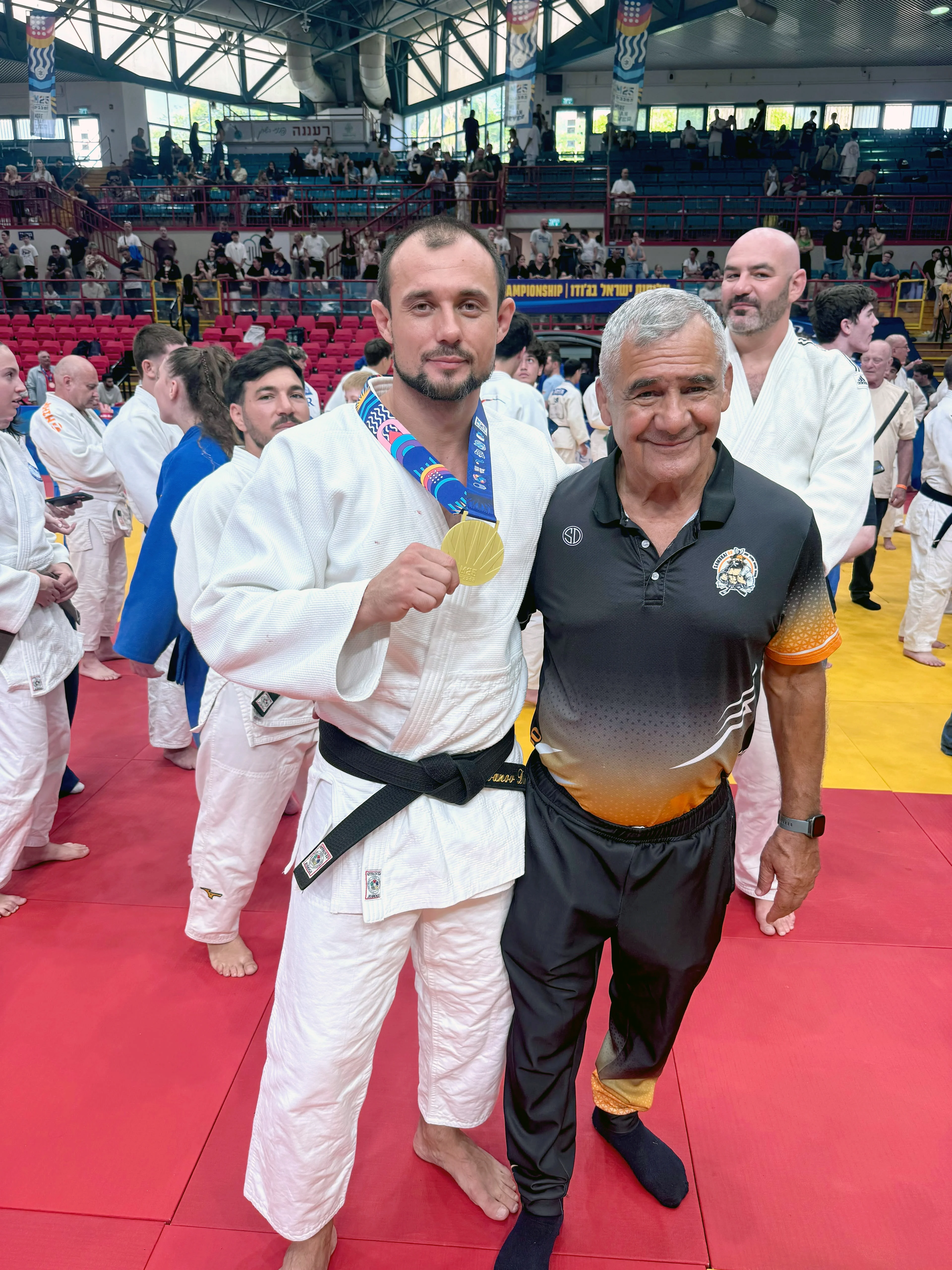
Dushanbe hosted the 2026 Sambo World Cup on September 19–20, where Israeli sisters Shaked and Rony Nisimian made their mark in combat sambo. Shaked, 23, claimed gold in the 72kg category, while Rony, 26, took silver in the 59kg division.
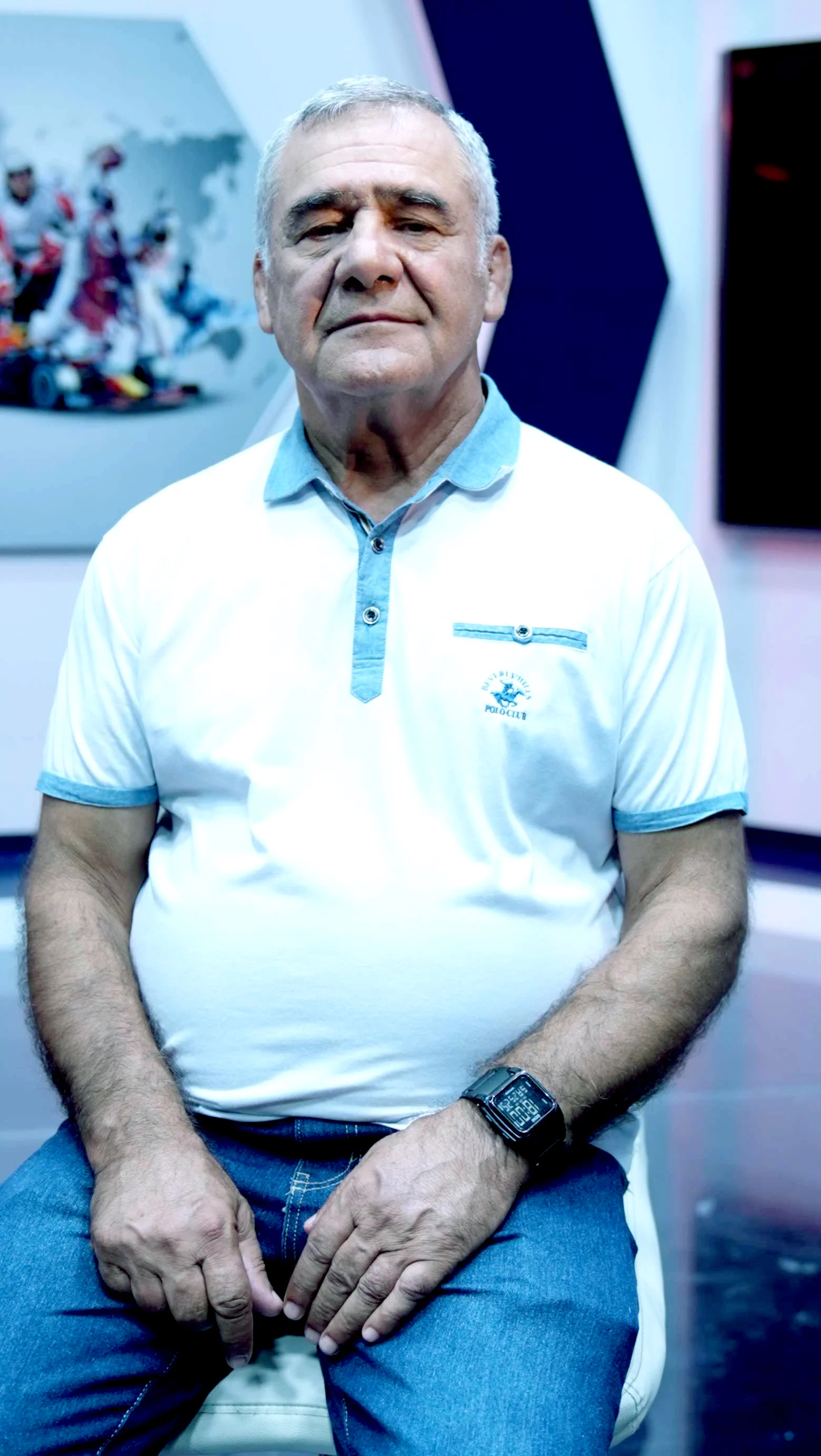
Behind their success is coach Edik Paltielov, a Dushanbe native and member of the Bukharian Jewish community who has spent decades developing sambo in Israel. Moishe Sabirov spoke with him about the sisters’ performances, the challenges facing Israeli sambo, and what it takes to build champions.
Moshe Sabirov: First of all, congratulations on the excellent result in Dushanbe. And what did you feel at the moment when it became clear that two athletes from Israel took gold and silver?
Edik Paltielov: What can I feel? Pride. It’s nice when you bring two athletes to a competition and both make it to the finals. To be honest, Rony could have taken gold but there she lost by chance. There in the last minutes she was striking and rushed in, wanting to do a turnover for a clean victory. I said, “Don’t go in, don’t go in!” She went in anyway. It’s good to make these mistakes at the Cup [and learn].
MS: You’re from Dushanbe, as I understand — how did your sambo career begin?
EP: I trained in sambo with Ismat Abdulaev. Then I entered the Institute of Physical Culture, graduated, and started working as a sambo coach.
MS: Can you briefly tell us about the athletes?
EP: They are sisters from Moldova. One of them won the World Games in sambo this year in China. The other only just started competing. It was her second competition.
Before this they did jiu-jitsu. The younger is a world champion, the older is also a vice world champion in jiu-jitsu. There they had some kind of conflict in the federation, and they moved to us. They’ve been with us already three–four years.
MS: Tell us about your school, when was it formed?
EP: The sambo school? Well, I came to Israel in 1990 and began coaching in 1991. And in 2004 I joined forces with Pavel Musin at his club in Rishon LeZion. We’ve been working together for more than 20 years.
MS: How many athletes do you have in the school?
EP: A couple thousand.
MS: For a small national team to reach two finals at once is a serious achievement. How much did this result exceed your expectations?
EP: We expected [Shoket to win] because she is a world champion. She took first place at the 2025 World Games in Chengdu. Rony, however, only just started. This was her second competition. She was fifth in the world in general sambo, in combat sambo.
MS: And she took second.
EP: To be honest, we didn’t expect it, but we foresaw that it could happen.
MS: What are your impressions of Tajikistan? How were you welcomed?
EP: I received a wonderful welcome. My former students met me at the airport [and looked after me throughout the competition.] They didn’t let me out of their sight.
MS: How did the preparation for the 2026 World Cup go? How many months did the athletes purposefully prepare specifically for this event?
EP: We prepared for about three months. To Tajikistan, there was supposed to be one more guy going, but something didn’t work out for him. He was somewhere at other competitions, it didn’t match with the flight, he didn’t make it, Oleg alone. And the girls prepared for about three months. We knew in advance that we were going to these competitions.
MS: What goals did you set for Shaked and Rony before the start of the competitions?
EP: For Shaked there was a specific task—to win. [She’s] a world champion after all. And for Rony it was to get into the top three at minimum.
MS: What was the hardest part about competing in Dushanbe?
EP: [Getting there. Because of some travel mishaps] we were a bit overstrained by the time we arrived. After the weigh-in we rested a little, and the next day we fought. Otherwise everything was fine.
MS: Were there moments in the final bouts when the course of the match could have changed literally in a few seconds?
EP: Shaked was [in control] from the first minute and won confidently. Rony, [on the other hand,] led the whole bout and in the last minute took a risk, [attempting a divisive throw that cost her the match.]
Tactically that was her mistake. When you’re winning, you need to hold a winning grip, not rush in and take risks. It’s the athlete who is losing who needs to take risks, not the one who is winning. But you learn from mistakes. This is not a world championship, it’s just a Cup. So it’s good that it turned out this way.
MS: Which part of her performance in Dushanbe was most memorable?
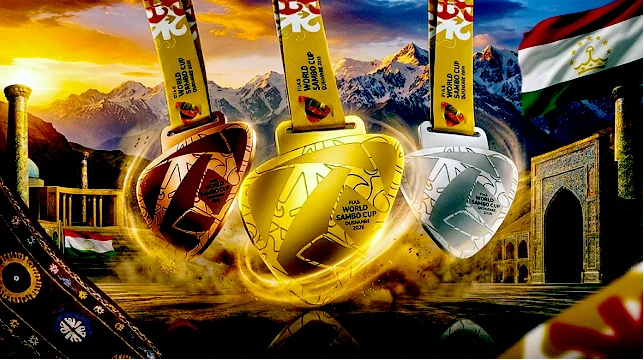
EP: Shaked fought intelligently and confidently throughout the competition, controlling her bouts and making no unnecessary mistakes. [You can watch it all on YouTube.]
MS: What do you say as Shaked’s coach after a victory? Do you ask her to enjoy the success or do you immediately start analyzing mistakes?
EP: [During a competition,] we don’t start analyzing victories because we need to prepare for the next bout. We review everything afterward.
MS: Shaked has repeatedly said that she wants to prove that a woman can be strong, athletic, and feminine at the same time. How important is this message for her career, do you think?
EP: Well, what she says, she does — in principle, a woman should be feminine, beautiful, and strong.
MS: And does Shaked feel responsibility for having become a role model for other girls in Israel?
EP: You have to ask her. I think she does.
MS: What, in your opinion, do viewers not see behind her medal? How much work, sacrifice, and worry are behind this victory?
EP: In Russian there is a saying: without labor you can’t even pull a fish out of the pond. Of course, there is work there, and not a small amount. A person works, trains, strives, achieves. If that were not the case, she would not have achieved anything.
MS: What ambitions does Shaked still hope to fulfill?
EP: She wants to become a two- or three-time world champion. Right now, she and Rony are preparing for the World Championships in Tashkent in November.
MS: May they take first place, Baruch Hashem. Now let’s talk about Rony. How do you assess her performance in Dushanbe?
EP: She performed very well. [She was leading in the final but] made a mistake in the last seconds. She said: “I wanted to win cleanly.” She was up by one point, it was possible, she was calmly leading and could have calmly won. But she wanted to make an extra move, although it wasn’t necessary. I hope [she won’t repeat this mistake next month in Tashkent.]
MS: I see. What especially impressed you in Rony’s performance?
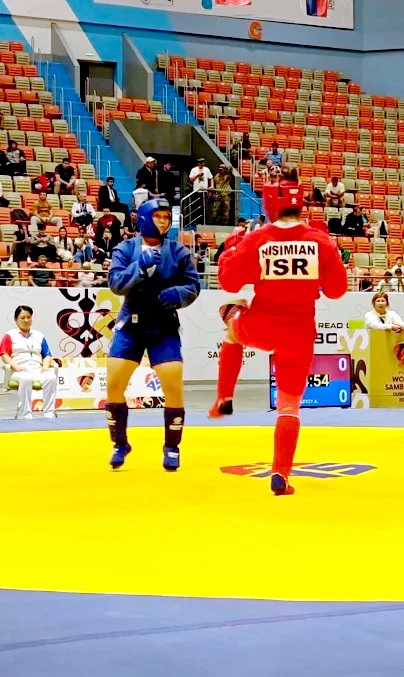
EP: The drive, the desire to show, to prove. She won the first bout well. She beat a Russian woman with an arm lock, she won the second bout against someone else, and in the third bout she fought a Belarusian in the final.
MS: How does Rony differ from Shaked in fighting style and character?
EP: Shaked joined us first and later she brought Rony. Shaked has more experience, [having competed] at the European level and the World Games. For Rony, this was only her second competition and her first in combat sambo. Experience is all that separates them for now. Rony will grind it out; [she has the potential to be just as successful.]
MS: Can they be called a sports tandem that can bring Israel medals for many years to come?
EP: I [think for another] two to three years they can bring medals. [But much depends on their motivation and whether they can secure sufficient funding and sponsorship.] These are serious athletes. [With the right resources], anything is possible.
MS: What are the nearest goals of Team Israel after the success in Dushanbe?
EP: Well, first of all, we had the Youth World Championship. We took two medals. It was held in Thessaloniki, in Greece. The guys just got back from there. Next there will be the Sambo World Championship in Tashkent in November for adults. The task is to win as many medals as possible.
MS: Which young athletes are now in the team’s reserve?
EP: I’ll tell you honestly, in Israel, sambo is not at the very best levels. There is youth, there are clubs that work, but we have few — three or four clubs in Israel that do sambo at all, the rest go to judo and so on.
MS: Do you have a personal coaching dream that you haven’t achieved yet?
EP: Without dreams, there would be no point in working. Of course there is a dream, a desire to achieve as much as possible. I’d like Israel to finish among the top three or four countries in the team standings. It’s hard to compete with the Russians. They have 50 times more teams there, if not 150 times more. In every city there is a sambo team. They hold training camps and competitions every two weeks, so they’re more battle tested. We have a handful of clubs. Competitions are infrequent. But we try — we try our best.
MS: Well yes, still you took such places, first places — that’s already, that’s a big success, it seems to me. So I congratulate you.
EP: Thank you.
MS: At what moment did you realize that you were coaching not just athletes, but the future history of Israeli sports?
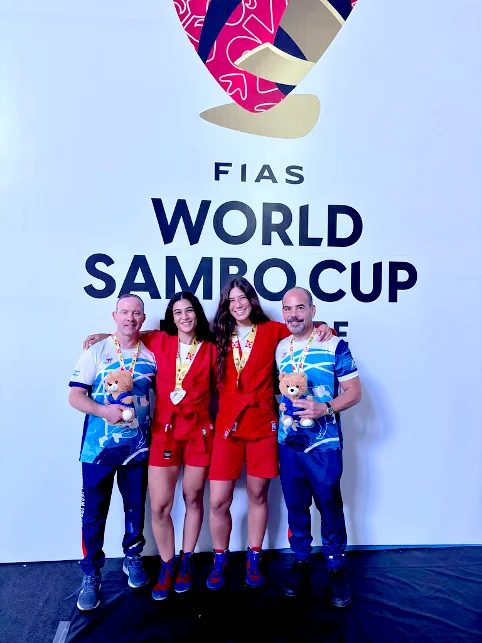
EP: First, I’m not the only one coaching, we have a whole team of coaches there. Pasha, me, Andrey, Sergey. Four coaches, five coaches, we work with the national team.
Second, at what moment did I realize?
Right away, as soon as they started training, we realized that we could make a champion out of Shaked. She started competing last year and excellently. Almost from the first competitions she started taking podium places. I took her last year to Kyrgyzstan. There she got knocked out the year before last. And after that she won the world championship. That is, a person who draws conclusions, tries and learns from her mistakes. She learned a lot, she added a lot. She has been training with us for about two years and has added a lot. The kid is trying, the athlete is trying, so to speak.
MS: What is strongest: the athlete’s talent, the coach’s work, or the team’s belief in itself?
EP: I think it’s a combination. [Without talent, even the best coaching can only do so much.] Talent is talent. Belief is also needed. If you don’t believe in yourself, you won’t beat anyone. These girls are fighters—they’re fearless, talented and hardworking. All of these qualities combined produce results.
MS: If you had the chance to address every girl in Israel who is afraid to start martial arts, what would you tell her?
EP: I’d say: try. Whoever doesn’t try won’t feel all this. You have to try, take a risk and strive. Effort and hard work will grind everything down. Even if you’re not a world champion, you will be more disciplined, healthier, you’ll know how to stand up for yourself.
Results are secondary. Whoever works hard will also have results, whoever won’t work hard — well, nothing, not everyone is born champions. As the Russian saying goes: “water doesn’t flow under a stone that lies still.” You have take action to make something happen.
MS: What words would you use to describe Shaked and Rony—as ordinary people?
EP: They are good, modest, talented girls, diligent, purposeful, goal-oriented. And what I can say is they very, very much want to achieve something in sports and in life.
MS: Who was the first to congratulate you after the final?
EP: My students who were sitting with me, watching the final.
MS: Thank you. Well, you are the pride of our Bukharian community. Thank you very much for your time.
EP: All right. Be well.
By Moishe Sabirov
Israel