
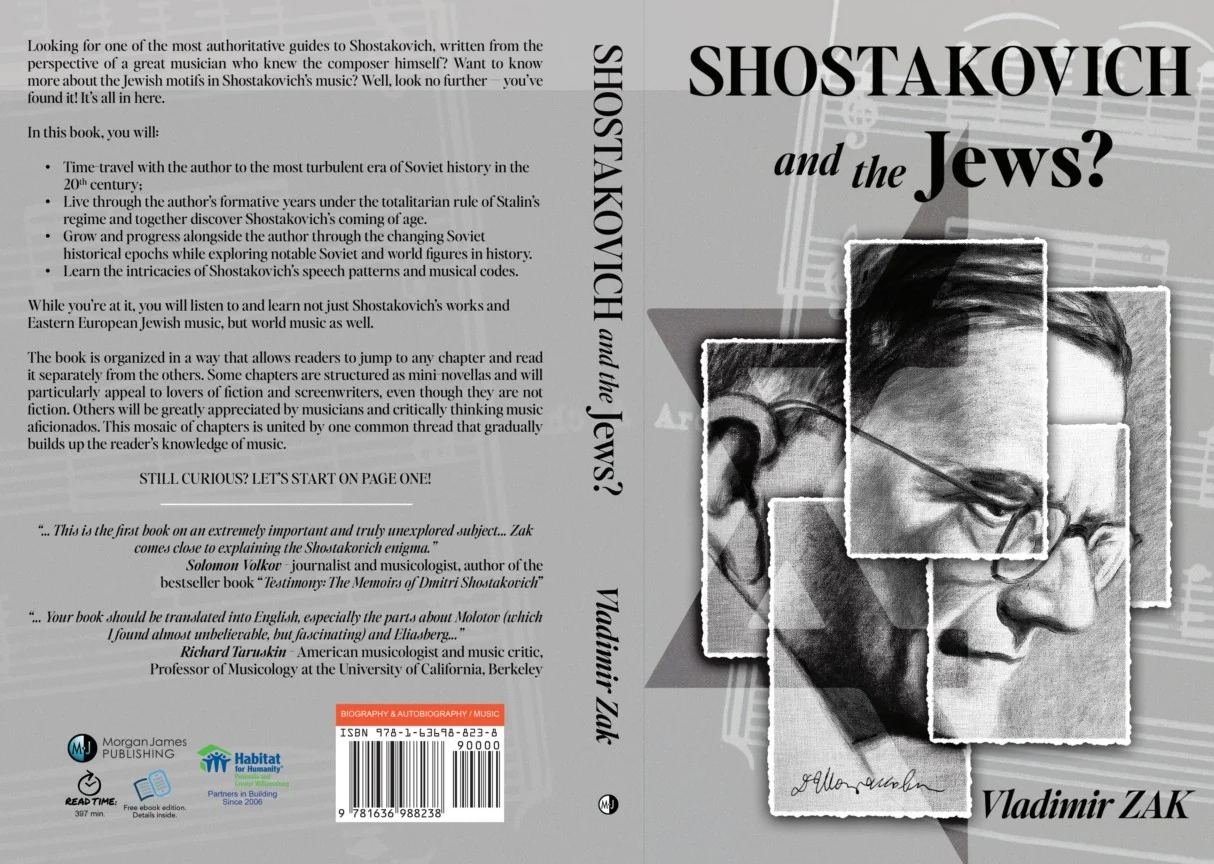
A landmark work of musicology has arrived in English translation more than 25 years after its original Russian publication. Shostakovich and the Jews?, written by the late scholar Vladimir Zak and translated by his son Alexander, was released this month through Morgan James Publishing.
First published in Russian in 1997, the book examines a question no musicologist had previously addressed: where did Dmitri Shostakovich — one of the 20th century’s greatest composers — draw his Jewish musical intonations from, and why? Zak argues that Shostakovich deliberately wove Jewish motifs into his music as a form of encoded resistance against Soviet censorship, at a time when open dissent could mean a labor camp or a firing squad.
While writers including Laurel Fay, Malcolm Hamrick Brown, Richard Taruskin, and Solomon Volkov have all written about Shostakovich, none tackled the Jewish dimension of his music. Zak’s book, divided into 13 chapters spanning musicology, memoir, and cultural history, stands alone in the literature.
Vladimir Zak was uniquely positioned to write it. A graduate of the Moscow Conservatory, he holds two doctorates and won the Russian Competition of Musicologists in 1982. He worked within the Union of Composers of the USSR from 1962, eventually serving as chairman of its musicological commission, and knew Shostakovich personally. He moved to New York City in 1991 and began preparing an English edition in 2006, but died in 2007 before seeing it completed.
His son Alexander, a computer scientist, spent over a decade on the translation. “I couldn’t see my father’s voice — the music of his language — in any other translation,” he told The Bukharian Times.
The book is available now on Amazon and at The Strand in Manhattan. For more fascinating background, visit the website Alexander built to compliment the book: www.shostakovichandthejews.com.
By Erin Levi