Rafael Nektalov / Editor-in-Chief of The Bukharian Times
Queens
The memorial will honor the victims and survivors of the Holocaust and will also become a place of remembrance and education.
November 25 will enter the modern history of Queens as a Day of Remembrance and Respect for the victims of the Holocaust—the total war waged by Nazi Germany against the Jewish people of Europe.
New York City Mayor Eric Adams and Queens Borough President Donovan Richards announced the creation of the “Queens Holocaust Memorial,” a new public space dedicated to the memory of the six million Jews murdered during the Holocaust, as well as the survivors who rebuilt their lives in New York.
Richards and Mayor Adams allocated $3 million for the creation of the memorial, which will be located on the southeastern lawn in front of Borough Hall at 120-55 Queens Blvd in Forest Hills, a neighborhood with a large Jewish population.
Unfortunately, the mayor himself was unable to attend the commemorative event—where many kind words were spoken about him—and was represented by his First Deputy Mayor, Randy Mastro.

Queens will thus become a permanent place of memory, education, and unity. The city and the borough president’s office have together allocated $3 million to support the project’s development; the New York City Department of Citywide Administrative Services (DCAS) will oversee the site’s designation and coordinate with community stakeholders and civic leaders. The city will initiate the official design process to create a memorial garden and a public artwork.
The artist-selection process will be led by the NYC Department of Cultural Affairs’ “Percent for Art” program, in consultation with artists, historians, and Holocaust survivors.
Among those involved is Vladimir Iosifovich Epstein—well-known in New York’s Russian-speaking community as a civic and political leader, writer, and publicist, and chairman of the New York Association of Russian-Speaking Parents.

Richards and the Adams Administration Present Plans for the Queens Holocaust Memorial
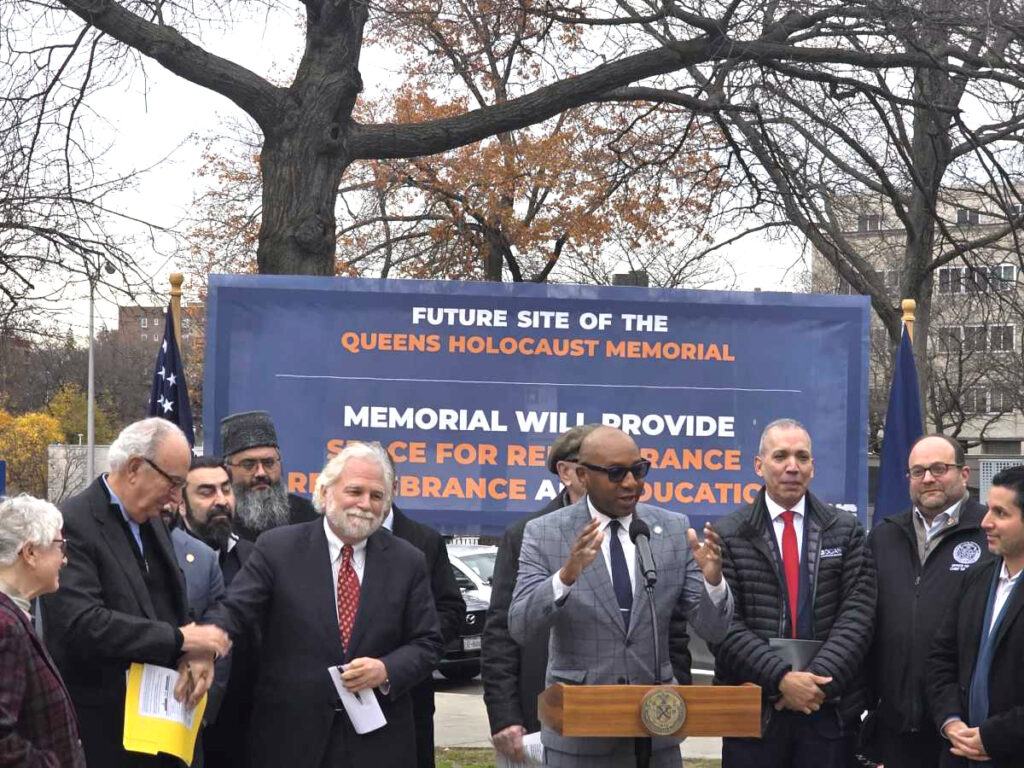
Queens Borough President Donovan Richards speaks during the official announcement of the Queens Holocaust Memorial at Borough Hall on Tuesday.
On Tuesday afternoon, Borough President Donovan Richards and First Deputy Mayor Randy Mastro were joined by state legislators and members of Queens’ Jewish community in front of the borough administration building to officially announce the creation of the Queens Holocaust Memorial—a new public space dedicated to the 6 million Jews murdered by Nazi Germany during the Holocaust.
Richards and Mayor Adams allocated $3 million for the memorial, which will be located on the southeastern lawn in front of Borough Hall at 120-55 Queens Blvd at the corner of 82nd Avenue.
The memorial will also honor the individuals and families who survived the Holocaust and will play an important role in educating the public about the Holocaust and the consequences of antisemitism, activists said at Tuesday’s announcement.
Among the elected officials present at the November 25 groundbreaking ceremony were Assemblymembers David Weprin, Sam Berger, Nily Rozic, Alicia Hyndman, and Ed Braunstein. State Senators Toby Ann Stavisky and Leroy Comrie also attended, along with Queens District Attorney Melinda Katz and representatives of Mayor-elect Zohran Mamdani.
The project is the brainchild of Michael Nussbaum and other prominent members of the Queens Jewish community (including V. I. Epstein and L. Bard of Chicago), the president of the Queens Jewish Community Council, who first approached Richards and City Hall with the idea of a Holocaust memorial three years ago.

Nussbaum, in turn, thanked Mastro for cutting through bureaucratic hurdles and launching the project in June.
On Tuesday, Adams announced he was allocating $2 million to fund the site, while Richards contributed $1 million for the memorial, with additional funds still to be secured.
Senator Stavisky announced at the event that she would allocate $1 million for the project, and Berger later said the Queens Assembly delegation would advocate for $1.5 million in funding. Richards then allocated an additional $1 million to the project.
The city will now work with community stakeholders and civic leaders to transform the site into a memorial garden. The garden will feature artworks selected through the “Percent for Art” program in consultation with artists, community members, and Holocaust survivors.
Richards described the announcement as an “emotional day” for Jewish families across the borough, adding that the memorial is proof that Queens “will never forget” the horrors of the Holocaust.
“We will never forget what happened to 6 million Jewish families during World War II,” Richards said. “We will never forget because we cannot forget the numbers tattooed on the arms of our neighbors, the scars they still bear from beatings and slave labor.
Today, as a borough, we commit to never forgetting what they endured. We commit to never again allowing such evil and hatred to take root in our society.”
He promised that the memorial would “send a signal” that Queens will not allow antisemitism to “claim the day.”
Mastro, for his part, said the phrase “never again” is more relevant today than ever, and that it is “very important” to build a Holocaust memorial in Queens, where many Holocaust survivors settled after arriving in the United States.
Elected officials and community members will now work together to create a “beautiful landscaped memorial” honoring Holocaust victims. Antisemitism accounts for more than 50% of hate crimes in the city, he noted, and the memorial will play a vital role in combating rising antisemitism. “We must remain vigilant,” Mastro said. “Hatred toward any community—Jewish, Christian, or Muslim—is unacceptable.”
Vladimir Epstein, a Holocaust survivor who moved to the United States after being imprisoned in a Soviet jail during the Cold War, said the memorial would send the message that “nothing is forgotten.”

“Sixty-eight members of the Epstein and Feuerstein families from Bessarabia (now Moldova and Ukraine) were murdered by fascists and antisemitic collaborators.”
Epstein, who was born in Bessarabia shortly after the start of World War II, fled with his mother to what is now Kazakhstan, and was later imprisoned in the USSR for speaking out against Soviet treatment of Jews. He said he witnesses antisemitism rising around the world but added that the memorial is “an important sign” that hatred and antisemitism “have no place” in the United States.
Rabbi Shlomo Nisanov—well known for his active political and charitable work—said that the issue of the Holocaust, historical memory, and its preservation holds a special place not only for Jews worldwide but also for people of other faiths—Muslims, Christians, and Buddhists—because it represents the quintessence of the suffering inflicted on an entire people who have never fully recovered their pre-war population.
He emphasized that he was born in a Muslim country—multiethnic Uzbekistan—where much was done during World War II to support Jewish refugees from Eastern Europe. He introduced Aron Aronov, the director of the Bukharian Jewish Heritage Museum in America, who stood beside him and is a witness to those events.
“I hope,” he said, addressing Ali Najmi (representing Mayor-elect Zohran Mamdani), “that the new mayor will support the construction of the new Bukharian Jewish Museum in Queens, which will reflect the centuries-old relationship between Jews and Muslims.”
They shook hands and embraced warmly.
Afterward, together with representatives of the mayor’s office, Ali Najmi, Imam Muhammad Shahidullah (who works closely with their great friend Imam Shamsi Ali), they went to the office of Queens Borough President Donovan Richards to examine in more detail the model of the future memorial complex.
City and community leaders then laid the first stone in the foundation of the future Queens Holocaust Memorial.
Photos by Merick Rubinov
This was translated
from Russian into English.