
Academic Conference
By Erin Levi
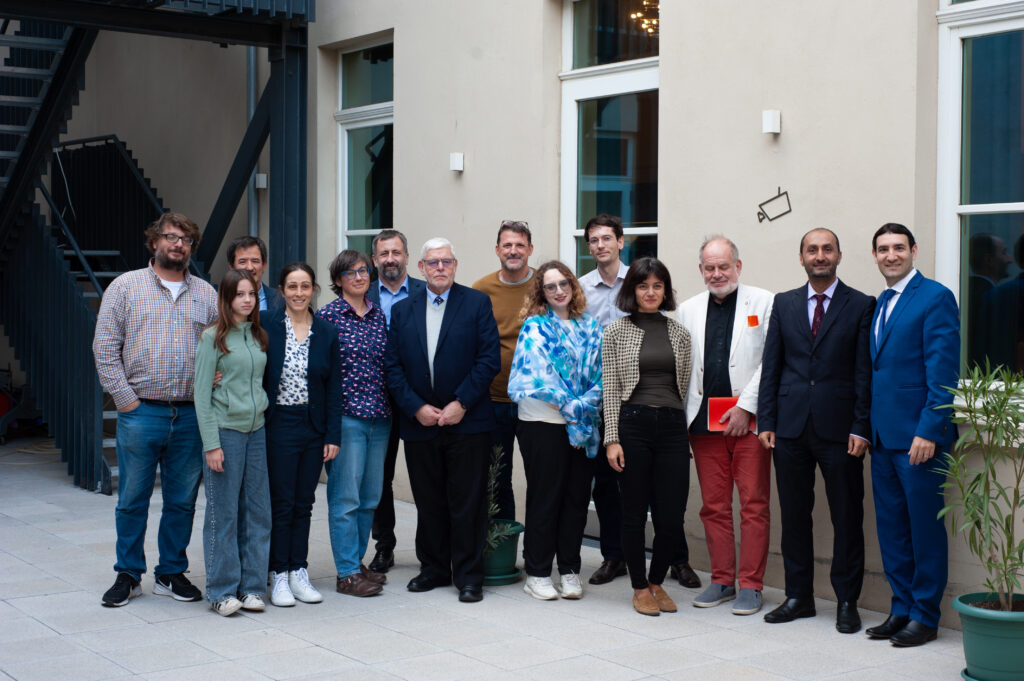
The “Beyond Borders” conference, held in mid-October at the Orient-Institute Istanbul, brought together leading scholars to explore the intertwined histories of Afghanistan, Central Asia, and Iran through the lens of their religious minorities. Among its central themes was the story of Bukharian Jews — their merchants, philanthropists, and transnational networks that once connected Samarkand, Kokand, and Bukhara to Jerusalem, Bombay, and beyond.
Organized by Dr. Thomas Loy of the Czech Academy of Sciences and Dr. Ariane Sadjed of the Austrian Academy of Sciences, the conference assembled fourteen researchers from Europe, North America, and Central Asia. Over the course of three days, participants examined how Jews, Armenians, Hindus, and Sikhs navigated shifting imperial frontiers in the nineteenth and early twentieth centuries, offering fresh insights into coexistence, trade, and identity in the region.
Revisiting Afghanistan’s Religious Mosaic
Several early papers turned the spotlight on Afghanistan as a crossroads of faith and empire. Dawood Azami, Associate Fellow at the International Institute for Strategic Studies in London, provided a sweeping overview of the country’s non-Muslim communities from the establishment of the Durrani Empire onward. His presentation emphasized their influence on Afghanistan’s economic and cultural life.
Following him, Ahmad Azizy, a postdoctoral researcher at the Oriental Institute of the Czech Academy of Sciences, offered a microhistorical study of two Jewish merchants who petitioned Amir Amanullah Khan in 1919. This rare document illuminated both the vulnerabilities and the civic engagement of Afghanistan’s Jewish traders. Continuing this thread, Sumaira Nawaz of McGill University analyzed Hindu and Sikh voices in the early twentieth-century Afghan press, revealing how minority writers negotiated belonging through print culture and debate.
Bukharian Jews in the Central Asian Crossroads
From Afghanistan, the focus shifted northward to Central Asia, where Bukharian Jews figured prominently in discussions of commerce, philanthropy, and modernization. University of Liverpool historian Beatrice Penati explored the entrepreneurial ambitions of Pinkhas Abramov, a Samarkand industrialist who sought to build a cotton mill before the Russian Revolution. His story reflected both the promise and prejudice that shaped Jewish enterprise in Tsarist Turkestan.
Building on this economic theme, our very own Imanuel Rybakov presented his study of Rafael Poteliakhoff—a merchant of the first guild from Kokand whose civic generosity and rise to prominence captured the achievements and challenges of the Bukharian Jewish bourgeoisie. His research offered a rare glimpse into a family that helped define Jewish prosperity in late imperial Central Asia.
Trade remained a unifying thread in the next sessions. Dr. Ariane Sadjed’s paper, “From Subject to Citizen,” examined how Persianate Jews across Iran, Central Asia, and Jerusalem navigated colonial citizenship and emerging national identities. Jonathan Lee, a fellow of the Royal Asiatic Society, followed with a keynote lecture on the survival strategies of non-Muslim communities at the frontiers of empires—highlighting how cooperation, mobility, and faith intertwined across borders.
Networks of Commerce and Connection
The conference’s next panels deepened the exploration of transregional trade. Dr. Thomas Loy mapped the Jewish networks that historically linked Afghanistan and Iran with Russian Turkestan, tracing routes from the Marv oasis to Herat, Mashhad, and Bukhara. His work underscored the enduring role of Bukharian and Afghan Jews as intermediaries in Eurasian commerce.
Continuing into the twentieth century, Professor Magnus Marsden of the University of Sussex charted the resilience of Central Asian merchants in the global karakul (Afghan lamb) fur trade. Despite attempts by the Hudson’s Bay Company to “modernize” operations, traders from the region maintained dominance through their cultural fluency and business acumen. Among them was Elli Simkhaeff, celebrated for his expertise in Afghan lamb fur — an emblem of the community’s enduring adaptability.
Further extending the theme of commerce, Dr. Jeanine Dagyeli of the University of Vienna discussed a German entrepreneur who built a thriving sheep business in colonial Tashkent, highlighting how cross-cultural ties shaped the economic landscape of Russian Turkestan.

Cultural Expression and Memory
Shifting from economics to culture, the later panels explored how literature and memory preserved Jewish identity across the Persianate world. Dr. Roza Ashkenazi of the Russian Academy of Sciences examined the Jewish-Persian literary canon that flourished under the Qajar dynasty, spotlighting poets such as Shahin(14th century) and Imrani (15th-16th centuries) who blended Jewish themes with Persian poetic form.
Adding a historical dimension, Christoph Hopp of the University of Potsdam presented an overview of Hebrew writings chronicling Jewish life in Herat from the nineteenth to twenty-first centuries, reflecting on evolving Jewish-Muslim relations.
The program concluded with a presentation by Dr. Sara Koplik of the University of New Mexico and Osnat Gad, a businesswoman of Afghan and Bukharian Jewish descent. Together, they traced the remarkable story of the Gad family — from land ownership in Afghanistan to global trade and resistance against Soviet collectivization — a testament to the courage and innovation of Jewish families navigating turbulent times.
A Shared Legacy Beyond Borders
As the final session drew to a close, organizers announced plans to publish a collected volume of the conference papers — an important step toward making this body of research accessible to a wider audience. For Bukharian scholars and descendants alike, Beyond Borders underscored how deeply our community’s story is woven into the fabric of Central Asian and Middle Eastern history.
Far from confined to a single city or empire, the Bukharian Jewish experience emerged as global: merchants shaping international trade, writers blending Persian and Hebrew traditions, and communities merging with Iranian Jews, in some cases. By revisiting these interwoven histories, the conference reminded participants that cultural borders are rarely fixed—and that the spirit of coexistence, enterprise, and resilience that once defined the Bukharian world continues to inspire new generations today.