
Uzbekistan
One of the goals of my stay in Bukhara was to visit the synagogue that has been preserved in the city of Kagan (or Kogon). It is listed in Uzbekistan’s national register of protected buildings as an Ashkenazi synagogue—a two-story brick structure built in the 1890s.
I first learned of its existence from Botirjon Shakhriyorov, Deputy Hokim (Governor) of the Bukhara Region, who had specially come to our community to help activate ties between the Congress of Bukharian Jews of the United States and Canada and the Bukhara Region.
Two weeks after his visit, I was invited to Bukhara, where I was able to see this unique building with my own eyes.
Why Do We Know Nothing About Kagan?
To be honest, I had been to Bukhara many times before, arriving by train, which naturally stopped at Kagan station, where a railway terminal later appeared, known as Bukhara-1 since 1922.
As is well known, the Russian Empire sought to quickly connect newly acquired territories with its center through modern trade routes. The most advanced solution to this task was the construction of railways. Kagan was founded as a Russian settlement called New Bukhara for railway workers. Built in 1888, 12 kilometers/7 miles from Bukhara, to service stations and tracks of the Trans-Caspian Railway, the settlement eventually also became a kind of “embassy city.” This fact was not widely publicized.
During the establishment of Soviet power in Central Asia and Turkestan, Kagan found itself at the center of turbulent revolutionary events.
The commander of the Turkestan Front, M.V. Frunze, attached great importance to the units of the Kagan garrison in the operation to eliminate the Bukhara Emirate.
He ordered the capture of Bukhara, where the main enemy forces were concentrated. The Kagan group went on the offensive on August 29, 1920, and fulfilled the assigned task.
Previously, when I came here from Samarkand, my main interest was Bukhara itself—the Jewish quarter, relatives, the cemetery… Naturally, the residents of Bukhara knew about Kagan, but for us, Bukharian Jews from other cities of Uzbekistan and Tajikistan, it was virtually unknown.
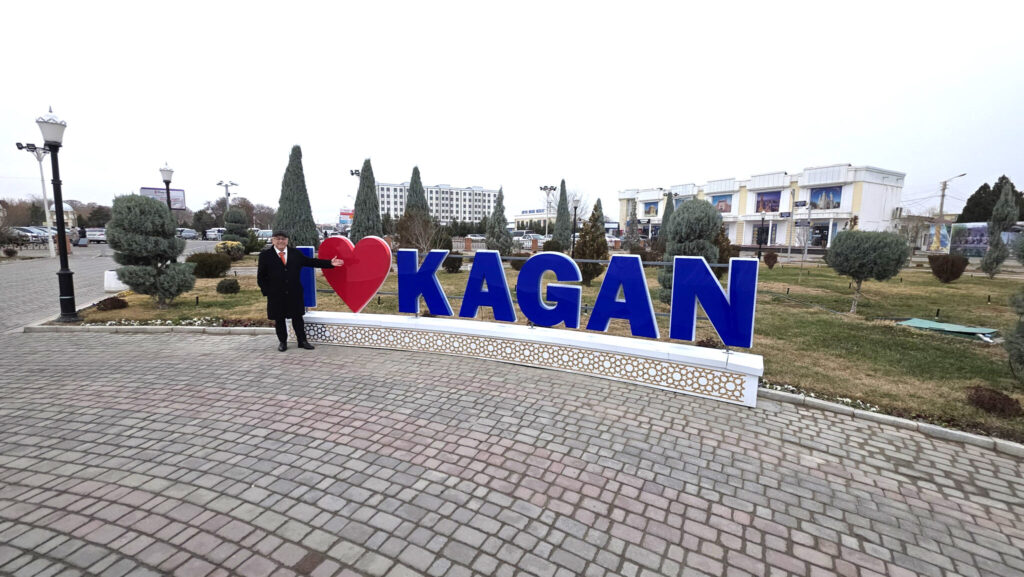
But on this visit, Botirjon Shakhriyorov took me to Kagan via a new road, and I saw how rapidly the Bukhara Region is developing, the scale of transformations taking place on this beautiful, ancient land where Jews have lived for millennia.
We arrived in the city of Kagan—New Bukhara, as it was called in tsarist times—and I was immediately struck by the architecture of the Russian colonialists, so different from the surrounding Muslim urban environment.
In addition to residential buildings for railway workers, the settlement housed a special institution that handled diplomatic relations between the Russian Empire and the Bukhara Emirate. One could even say—between the Christian world and Islam.
But the most interesting site for me was the synagogue.
We drove up to a large brick building surrounded by a new fence. Construction and restoration work was actively underway.
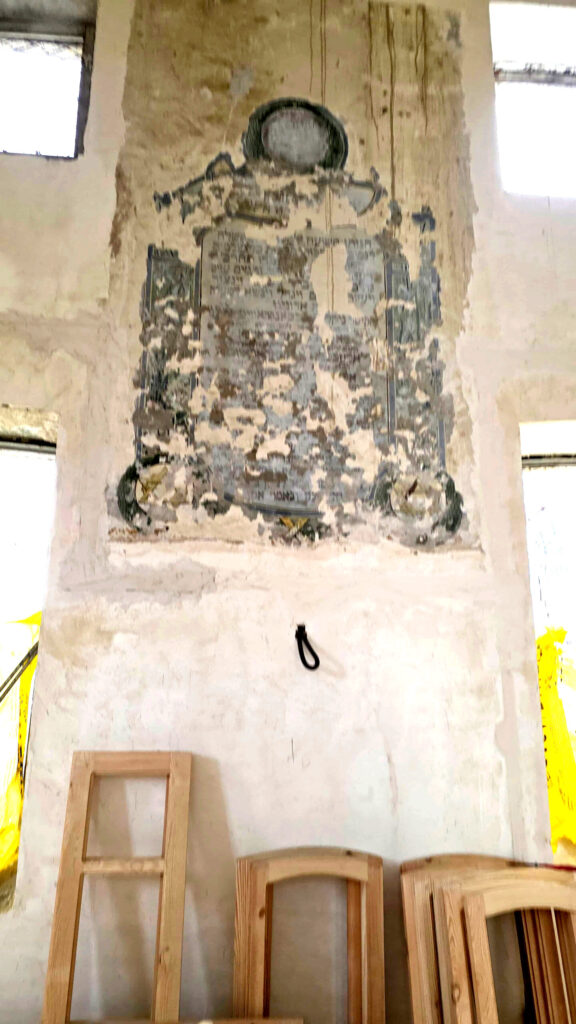
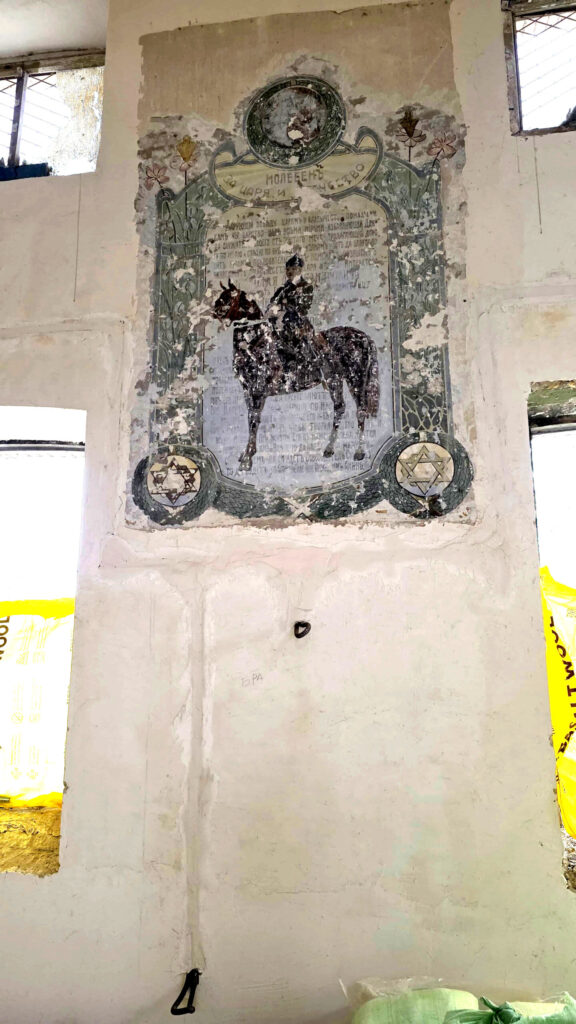
Entering inside, I saw a large hall whose roof was supported by four cement columns. On two sides there were frescoes. One depicted Marshal Voroshilov on a red horse, against a background of text about a prayer for Russia; on the other was a version in Hebrew.
I was curious about where the Ark—the aron ha-kodesh, in which the Torah was kept—might have been located.
Tuygun Boboev, a UNESCO representative under whose supervision the work is being carried out, showed me the building plan and also mentioned the name of the well-known Israeli scholar Zeev Levin, who was among the first to describe the synagogue. Here is what that text said:
“Due to its special status—as a Russian settlement on the territory of the semi-independent Bukhara Emirate—the city attracted a significant Jewish population. Neither Russian laws restricting Jews to the Pale of Settlement nor the anti-Jewish Muslim legislation of Bukhara applied here. According to the All-Russian Population Census of 1897, the Jewish population of New Bukhara reached 700 people, mostly men. This was about 7% of the city’s residents. By 1926, the number of Jews had doubled, and they made up about 10% of the population.
The synagogue appears to have been built in the 1890s and functioned until its closure by Soviet authorities in the late 1920s.
During the Soviet period, the building was used as a city mill.
…The dimensions of the synagogue are 12 by 15 meters (a hair under 2,000 square feet). The main façade is three-sided; the central part with the main entrance slightly protrudes forward. Its upper triangular section is decorated with two shallow niches with semi-columns between them, which may indicate the Tablets of the Law. The building consists of a two-story prayer hall, a vestibule with auxiliary rooms on the ground floor, and a women’s section above them.
The ceiling of the prayer hall is supported by four columns; it is not yet known whether they are original or were added during the Soviet period. The women’s section is connected to the hall through arches with metal railings.
Entry to the women’s section was likely via an external wooden staircase that has not survived. The direction of prayer in this synagogue was oriented toward the northwest.”
Later, I contacted Zeev Levin, and he was very pleased to learn that extensive restoration work is currently underway.
“Although the synagogue was recently added to the list of protected monuments, its current condition requires immediate restoration. In addition, historical and archival research is needed in the archives of Bukhara and Tashkent to uncover the true history of this unusual building,” he emphasized. “As for the red horse with the marshal, that was done during the Soviet period. Beneath that painting there is another, authentic layer.”
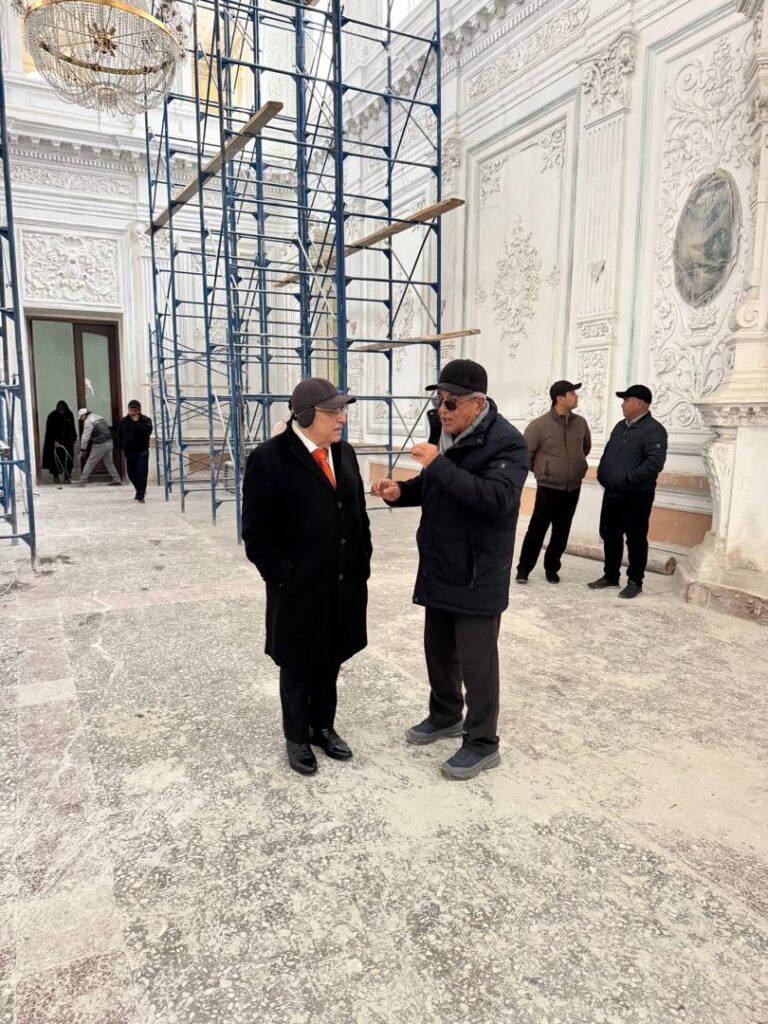
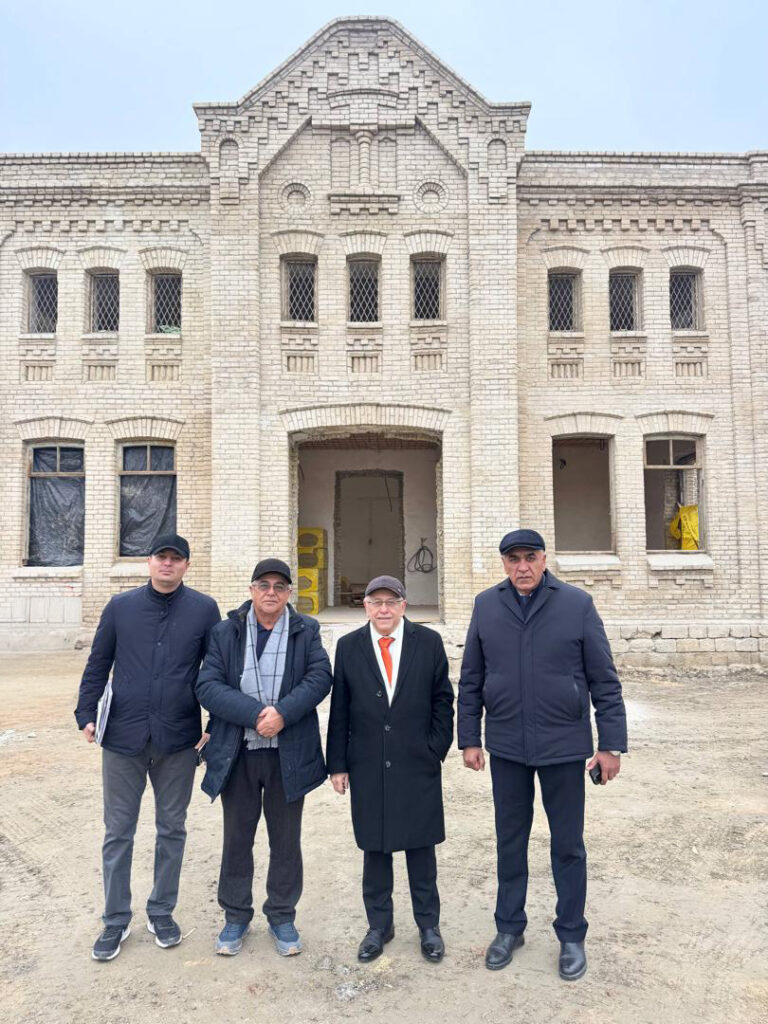
As the regional governor, Botir Zaripov, said at our meeting, large-scale efforts are underway in the republic to restore monuments of material culture, regardless of whom they belong to. Judging by the approach to this synagogue—now more than 130 years old—as well as to the Jewish cemetery in Bukhara, one can see with what care the country’s authorities treat this work.
“We are also ready to undertake a scholarly reassessment of the heritage of the Jewish people on the territory of the Bukhara Region and the region as a whole,” noted the rector of Bukhara State University, Obidjon Khamidov. “That is why in late February–early March we are holding an international conference at which we are ready to discuss papers on these topics.”
“In 1890 there were already several transport offices, several shops and stalls, and a post and telegraph office,” explained Botirjon Shakhriyorov, pointing to the ruins of an Orthodox church. “Here a parish school was opened and a magistrate’s court was established. In 1894, a branch of the State Bank opened, followed by a customs office.”
I walked through this city, which had a serious impact on the subsequent development of the history, politics, and social and political life of the Bukhara Khanate, and it was frustrating to realize how little I had known about it. I saw how the buildings of a lycée, a bank, and an Italian restaurant are being transformed. Very soon, a new tourist center will appear here, becoming an adornment of Kagan—a city that until 1935 was called New Bukhara.
We then approached a bridge that connected different parts of the city, divided into west and east by the railway.
“A new cable car is planned to be built here, which will become a landmark of Kagan,” Shakhriyorov told me.
In one part of the city there is modern, industrial life—trains moving, passengers on the platform—and in the other, a true museum of the remnants of the Russian Empire.
And almost all of these buildings have survived to this day.
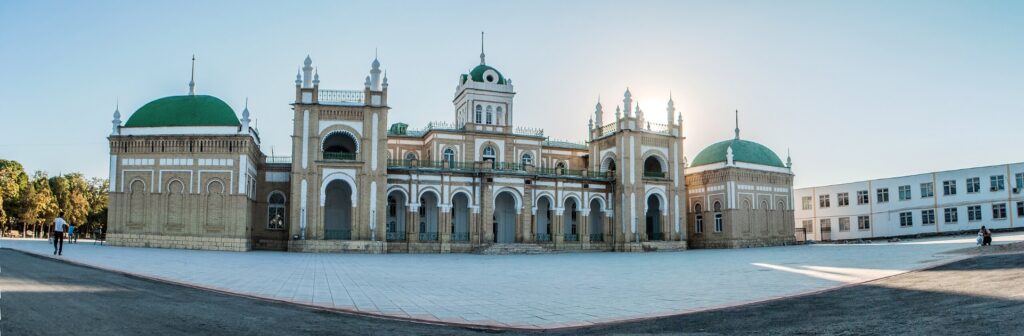
On August 14, 1895, by order of Emir Sayyid Abdulahad Khan, construction began on a new palace in anticipation of the arrival of the Russian emperor in Turkestan. However, the emperor never came.
The palace was designed by the outstanding Russian architect Alexei Leontievich Benois. Construction was completed in 1898 by Bukhara and Russian craftsmen under the supervision of engineer Dubrovín.
The palace, with its many towers, domes, and columns, is eclectic, built in a Neo-Moorish style combined with Baroque and Empire elements. Alongside a typically European style, Arabic motifs were also used in the decoration. Buildings of this kind exist in Tashkent, Fergana, and Samarkand, but this one is the crowning achievement of the great master Benois’s architectural work.
There are different versions of the purpose of the palace’s construction. According to one, the emir ordered the palace built for himself personally but, after inspecting it upon completion, deemed it insufficiently magnificent and luxurious. According to another version, the palace was originally intended for the visit to the Bukhara Emirate by Emperor Nicholas II (which, as mentioned, never took place).
After the death of Sayyid Abdulahad Khan, his successor, Emir Sayyid Alim Khan, began using the palace, located near the railway station, as a residence for high-ranking officials visiting Bukhara.
Today, the building—now housing the Railway Workers’ Palace of Culture—has the status of an architectural monument.
Rafael Nektalov
This was translated
from Russian into English.