
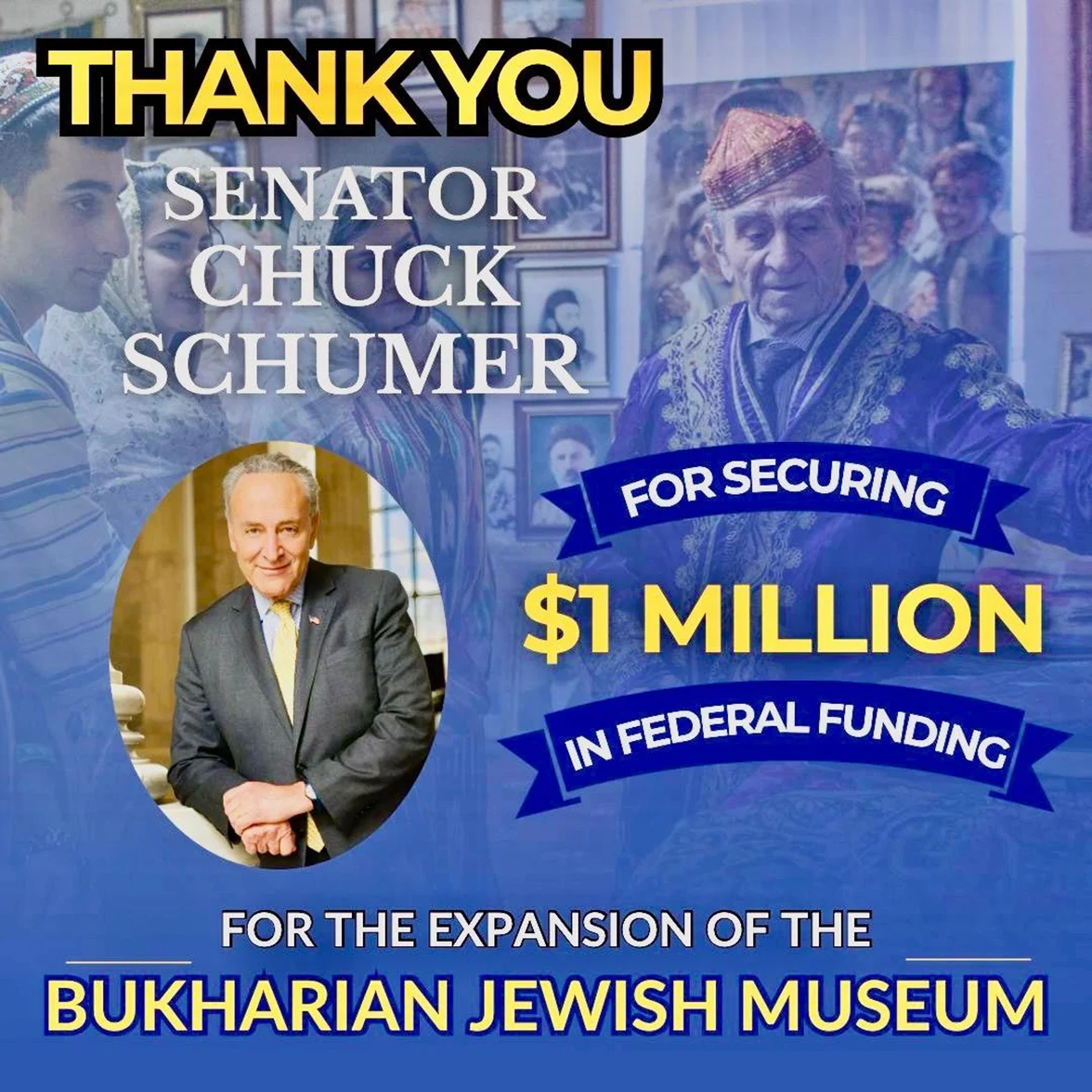
In a historic win for the Bukharian Jewish community of Queens, Senator Chuck Schumer has secured $1 million in federal funding for the Bukharian Jewish Museum and Community Center — the largest federal grant ever awarded to a Bukharian-run nonprofit in the United States. The grant, years in the making, promises to lift a one-of-a-kind cultural institution out of a basement (albeit a lovely one, thanks to the generosity of Yan Moshe!) and into a permanent, visible home worthy of the community it represents.
“I’m proud to deliver $1 million in federal funding for the Bukharian Jewish Museum and Community Center in Queens,” said Senator Schumer. “With this federal support, the Bukharian Heritage Society will be able to expand its community facility and construct a new home for the Bukharian Jewish Museum, preserving, promoting, and honoring the rich cultural heritage of the Bukharian-American Jewish community here in New York City and around the world.”
The man who helped make it happen is David Aronov, a young government veteran and tireless Bukharian community advocate. His years of experience navigating federal funding channels (he landed his first government role was in 2012), combined with a pivotal 2023 delegation trip to Washington, D.C., set in motion a process that culminated in this landmark award.
Years in the Making
David Aronov began working on the grant application roughly two years ago, drawing on a decade of experience in government to identify an opportunity that most people — even many community leaders — don’t know exists: elected officials have the ability to allocate discretionary federal funding directly to their districts.
“A lot of people don’t know this,” Aronov explained. Usually, those who do are large institutions with professional fundraising staff. Aronov saw an opening for a smaller, community-driven organization like the Bukharian Jewish Museum.
The grant application went through rounds of back-and-forth, and the path was not always clear. The 2024 election cycle brought new uncertainty — when Republicans took control of the House, community funding grants across the board were cut. For a time, the project was in limbo. Senator Schumer’s office kept pushing to restore the funding, repeatedly returning it to the legislative agenda during the long back-and-forth of budget negotiations. After a government shutdown further complicated matters, the latest round of funding was ultimately approved and made public. The Bukharian Jewish Museum received $1 million — the same as every other funded project in this round.
The money is capital funding, meaning it is designated specifically for construction and building costs. It cannot be used to hire staff or pay for programs, explained Aronov. The funds will flow through the Department of Housing and Urban Development (HUD), which will coordinate directly with the museum’s leadership on how to deploy the money. The process involves multiple layers of review, including an environmental assessment and coordination with local review boards — a rigorous but necessary path for federal dollars of this scale.
Aronov is also clear-eyed about what comes next: $1 million, while transformational, is not enough on its own. The museum will need supplemental funding from city and state sources, private donors, and other fundraising channels to fully realize its vision. But this federal grant is the anchor — the largest commitment any Bukharian organization in the United States has ever received from the federal government.

“This is a really big deal,” Aronov said simply.
A Delegation That Made History
The story of this grant has a specific turning point: April 2023, when a Bukharian delegation traveled to Washington, D.C., and met with Senator Schumer’s office. The visit was organized by Ezra and Gabriella Friedlander. Chagit Leviev Sofiev, Boris Kandov, Leon Nektalov, Rafael Nektalov, Rabbi Baruch Babayev, Roman Kaykov, and a plethora of other Bukharian leaders joined. David Aronov, who had longstanding relationships with staff in the senator’s office from his prior years working in government, also attended. Though the meeting was brief, it was impactful — an intimate moment whereby Senator Schumer reflected upon his past work to free Soviet Jews and provide visas to the US, a face-to-face result with the fruits of his efforts. He asked going forward how he could support the community.
This grant is a direct result of that meeting.
A Permanent Home
Today, the Bukharian Jewish Museum operates out of a spacious basement of a commercial building in Queens–a generous offer from Yan Moshe towards preserving and showcasing Bukharian heritage. It is open by appointment only. Despite these limitations, it has drawn visitors from across the city and around the world: Bukharian Jews from London, diplomats stationed abroad, New York City Council leadership, and schoolteachers from local public schools with no personal connection to the community — all drawn by the richness of a story that most of the world has yet to discover.
This publication has covered many of those visits over the years, and the impressions are strikingly consistent: visitors arrive curious and leave moved. The museum’s collection — documenting the history, traditions, and artistic heritage of Bukharian Jews, a community that traces its roots to the ancient Jewish communities of Central Asia — is not something found anywhere else.
Museum leadership has expressed deep gratitude for the grant:
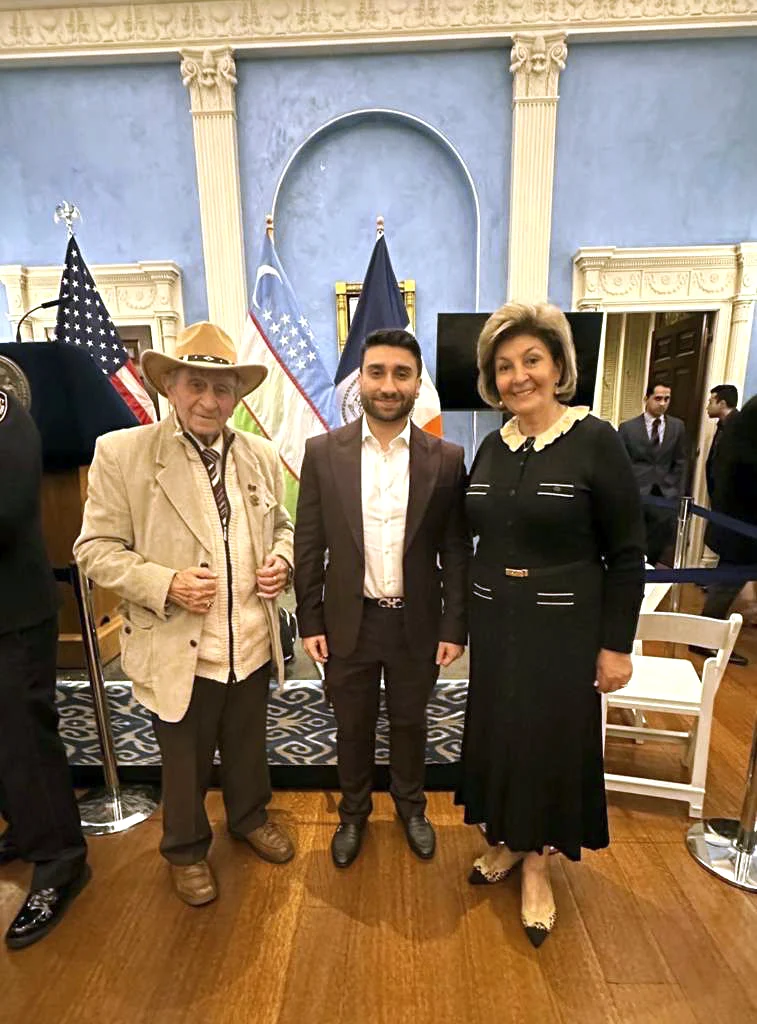
“Our heartfelt gratitude to David Aronov for the enormous efforts to get financial grant to expand the Bukharian Jewish Museum, which is the only one in the world. Now we have a good chance to properly display our artifacts. May Hashem grant him good health to continue his noble mission by helping us introduce the Bukharian Jewish community to the American people at large. With great respect, Aron Aronov, Executive Director of the Bukharian Jewish Museum in New York; Yuriy Sadikov, President of the Bukharian Jewish Museum; and Alla Aronova.”
For the first time, the museum will have the resources to search for a permanent, visible location — a space that can welcome visitors without an appointment, that can anchor community life, and that can tell its story to the broader public on a meaningful scale.
“This is not just for Bukharians,” David Aronov emphasized. “We want the general public to know about our rich history and traditions.”
Before its current location, the museum operated out of a JIQ facility — a reminder of how far the institution has come, and how much further it has the potential to go.
A Community on the Rise
The Bukharian Jewish community of Queens is one of the most vibrant immigrant communities in New York City. Having arrived primarily from the former Soviet republics of Uzbekistan and Tajikistan beginning in the 1970s and accelerating through the 1990s, Bukharian Jews brought with them a distinctive culture shaped by more than two millennia of Jewish life in Central Asia — a unique fusion of Persian, Jewish, and Soviet influences expressed in language, music, food, art, and religious practice.
Despite the community’s size and dynamism, it has historically received little in the way of institutional support or public recognition compared to older-established Jewish communities. Federal grants of this scale — the kind that large universities, hospitals, and established nonprofits routinely pursue — have been largely out of reach.
That changes now.

“It’s nice because there’s not that much funding for communities like ours,” Aronov noted. “The big ones have big asks. It’s nice to see funding for something new.”
What Comes Next
The immediate next steps involve working closely with HUD to navigate the federal requirements for capital funding. Environmental reviews and coordination with local planning bodies will take time. The museum’s leadership will need to identify a suitable new location — one that is permanent, accessible, and visible enough to serve both the Bukharian community and the general public.
Supplemental funding will be essential. Community fundraising efforts, city and state grants, and private philanthropy will all need to play a role. But with $1 million in federal backing now secured, the Bukharian Jewish Museum has something it has never had before: a foundation.
For David Aronov, accustomed to uncertainty and political hurdles, the message is one of possibility. The federal government can support communities like this one. It takes knowledge of the system, relationships built over time, and the willingness to make the case — again and again — until someone listens.
Senator Schumer listened. And now, a community’s heritage has a future.
Erin Levi
