
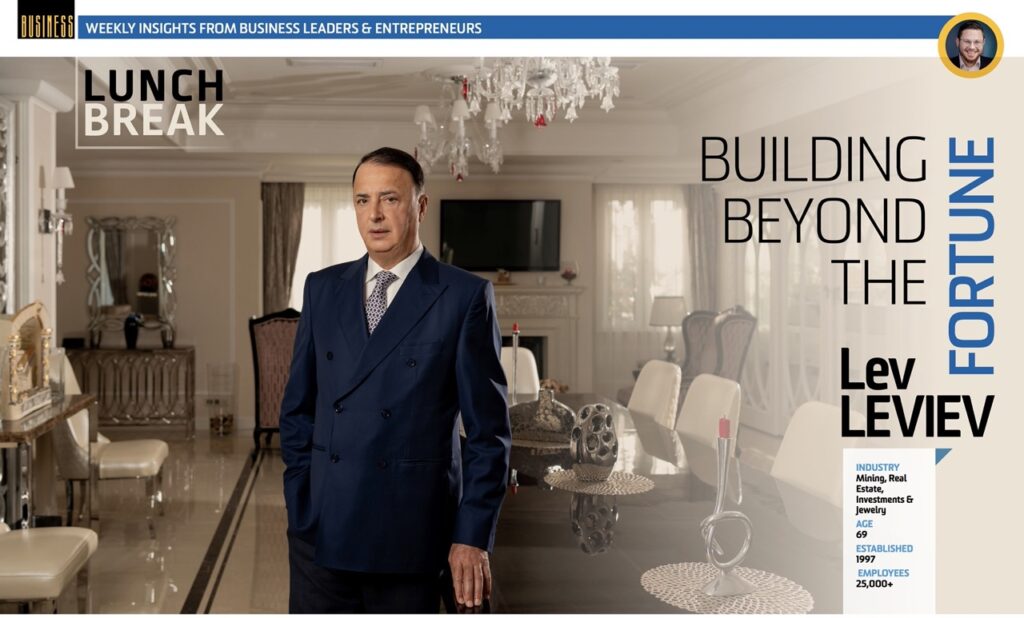
In a rare and candid interview featured in the March 30, 2026 issue of Ami Magazine, dynamic diamond magnate and philanthropist Lev Leviev opened up about his extraordinary life journey—from hiding his Jewish identity behind the Iron Curtain to building one of the world’s most powerful diamond empires. The interview, conducted by Nesanel Gantz as part of Ami’s weekly Lunchbreak business series, offered an unusually intimate portrait of a man who has long been one of the most prominent yet most private figures in the Jewish world.
Born in 1956 in Tashkent, Uzbekistan, the fifth of eight children in a strictly Orthodox family, Leviev grew up practicing Judaism entirely in secret under Soviet rule. From the age of five, a Chabad teacher came daily to teach him Torah in hiding. At 12, unwilling to compromise on wearing his hat or risk missing class on Shabbos, he made the bold decision to stop attending school and was smuggled to an underground yeshivah in Samarkand. In 1971, the family emigrated to Bnei Brak, Israel, where a chance encounter at a diamond exchange—watching his father get badly swindled—ignited a resolve that would define his career. «Seeing my father being taken advantage of like that triggered something in me,» he said, «and I decided to enter the diamond industry and become an expert.»
By 16, Leviev was learning every aspect of the trade. By 17, he had opened his own factory in Ramat Gan. His real breakthrough came during the global diamond crisis of the late 1970s, when a speculative bubble burst and prices collapsed dramatically. While 95% of jewelers went bankrupt, Leviev absorbed failing factories one after another. His edge was technology—while rivals spent $40 per carat on polishing, his proprietary systems brought costs down to $15–20. «When everyone else was earning nothing, I was earning 30 to 40 percent. That was the difference.» By 1985 he was named Israel’s top diamond exporter, and a year later De Beers granted him coveted «sightholder» status. He eventually built a fully integrated operation stretching from mines in Angola, Namibia, and South Africa all the way to high-end retail, with his business interests later expanding into large-scale real estate and infrastructure worldwide.
Running through Leviev’s entire story is the profound influence of the Lubavitcher Rebbe. When he visited the Rebbe proud of the institutions he had opened, expecting praise, the Rebbe instead looked him in the eyes and said plainly: «You can do much more than this.» It became a defining life philosophy. The Rebbe also directed Leviev’s greatest philanthropic chapter—urging him, when the Soviet Union began to open up, to focus on restoring Jewish education to a people cut off from their heritage for generations. What followed was the establishment of 500 communities across the former Soviet Union, hundreds of schools under the Ohr Avner name, seminaries, soup kitchens, and orphanages. «Today, wherever I fly, I meet Yidden from all over the world who tell me, ‘I studied in Ohr Avner,'» he reflected, «from politicians to rabbanim, all over Europe.»
Closer to home, Leviev transformed the Bukharian Jewish community of Queens, New York, which he watched drifting toward assimilation a quarter century ago. He founded schools, established a beit din, and offered financial incentives to move children out of public schools.

The results speak for themselves. «In the last 25 years, there have been almost no intermarriages among the Bukharian Jews,» he noted. This year he announced a $50 million commitment over five years to expand Jewish education for immigrant communities across the board.
At 69, Leviev shows no signs of slowing down. He exercises six days a week, travels constantly, and pursues new ventures with undiminished intensity. His formula, forged in the basements of Soviet Tashkent and refined through decades of triumph and crisis, remains unchanged: give generously, trust in Hashem, and never rest on what you have already built. «A Jew who does not give, who finds it difficult, should try to give,» he said. «He will see that he derives satisfaction from it, and he will give more. The more he gives, the more Hakadosh Baruch Hu will give him.»
For Lev Leviev, the fortune was never the point. It was always just the means.