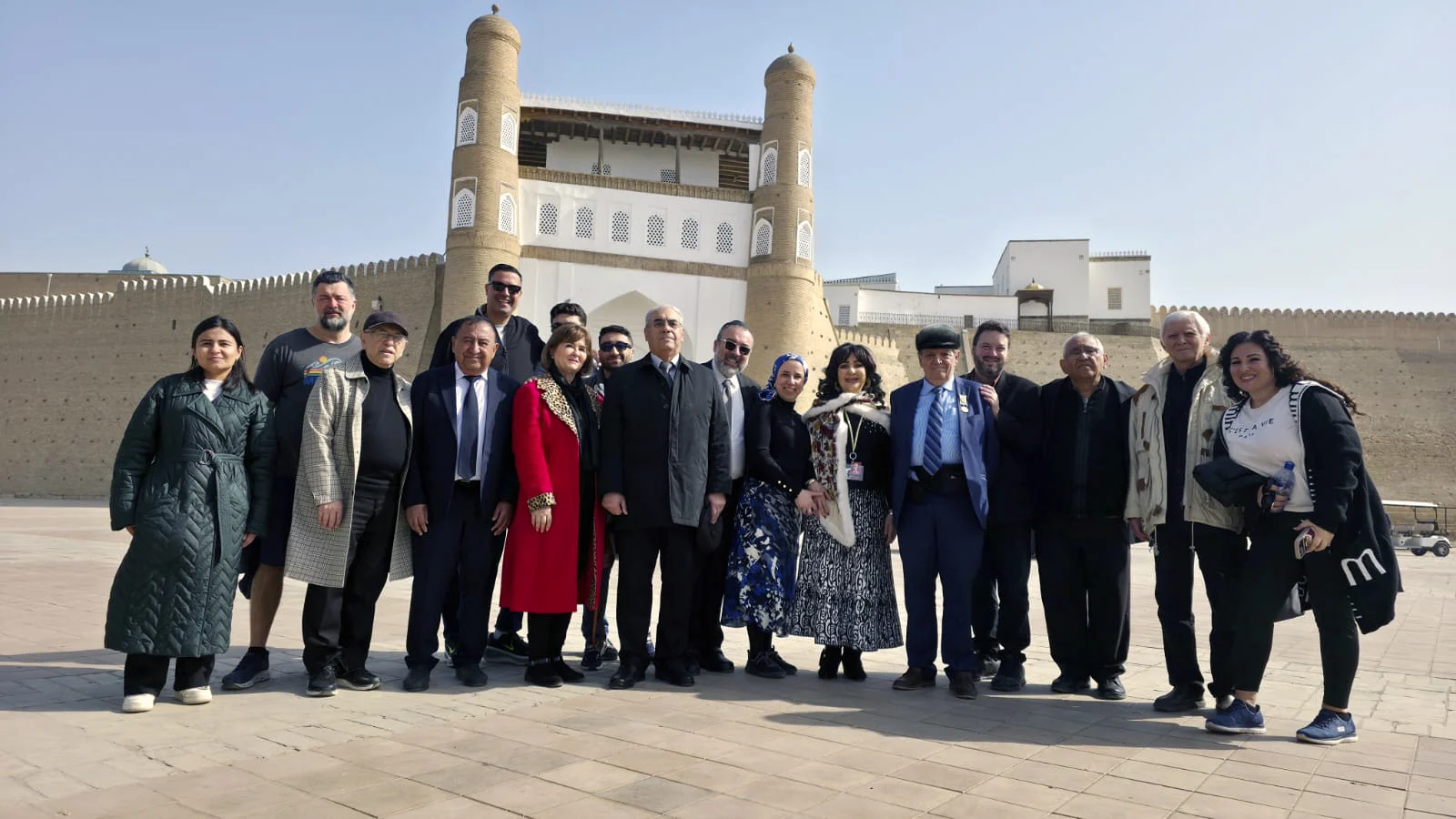
The visit of the delegation from the Congress of Bukharian Jews of the United States and Canada, headed by Anatoly Iskhakov, president of the Jewish community of Atlanta (Georgia), and Rafael Nektalov, coordinator of the Congress of Bukharian Jews of the U.S. and Canada, president of the international festival “Shashmaqam Forever,” and editor-in-chief of The Bukharian Times, became a landmark event symbolizing a new stage of interaction between the diaspora and its homeland.
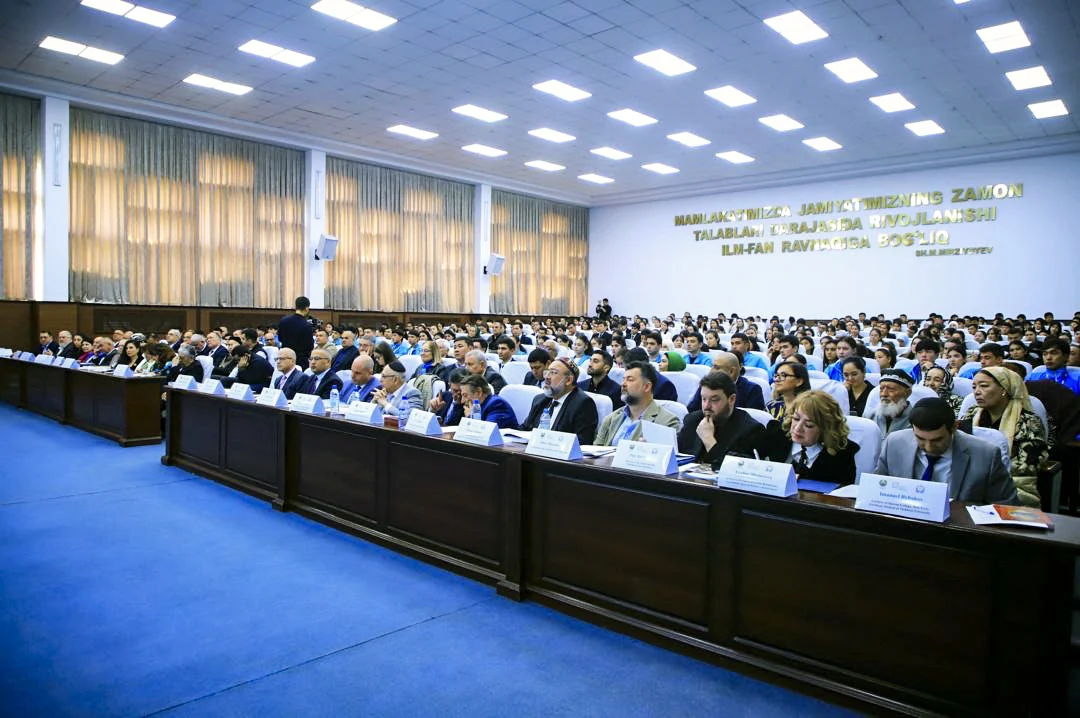
The guests from America arrived in connection with the international conference at Bukhara University titled “Bukharian Jews in the Socio-Economic and Cultural Life of the Region.”
A Return to Historic Roots
On the very first day, members of the delegation visited key sites connected to the centuries-old history of Bukharian Jews in the region. They walked through the historic and legendary Jewish mahalla (neighborhood), paid respects at the graves of relatives and ancestors, and explored architectural monuments of the ancient city, including the Ark Museumand the Sitorai Mokhi-Khosa palace complex.
Conference participants were also taken on a special excursion to the town of Kagan, a monument of the Russian imperial colonial period. There, several historic buildings remain preserved or are being restored: a hotel, a church, a hospital where Japanese prisoner-of-war doctors once worked, and a synagogue linked to the history of Ashkenazi (German) Jews who lived in the region in the late 19th and early 20th centuries.
This synagogue served as an important religious and community center for European Jews in Kagan and its surrounding areas. During the Soviet period, religious activity there was restricted, and the building was used for communal and other purposes. Today it stands as a significant historical monument in need of restoration and preservation. The synagogue represents not merely a place of worship, but a symbol of spiritual life and generational continuity.
Discussions on Heritage and Tourism
During the visit, Botir Shakhriyorov, head of the Bukhara Regional Tourism Department, spoke with Gideon Lustig, Israel’s ambassador to Uzbekistan. The ambassador expressed particular interest in the future of the Kagan synagogue, its potential restoration, and its future functions once renovated.
He also asked about Bukhara’s tourism potential, the business climate, conditions being created for foreign investors, and opportunities to involve the Jewish community in international festivals and cultural initiatives.
Historian Vyacheslav Shatokhin, who researches the history of European Jews in Uzbekistan and their evacuation to the republic during World War II, also took part in the conversation.
Shakhriyorov emphasized that restoration of cultural heritage sites in the region is being carried out step by step. After restoration, the synagogue may be transferred for use on a commercial or entrepreneurial basis, ensuring its preservation and sustainable development. He noted that wide opportunities are being created for investors and that members of the diaspora will be invited to participate in major regional festivals.
The Conference
Bukharian Jews are one of the oldest Jewish communities in Central Asia. Written sources mention Jewish presence in the Bukhara oasis as early as the 9th–10th centuries, while archaeological evidence suggests an even earlier formation of the community.
For centuries, Bukharian Jews lived alongside their Muslim neighbors, actively participating in trade, jewelry craftsmanship, music, poetry, literature, the economy, and healthcare of the region.
Conference presentations reexamined Jewish mahallas, synagogues, residential architecture, rituals, and traditions—demonstrating that Jews in Bukhara were never viewed as outsiders but rather as an organic and respected part of the city.
Diplomatic Greetings
In the packed assembly hall of Bukhara University—set against the flags of the United States and Uzbekistan and photographs of Presidents Shavkat Mirziyoyev and Donald Trump—welcome remarks were delivered in English and Uzbek.
The first speaker was U.S. Ambassador to Uzbekistan Jonathan Henick, who noted the positive shift currently taking place in U.S.–Uzbek relations. He described Bukhara as a living example of interethnic harmony, highlighting how Bukharian Jews in the United States preserve their language, traditions, and musical heritage while making meaningful contributions to American society.
Israeli Ambassador Gideon Lustig emphasized that Uzbekistan has historically been a safe and hospitable homeland for the Jewish community and that Bukharian Jews play an important role in strengthening spiritual and cultural ties between Israel and Uzbekistan.
“Bukhara Lives in Our Hearts”
Delegation leader Anatoly Iskhakov stated in his remarks: “For all of us, Bukhara exists not only in the past but also in the present and the future.”
He expressed hope for expanding cultural, scientific, business, and economic ties, and shared plans to build a new Jewish center, mikveh, and hotel with kosher cuisine, making Bukhara attractive for Jews from around the world.
Particular interest was generated by a lecture by Rafael Nektalov, titled “Bukhara – the Cradle of Jewish Civilization in Central Asia.” His presentation explored ethnogenesis, identity, social and artistic life, musical culture, lifestyle, clothing, and value systems.
He said: “Bukhara is our historical root, our memory, our culture. Wherever we live, Bukhara lives in our hearts. The tradition of Bukharian Shashmaqam, our customs, and family values formed here define who we are. We are part of Bukhara in America. The names of our Congress, our newspaper, and fifty synagogues include the word ‘Bukharian’ because behind that name stands a vast history and a love for our homeland.”
Nektalov cited the work of maqam musician Ezra Malakov, who in the United States revealed his pedagogical talent and taught nearly 400 children the basics of cantorial singing and maqam music.
Holding up a disc collection, Nektalov said: “Here are seven hours of Bukharian Jewish music—chants, hymns, and songs—recorded, transcribed, and published in 2007.”
Scholarly Presentations
The conference’s academic reports were divided into thematic sections devoted to: historical sources and archaeology; cultural heritage and musical traditions; contemporary diaspora processes.
Scholars from Bukhara University and Tashkent presented research on the historical role and cultural contributions of Bukharian Jews.
The musical world was represented by Dr. Pete Rushefsky, executive director of the Center for Traditional Music and Dance in New York, who later performed Ashkenazi folk melodies on the cimbalom during the concert.
World-renowned maqam performer Ezra Malakov, People’s Artist of Uzbekistan and head of the Academy of Hazanut, conducted a lecture together with Rafael Nektalov about Bukharian Shashmaqam and remote teaching via Zoom.
Other presentations included genealogical research on prominent Bukharian Jewish families, studies of historic poets, and analyses of the political development of the Bukharian Jewish community in New York.
Musical Heritage
Special attention was devoted to Bukharian Shashmaqam, the classical musical tradition whose flourishing is closely tied to Bukhara.
In the 19th and early 20th centuries, Bukharian Jewish musicians made significant contributions to the development of distinctive maqam performance schools. Through the traditional teacher-student system, this art form was passed down from generation to generation. Their contribution is inseparable from the broader musical culture of Central Asia.
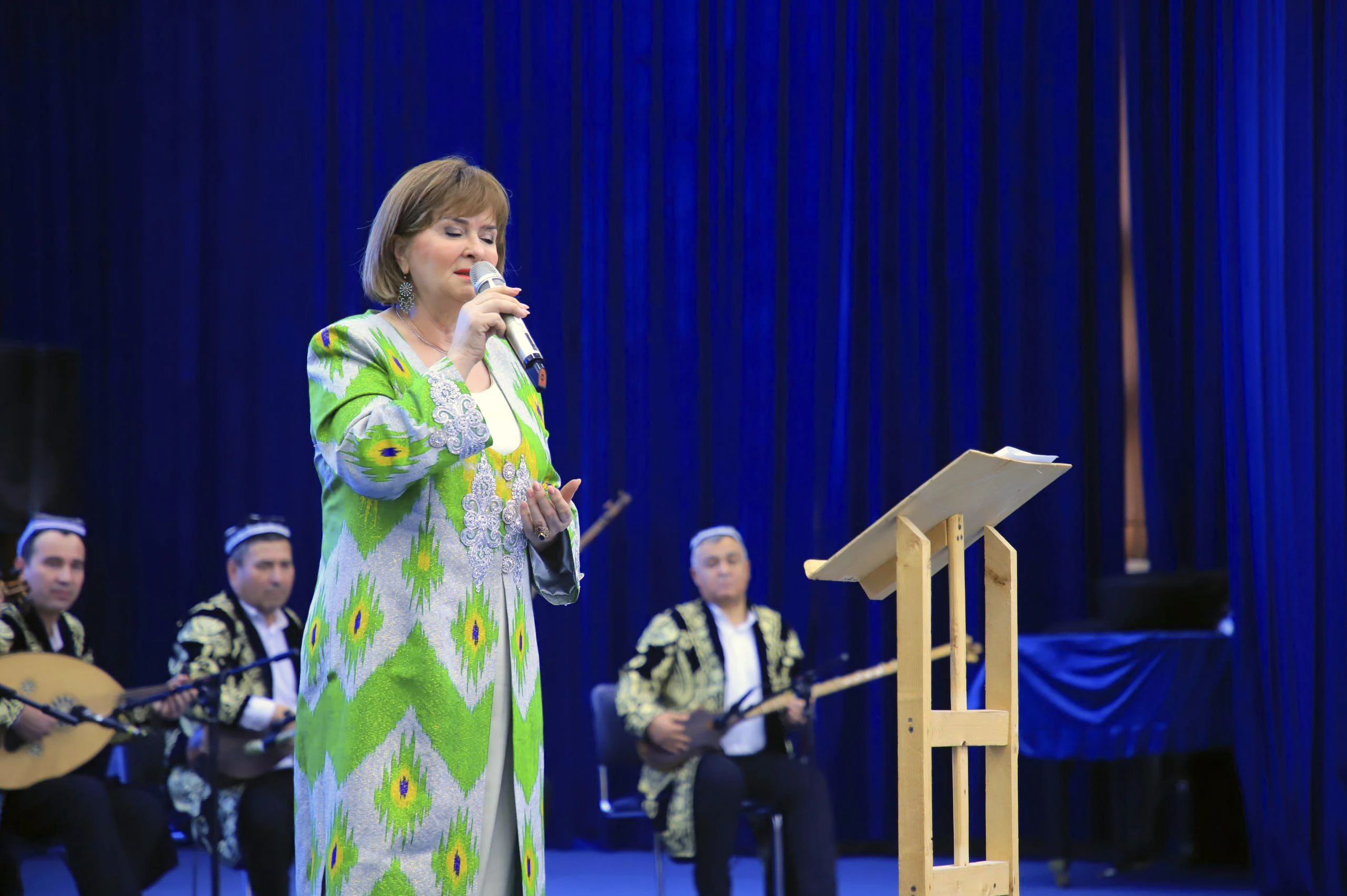
The concert featured master maqam performers from Bukhara, as well as Tamara Kataeva and Rita Yusupova.
Practical Results
In closing the conference, the rector of Bukhara University thanked all participants and proposed: “Let us hold conferences like this alternately—one year in Bukhara, Uzbekistan, and the next in New York, USA.”
Beyond the academic discussions, the conference produced practical outcomes. Memorandums of cooperation were signed between organizations and businesses in the Bukhara region and leading partners from the United States. The agreements aim to expand trade and economic ties, launch joint investment and innovation projects, and promote Bukhara’s tourism potential internationally.
Direct negotiations were held on topics including: tourism packages; hospitality standards; export of handicrafts; investment initiatives.
What initially appeared to be purely an academic event evolved into a multidimensional platform where history, culture, economics, and diplomacy intersected.
A Bridge Between Worlds
The concert program added further warmth to the gathering. Performances of traditional music—including masterpieces of Shashmaqam and works from the Bukharian Jewish musical heritage—created an atmosphere of shared memory and artistic continuity.
Once again, Bukhara demonstrated that it is not merely a city of monuments, but a living space of dialogue—a cultural bridge and crossroads of civilizations. For centuries, representatives of different peoples and faiths have coexisted here peacefully. Today this legacy continues to inspire international cooperation.
The visit of the American delegation and the conference underscored an important idea: distance does not always sever identity. Across oceans and generations, Bukhara remains present in New York—not only in name, but in the hearts of those whose roots are connected to this great ancient city.
Dildora Ibrokhimova, Newspaper “Ishonch”
This was translated from Russian into English.