
Twenty years ago, Amnun Baibachaev, the grandfather of Chanan Babacsayv, passed away in Israel. The grandson took this as an opportunity not only to document his grandfather’s life but to gather data, stories, documents, and photos from the entire family. The undertaking ultimately proved more challenging than initially assumed. Nevertheless, Babacsayv recommends that others follow his lead. «When a family engages with its history, it also strengthens its Jewish identity,» he says.
«Boy Batsha» is written in white script on a modern, simple dark green book cover. The subtitle: Son of a Rich Man. Since autumn 2024, Chanan Babacsayv has poured everything he could research about his grandfather and, ultimately, his family as a whole into book form. However, a commercial publication of the volume—which was self-published in three languages (German, Russian, Hebrew)—is intentionally not planned. «I had 100 copies printed for family and friends. For me, this is simply about documentation.»
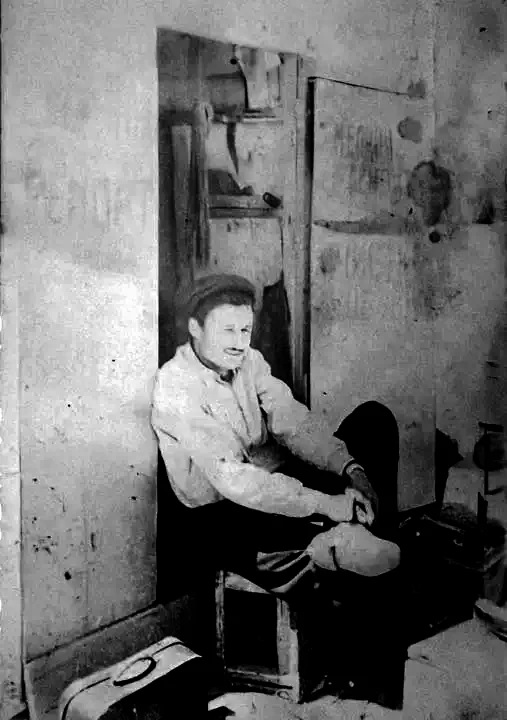
What the former Bukharian IKG (Israelite Religious Community) Vice President gathered through many conversations with family members across the world, along with their help regarding photos and data, now presents itself as a comprehensively annotated photo album. For example, there is the grandfather in a slightly faded black-and-white shot from the 1950s in his shoe repair shop in Samarkand. There is also a brown-tinged photograph of his father, Hanan, in Red Army uniform in the early 1940s. Using the software Ahnenblatt, Babacsayv was able to trace the family tree back to Josef ben Juschaja (1861–1931). While no portrait of him exists, the volume includes a photograph of his gravestone in Samarkand.
«Everything we are today, we actually owe to our ancestors.»
— Chanan Babacsayv
Josef ben Juschaja was also the founder of the family name. He was a veterinarian who accepted food or other goods from those who struggled to pay. This earned him the nickname «Boy Batsha,» meaning «son of a rich man.» His great-great-grandson says this also reflects the respect he enjoyed. When the Tsar’s troops reached the region, the use of surnames was introduced by law. Josef was actually known as «Israel» or «Israelov.» However, the sentiment toward Jews was not good. Thus, the ancestor decided to use the nickname as a surname: «Baibachaev.»
Scattered yet closely connected. His descendants still bear the name today, though in various transcriptions or translations due to the history of emigration from present-day Uzbekistan to Israel—where a large part of the family still lives—and beyond to Austria. Chanan and his family spell it «Babacsayv.» His brothers living in Vienna, on the other hand, translated their surname into German as adults in Austria and now call themselves «Reichmann.»
The ancestral chart documents a rich lineage from the grandfather, whose full name was Amnun ha-Kohen ben Zulaicha we Hanan Baibachev: six children, 26 grandchildren, 60 great-grandchildren. Texts and photos describe and illustrate a strong family bond despite the geographical distance—a momentum that pulls through the generations. Many family members had to take on significant responsibility at a very young age.
Grandfather Amnun (1930–2005), for instance, became a «quasi-provider» for the family at just eleven years old following the events of World War II. Chanan Babacsayv shares that he himself came to Vienna from Israel as an eight-year-old, where his parents were primarily busy earning a living. Thus, he was also responsible for managing his own school success at an early age. With his own children, he felt it was important to give them responsibilities early on.
Chanan Babacsayv also assigned various tasks to his extended family: in conversations, his initial goal was to learn as much as possible about his grandfather. But he also asked everyone to search for photos and documents and to send him the vital statistics of all known relatives. In this way, Boy Batsha became something of a foundation for a family chronicle that he expects his children—and the children of his siblings and cousins—will ideally continue generation after generation. Appropriately, the last page of the book is largely blank. The only sentence at the top of the page reads: «From here on, you continue writing – memories for posterity.» History is a permanent continuation.
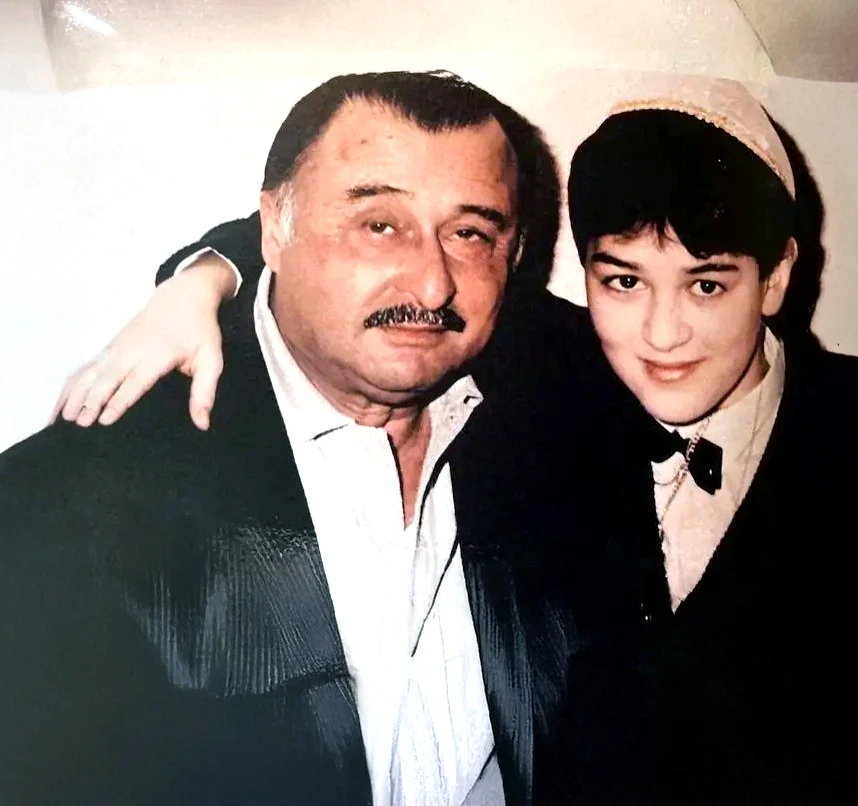
Reflecting on what he gained personally while working on these memories of his grandfather and other family members, he says: «Everything we are today, we actually owe to our ancestors.» He also found great joy in connecting with family members in Israel, Germany, and the USA during the project. «Indirectly, this work helped everyone reflect on our family history, and it brought us all closer together.» He is proud that this was recognized very positively within the family. At the Yahrzeit ceremony for his grandfather, for which relatives traveled to Vienna from all over the world, the book provided plenty of conversation fodder, as each of the roughly 80 guests was presented with a copy.
He would be delighted if other families now said: «We’ll do that too.» For Chanan Babacsayv is convinced: documenting the history of one’s ancestors strengthens identity, and a strong Jewish identity is, in turn, the key against assimilation.
«The more a family knows about itself, the more likely it is to remain within that framework.»
Tradition, after all, means more than just language and food culture. «You need the whole package.»
This was originally published in WINA – Das jüdische Stadtmagazin, a Jewish city magazine from Vienna, Austria. it was translated from German to English.
By Alexia Weiss VIENNA